

UV Disinfection for Rural Safe Drinking Water
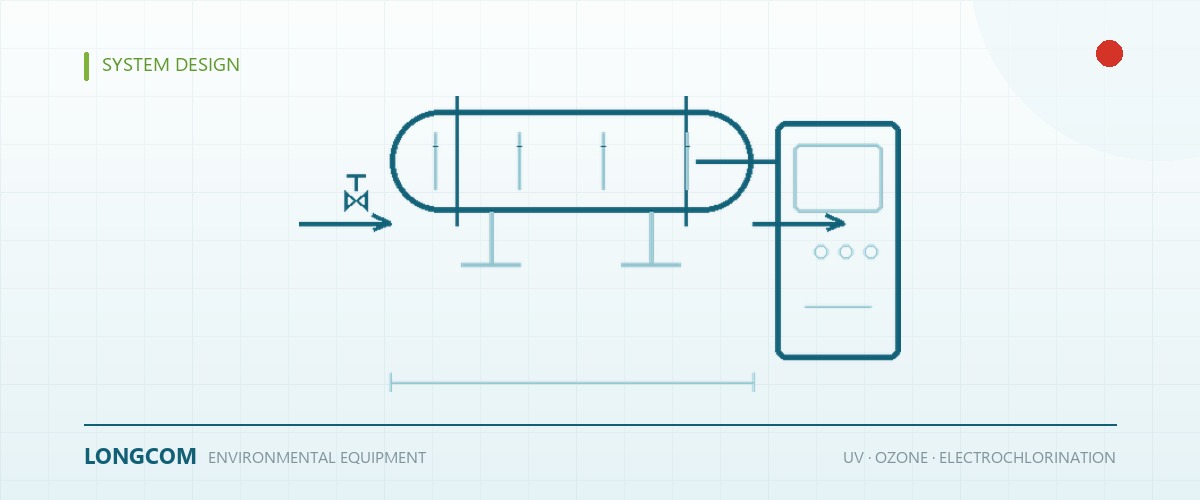
Rural safe drinking water supply is a priority public-welfare infrastructure programme, and UV sterilizers are widely used in rural water supply projects because they are simple to operate, low in running cost and effective at disinfection. Longkang supplies disinfection equipment for many rural drinking water projects. This article explains the application characteristics and the scheme design for this scenario.
1. Characteristics of rural drinking water supply
1.1 Supply modes
- Centralised supply: source (well water / spring water / surface water) → storage tank → booster pump (or gravity) → UV sterilizer → pipe network → households
- Single-village supply: one village, one supply system
- Joint-village supply: several villages sharing one supply system
- Decentralised supply: small units for a single household or a group of households
1.2 Source water characteristics
- Groundwater: well water, generally good quality but may contain iron and manganese and have high hardness
- Surface water: spring water and river water, quality varies with the season, may contain sediment and microorganisms
- Unstable source: low yield in the dry season, poor quality in the rainy season
- May be affected by agricultural non-point-source pollution
1.3 Water quality requirements
- Complies with GB 5749 (Standards for Drinking Water Quality)
- Total plate count ≤100 CFU/mL
- Total coliforms: not detectable
- Microbiological control is the priority (source water may exceed microbiological limits)
- Joint supervision by water authorities and health authorities
1.4 Management characteristics
- Few management staff (often part-time)
- Limited technical capability
- High requirement for simple maintenance
- Sensitive to operating cost
- High requirement for equipment reliability
- Electricity costs borne by the village collective or covered by water fees
2. Disinfection scheme design
2.1 Disinfection point
- After the storage tank outlet (gravity supply)
- Or after the booster pump outlet (pressurised supply)
- All outgoing water passes through disinfection
- Not recommended: at the source inlet (raw water carries a high microbial load and may affect the equipment)
2.2 Treatment capacity
- Based on the maximum daily water demand of the village
- Formula: Q = q × N × Kh
- q: water use quota (50–100 L/person·d for rural areas)
- N: population served
- Kh: hourly variation coefficient (2.0–3.0; wide variation in rural areas)
- Typical villages: 1–20 m³/h
2.3 Dose requirements
- ≥40 mJ/cm² (national drinking water standard)
- When source water exceeds microbiological limits: ≥60 mJ/cm²
- Ensures complete inactivation
2.4 Equipment selection
- Small villages (<500 people): LK-UV-1 to LK-UV-5
- Medium villages (500–2,000 people): LK-UV-5 to LK-UV-20
- Large villages / joint-village systems (>2,000 people): LK-UV-20 and above
- Gravity supply: select low head-loss models
3. System configuration
3.1 Standard configuration
- UV sterilizer (304 stainless steel)
- Low-pressure UV lamps
- Quartz sleeves
- Electronic ballast
- Run/fault indicator lights
- Lamp operating-hour counter
3.2 Recommended configuration
- UV intensity monitoring (simplified type)
- Audible and visual alarm
- Bypass line
- Upstream filter (when source water quality is poor)
- Automatic cleaning (for iron-bearing water)
3.3 Ancillary equipment
- Storage tank (existing)
- Booster pump (existing or new)
- Upstream Y-strainer
- Valves
- Piping (existing or new)
4. Installation requirements
4.1 Installation location
- Beside the storage tank or in the pump house
- Indoor installation (a simple shelter is sufficient)
- Protected from rain and direct sunlight
- Close to a power supply
- Easy access for operation
4.2 Piping installation
- Install the unit horizontally
- Inlet connected to the storage tank outlet or the pump outlet
- Outlet connected to the supply pipe network
- Threaded connection (small diameter) or flanged connection (large diameter)
- Provide a bypass line (temporary supply during maintenance)
- Fit a Y-strainer upstream of the unit
4.3 Electrical installation
- 220 V single-phase supply (small units)
- Connected to the village power supply
- Reliable grounding (install a grounding electrode if no earth grid exists)
- Fit a residual-current protective device
- Interlocking with the water pump (optional)
4.4 Commissioning
- Fill with water and vent the air
- Check for leakage
- Power on and run
- Water quality testing
- Training for management staff
5. Operation management
5.1 Daily management
- Village water operator checks the unit daily
- Check whether the lamps are lit
- Check for leakage
- Keep simple records (operating hours, faults)
5.2 Periodic maintenance
- Monthly: clean the unit, inspect seals
- Quarterly: replace the filter screen, check lamp operating hours
- Semi-annually: clean the quartz sleeves (when water quality is poor)
- Annually: replace lamps, full inspection
- Technical support provided by Longkang or the local water authority station
5.3 Water quality testing
- Regular testing by the water authority (quarterly / semi-annually)
- Random sampling by the health authority
- Rapid tests by the village water operator (if equipped)
- Test results recorded
- Abnormal water quality handled promptly
5.4 Fault handling
- Common faults: lamp not lit, leakage
- Simple faults handled by the water operator (lamp replacement, tightening fittings)
- Complex faults: contact Longkang after-sales support or the local water authority station
- Open the bypass for temporary supply during a fault
- Repair without delay
6. Application advantages
6.1 Effective disinfection
- Effectively inactivates bacteria and viruses
- Prevents waterborne infectious disease
- Safeguards rural drinking water safety
- No chemical by-products
6.2 Simple operation
- Automatic operation, no dedicated operator required
- Simple on/off operation
- Maintainable by the village water operator
- No specialist skills required
6.3 Low operating cost
- Low power consumption (small units use only a few kWh per day)
- No chemical consumption
- Lamps replaced every 1–2 years (low cost)
- Affordable within water fee revenue
6.4 Safe and reliable
- Physical disinfection, no chemical risk
- No chemical storage required
- Long service life
- Low failure rate
6.5 Easy installation
- Compact unit
- Simple installation
- Operates once water and power are connected
- Suited to rural conditions
7. Comparison with other disinfection methods
| Comparison item | UV disinfection | Sodium hypochlorite | Chlorine dioxide | Ozone |
|---|---|---|---|---|
| Disinfection efficacy | Good | Good | Very good | Very good |
| Ease of operation | Simple | Moderate | Complex | Complex |
| Operating cost | Low | Medium | Medium-high | High |
| Safety | High | Medium (chemical leakage) | Medium-high (gas leakage) | Medium-high (gas leakage) |
| By-products | None | Yes (residual chlorine) | Yes (chlorite) | Yes (bromate) |
| Maintenance difficulty | Simple | Moderate | Complex | Complex |
| Suitability for rural areas | Very good | Fair | Poor | Poor |
Conclusion: UV disinfection is the best fit for rural safe drinking water projects.
8. Typical case
Case: a village safe drinking water project
- Village scale: 800 people
- Source: deep well
- Supply mode: storage tank plus gravity supply
- Disinfection scheme: LK-UV-5
- Installation point: storage tank outlet
- Operation: 24-hour continuous
- Electricity cost: approximately RMB 30 per month
- Water quality testing: total plate count <20 CFU/mL, coliforms not detected
- Five years of operation, two lamp replacements, low failure rate
- Villagers satisfied; passed acceptance inspection by the water authority
9. Longkang services
For rural drinking water projects, Longkang provides:
- Rural water supply project scheme design
- Equipment selection and flow calculation
- Installation guidance (remote or on-site)
- Commissioning and water quality testing
- Operator training for village water staff
- Periodic maintenance guidance
- Genuine spare parts supply (lamps, sleeves)
- After-sales technical support
- Emergency repair service
- Support for acceptance inspection by the water authority
Contact Longkang for selection support tailored to your village population, source water quality and supply mode.