

How UV Disinfection Works: Mechanism, History and Limits
UV is a small slice of the spectrum — roughly 200–400 nm in water-treatment usage — and its disinfecting power comes from one photochemical event: a photon absorbed by DNA or RNA. The damage stops the organism replicating. It does not poison the cell; it removes its ability to cause infection.
How it got here
Downes and Blunt described the disinfecting action of sunlight in the 1870s. Niels Finsen applied UV to medicine and received the 1903 Nobel Prize in Physiology or Medicine. Municipal and industrial water applications began in earnest in the 1970s, and from the 1990s — with better lamps, quartz and dosing models — UV became mainstream in Europe and North America. The driver was not novelty. Chlorination of secondary effluent was found to produce trihalomethanes and leave a residual toxic to aquatic life; UV offered a way out.
Compared with chemical disinfection
Chlorine, alcohols, peroxides, aldehydes and quaternary ammonium compounds all work by chemical interaction. They are effective against bacteria and viruses, persist for a long time, and handle protozoan cysts poorly. They also bring storage, transport, dosing and by-product management. UV is broad-spectrum across bacteria, viruses and protozoa, adds nothing to the water, and changes neither its chemistry nor its taste. Its limitation is the flip side: no light, no effect, and no residual once the water leaves the reactor.
Dose is the bridge. Power alone is meaningless — fluence is intensity multiplied by time, so a low-power lamp with long contact can match a high-power one with short contact. A threshold exists for each organism, which is why reactor sizing is validated rather than guessed.
Where you will find it
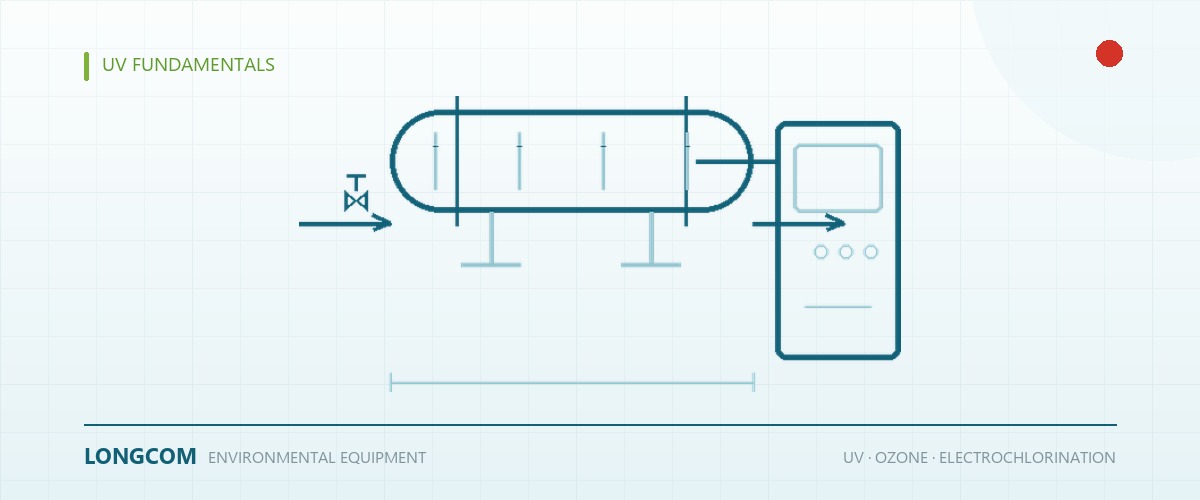
- Water: predominantly flow-through (in-line) reactors, with lamps in quartz sleeves; submerged arrangements exist but are less common for pressurised supply.
- Surfaces: food packaging, electronics, semiconductor and medical device lines, where fast chemical-free treatment matters.
- Air: upper-room and in-duct systems, and recirculating air purifiers in occupied spaces.
One safety note that has not changed since Finsen: UVC must not reach people, animals or plants directly. Interlocks, signage and eye protection are part of any installation. Beyond that, the technology is remarkably simple — a lamp, a quartz sleeve, a chamber and a validated dose.
Need a system sized for your water? Send us your flow rate, UV transmittance (UVT) and the target log reduction, and our engineers will specify the reactor and validated dose. Explore the product range or browse the Technical Library.
Condensed from our Chinese technical article. Read the full Chinese version.