

What Ozone Actually Does in Water Treatment
Ask what an ozone generator is for and most people say “disinfection”. That is one of four jobs. Ozone is a very strong oxidant with a short half-life, and the dose point decides which effect you get.
Four mechanisms
Coagulation aid at low dose. Around 0.5–1.5 mg/L, ozonation can improve flocculation — it strengthens the affinity between aluminium coagulant and ozonated organics, polymerises organic matter, breaks metal–organic complexes, and reacts with algae. In conventional treatment it boosts alum performance; in direct filtration it can raise filter rate. Push the dose too high and the effect reverses.
Colour, taste and odour. Ozone oxidises the compounds behind colour and smell, and avoids the chlorophenol taint that comes with chlorination. It is commonly paired with another process — biological filtration or activated carbon — so the ozone dose can stay low while overall removal improves.
Iron and manganese. Both oxidise readily, sometimes with air alone, so ozone is rarely installed just for this. Where groundwater is ozonated, Fe and Mn removal is a useful side effect; stoichiometric demand is roughly 0.48 mg O₃ per mg Fe and 0.88 mg O₃ per mg Mn.
Organic breakdown. Low-dose ozonation splits large molecules into smaller ones, converts refractory compounds into biodegradable forms, and reduces toxicity. Follow it with filtration or biological treatment and the whole train becomes more economical than trying to oxidise everything to CO₂ in one step.
Why dose control matters
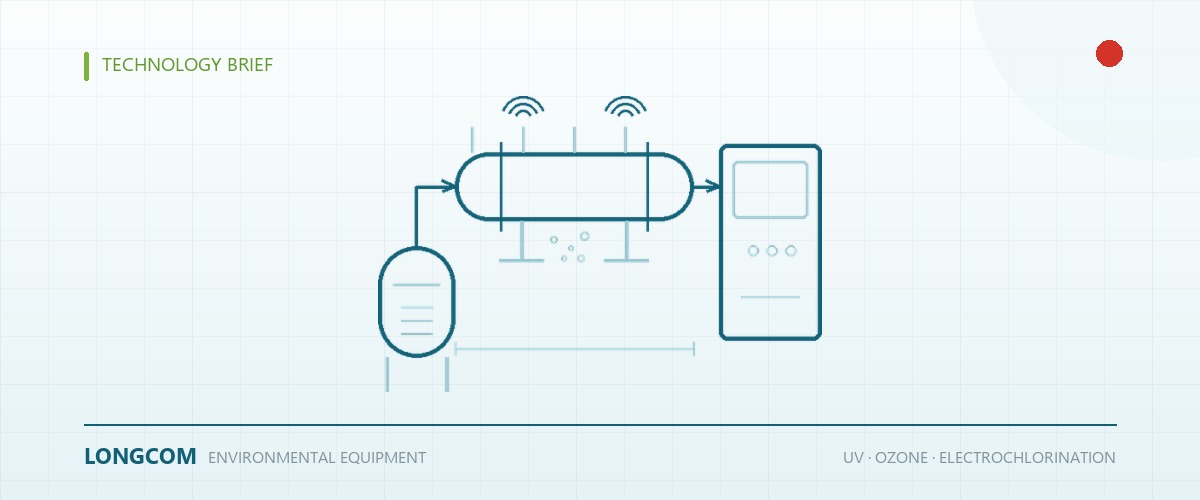
These effects do not scale linearly. A dose that helps coagulation can harm it; a dose that removes colour generates byproducts that need a downstream barrier; excess ozone in the off-gas must be destroyed before venting. That is why an ozone system is specified as a contactor, a generator, an off-gas destructor and a control loop — not as a box with a g/h rating.
On bottling lines ozone is the bulk oxidant and UV-C is usually the final polishing barrier before filling. The two are complementary: ozone handles oxidation and biofilm, UV handles the last microbiological step without adding anything to the product.
Tell us flow, target contaminant, and whether colour or organics dominate. Generator size and contact time follow from that split.
Need a system sized for your water? Send us your flow rate, UV transmittance (UVT) and the target log reduction, and our engineers will specify the reactor and validated dose. Explore the product range or browse the Technical Library.
Condensed from our Chinese technical article. Read the full Chinese version.