

Can a UV Disinfection System Run 24/7?
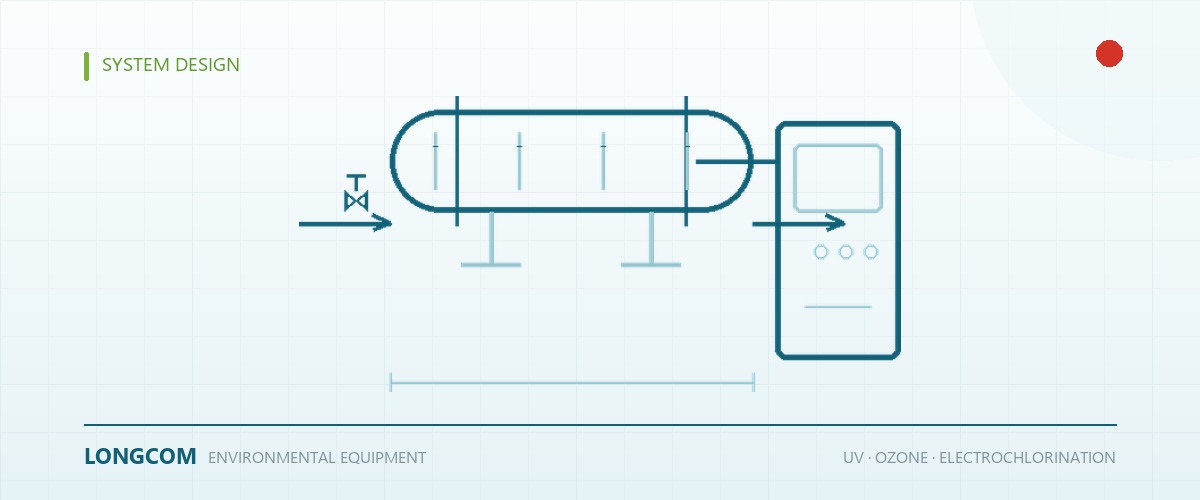
Yes. In fact continuous operation is the easier duty. What wears a germicidal lamp out faster than hours is starting: each ignition draws a large inrush current and stresses the electrodes. Installations that cycle repeatedly — on a float switch, a batch pump or a building schedule — burn through lamps well before their rated hours.
What changes on 24/7 duty
You lose the convenient “off” moment for maintenance, so monitoring has to take its place. Three things become mandatory: an hour meter, a UV intensity sensor with an alarm, and a planned service window for lamp and sleeve work. Without them, a continuously running reactor drifts out of specification silently.
Reading the lifetime bands
Lamp quality varies more than catalogues suggest. Entry-level tubes are often quoted at 3,000–5,000 hours, mainstream low-pressure lamps at 8,000–10,000 hours, and some high-specification imports beyond 12,000 hours at a noticeably higher price. Ask for the rated figure in writing, and size the reactor’s validated dose at end of lamp life with a fouling allowance — that is what turns a nominal wattage into a guarantee.
Hours alone are still only a reference. In continuous service, verify actual intensity. Around 70 µW/cm² (measured at one metre, per Chinese guidance) a lamp can remain in use but needs longer exposure to achieve the same fluence; below 40 µW/cm², extra contact time will no longer rescue the kill. Replace at that point regardless of what the hour meter says.
Why UV is often chosen here
Boiling handles most vegetative organisms but not the heat-resistant ones, and it does nothing for the free chlorine residual already in municipal supply. UV-C inactivates chlorine-resistant protozoa in seconds, adds no chemicals, and — relevant to this question — photolyses a portion of that residual chloramine load. It is a physical step that tolerates unattended continuous operation well.
Practical checklist
- Avoid control logic that switches the reactor on and off with every small demand change.
- Log hours, intensity and sleeve condition at every service visit.
- Keep a duty/standby arrangement if the plant cannot stop for a lamp change.
- Interlock the lamp circuit to flow, so a no-flow condition cannot overheat the chamber.
Continuous duty is not a limitation of UV equipment. It is the condition most in-line reactors are designed around.
Need a system sized for your water? Send us your flow rate, UV transmittance (UVT) and the target log reduction, and our engineers will specify the reactor and validated dose. Explore the product range or browse the Technical Library.
Condensed from our Chinese technical article. Read the full Chinese version.