

Chinese Product Standard for Drinking-Water UV Appliances
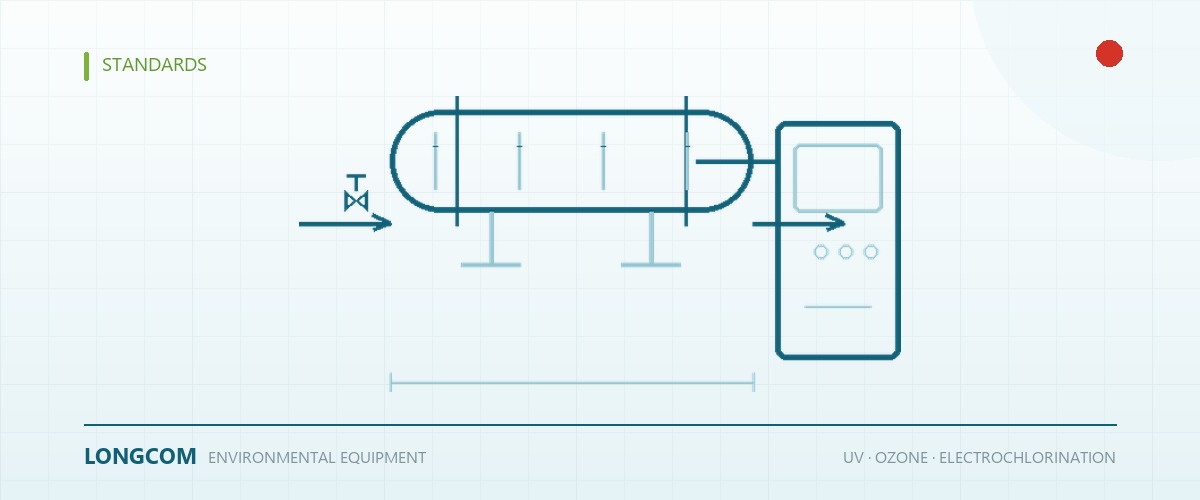
If you are buying a UV unit for a potable-water project in China, the applicable product standard is worth reading clause by clause. The requirements below are summarised from that standard; they are Chinese regulatory requirements, not universal international ones, though most align with good engineering practice elsewhere.
Design and construction
- The appliance must be built to approved drawings and technical documents, and parts of the same model must be interchangeable.
- Surfaces exposed to UV are polished; baffles are fitted in the chamber or housing so flow does not short-circuit the irradiation zone.
- Pressure-bearing chamber: working pressure ≥ 0.60 MPa, test pressure ≥ 0.90 MPa.
- Low-pressure mercury lamps and their mounting follow YY/T 0160; lamp layout must give uniform intensity across the irradiated surface.
- A lamp-on indicator, an elapsed-hour indicator or a relative UV-intensity indicator is required.
- Inlet, outlet, drain and sampling connections must be provided.
- Wetted materials follow GB/T 17219; 304L or 316L stainless is recommended.
- Head loss at rated flow below 0.05 MPa.
The two numbers that matter most
Quartz UVT. The sleeve separating lamp from water must transmit more than 85% at 253.7 nm. Good fused silica exceeds 90%, which is why material choice is not a minor cost decision.
Delivered dose. A unit with new lamps, filled with water, must measure at least 12,000 µW·s/cm²; an in-service unit must still meet its specified minimum. At rated flow, effluent microbiology must comply with GB 5749, the national drinking-water standard.
Why this matters in a tender
Two reactors with the same lamp count and the same 316L stamp can differ enormously. Interchangeability of parts, uniformity of the intensity field, a real hour meter, and a validated dose are the clauses that separate a compliant appliance from a bare chamber. Where ozone-free lamps are specified for enclosed or sensitive environments, say so in the order — 185 nm output is a controllable lamp option, not an inherent property of UV-C.
For projects outside China, treat this as a useful procurement checklist and confirm the local equivalent — NSF/ANSI 55, USEPA UVDGM or the applicable national guidance — with your engineer of record.
Need a system sized for your water? Send us your flow rate, UV transmittance (UVT) and the target log reduction, and our engineers will specify the reactor and validated dose. Explore the product range or browse the Technical Library.
Condensed from our Chinese technical article. Read the full Chinese version.