

Storage Tank Ozone Units: Design and Installation
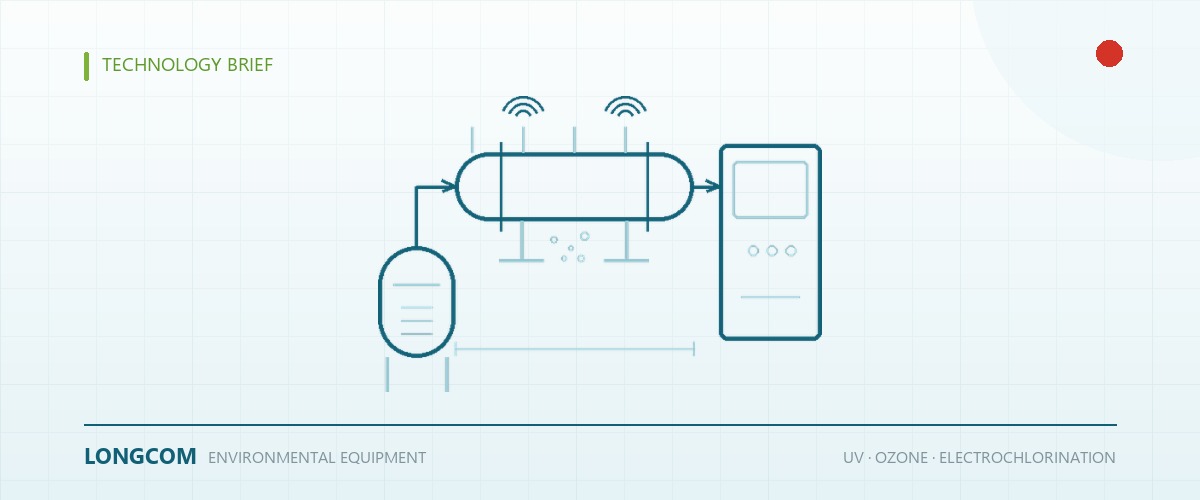
In Chinese specifications these are “water tank ozone self-cleaning sterilizers” (WTS units). Overseas, the same equipment is usually described as a storage tank disinfection system or tank-mounted ozone/UV unit. It addresses a specific problem: water that sits in a tank loses its residual, grows biofilm and picks up contamination from the headspace.
How it works
Ozone is a strong oxidant. Its oxygen atom attacks the bacterial cell wall, penetrates it and reacts with unsaturated bonds inside, killing the organism. It also decolorises, oxidises and deodorises, and breaks down to oxygen without a persistent chemical residual.
Two configurations exist. An external unit has a control cabinet (ozone generator plus controller), a circulation pump inside the energy-release head, and an injector; the head sits outside the tank. An internal unit places the energy-release head — submersible pump and injector together — at the bottom of the tank. In both cases the point is to circulate ozonated water through the whole tank volume, not to dose a single point.
Reference ratings
| Power | Ozone output | Duty |
|---|---|---|
| 405 W | 4 g/h | Smaller tanks |
| 745 W | 8 g/h | Larger tanks, twin-head |
Operating envelope: ambient below 45 °C, relative humidity 65–85%, 220 V ± 20 V at 50 Hz ± 2.5 Hz.
Installation rules that matter
- Mount the controller in a dry, ventilated, weather-protected position.
- Set operating windows to the site’s peak, normal and low demand periods at commissioning.
- The generator uses high-frequency high-voltage power — earth the cabinet reliably and never open the door while running.
- External units sit within 3 m of the tank; the suction line centre must be below minimum working water level, and the ozone line must enter from the top. Never block the energy-release head outlet.
- Internal heads go on the tank floor.
- Remove all swarf, wire offcuts and loose metal from the unit before energising 220 V.
- External units are preferred where conditions allow. For multiple units, distribute them evenly around the tank.
On power-up, confirm 210–230 V, then start and check current around 180–220 mA. Slight water movement in the tank and a faint ozone smell indicate normal operation. Units run intermittently on timers — commonly 30 minutes on, 5 minutes off — and must be restarted manually after a power cut.
For model dimensions and the applicable product standard, see WTS specifications.
Need a system sized for your water? Send us your flow rate, UV transmittance (UVT) and the target log reduction, and our engineers will specify the reactor and validated dose. Explore the product range or browse the Technical Library.
Condensed from our Chinese technical article. Read the full Chinese version.