

Why Does a UV Lamp Need a Ballast?
A UV lamp is a gas-discharge device, and gas-discharge devices cannot be connected directly to mains. Two things have to happen in sequence: a high-voltage pulse to break down the gas and strike the arc, then a hard limit on current so the arc does not run away and destroy the tube. The ballast does both.
Magnetic or electronic
At its simplest, a magnetic ballast is a coil of wire on an iron core. Its inductive reactance provides the starting voltage via self-induction, and its impedance limits current once the lamp is lit. It is robust and long-lived. Electronic ballasts do the same job at high frequency with lower losses, faster low-voltage starting, better power factor and — the main reason they have displaced magnetic types — longer lamp life. They cost more up front and pay for themselves over the lamp replacement cycle.
Three selection rules
- Match the lamp. Every lamp has a specified starting voltage and operating current. A mismatched ballast damages both parts: too little ignition voltage and the lamp never strikes reliably; poor current limiting and the electrodes erode early.
- Delayed start for high-power lamps. On 120 W, 150 W and 320 W lamps, instantaneous starting is hard on the electrodes — inrush current is very large. A programmed preheat/delay accumulates energy gently and protects the filament. On small lamps the difference is modest; on high-output banks it decides lamp life.
- Verify output, not just light. A weak ballast can still strike a lamp while delivering far too little UV-C. Check intensity after any ballast change.
Where it sits in the system
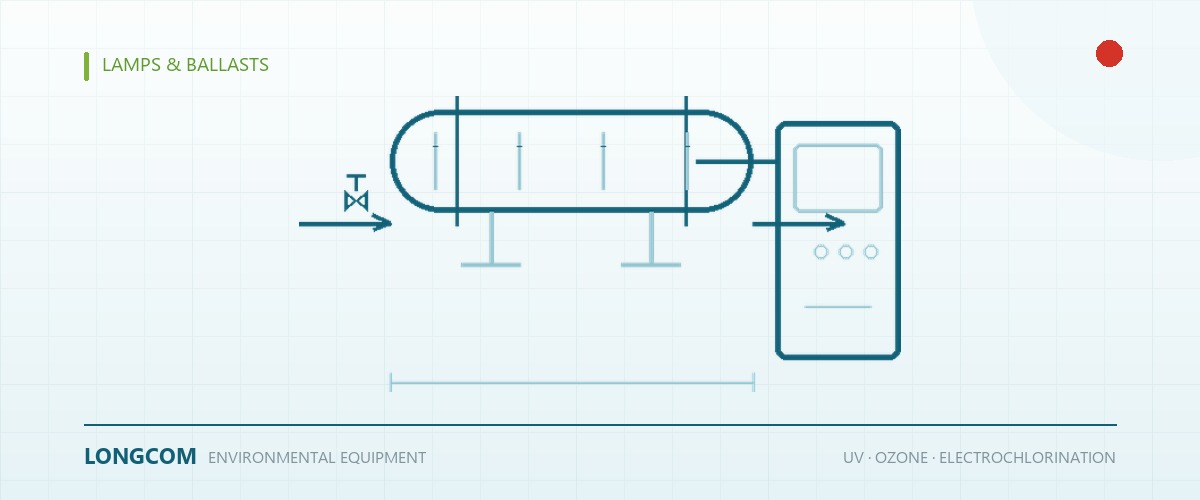
On an in-line reactor the ballast lives in the control enclosure with the hour meter and indicators. On open-channel banks it sits in a ventilated IP55 cabinet or is sealed into the module at IP68. Either way, heat and moisture are the enemies — see ballast failure causes for the field symptoms.
One practical note: when a ballast lights one lamp but not another, do not assume the second lamp is defective. Higher-output, hot-cathode lamps need a larger ignition pulse than cold-cathode ones. The ballast may simply be underrated for that lamp.
Need a system sized for your water? Send us your flow rate, UV transmittance (UVT) and the target log reduction, and our engineers will specify the reactor and validated dose. Explore the product range or browse the Technical Library.
Condensed from our Chinese technical article. Read the full Chinese version.