

Can UV-C Light Pass Through Plastic?
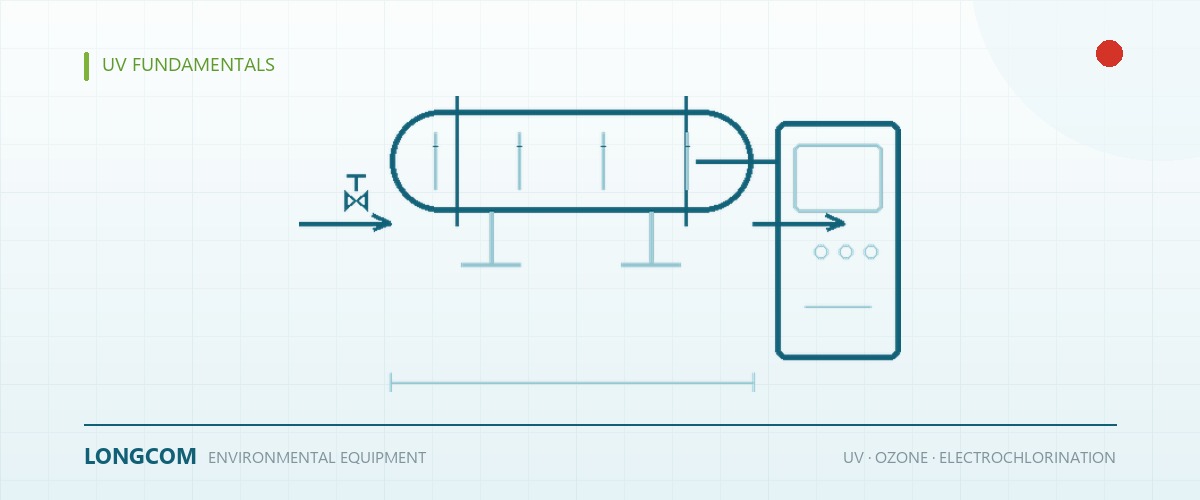
Short answer: almost never. Germicidal UV-C sits between 200 and 280 nm, and at those wavelengths common plastics absorb heavily. A polypropylene pipe wall, a PVC cover or an ordinary window pane will knock the intensity down by orders of magnitude. That is the whole reason a UV reactor is built around a fused-quartz sleeve rather than glass.
Why the wavelength matters
UV is not one thing. UVA (315–400 nm) travels furthest and is what you meet in banknote checkers and insect traps. UVB (280–315 nm) is used in plant-growth and therapy lamps. UVC (roughly 200–275 nm) does the disinfecting — and it is also the band with the weakest penetration. Low-pressure mercury lamps put nearly all their output at 253.7 nm, almost exactly where microbial DNA absorbs best. The same property that makes it lethal to a cell makes it easy to block.
Thickness decides the rest. A thin film or a thin-walled part may pass a measurable amount; a thick section will not. A handful of specialty grades — certain PMMA, PC and PEA formulations — are engineered to transmit UV-C, but the cheap film used for packaging is not among them. Even when transmission occurs, UV-C breaks polymer chains. The plastic yellows, crazes, goes brittle. So a component that transmits UV-C today will not do so reliably for long.
What this means for a reactor
A pressure-rated in-line UV disinfection system is a sealed 304 or 316L stainless chamber with a polished inner face. The lamp sits inside a quartz sleeve; the water flows around it. Nothing escapes the shell — a sheet of paper, let alone a steel wall, is enough to stop the radiation. High-purity quartz is specified because a clean sleeve still transmits 90% or more at 253.7 nm, while soda-lime glass transmits very little.
One practical consequence: you cannot judge UV output by eye. The blue-violet glow you see is a mercury discharge artefact, not the germicidal band. If you need to know whether dose is still being delivered, use a calibrated UV sensor or a validated dose monitor, not a visual check.
Common questions
- Can UV-C disinfect water through a plastic bottle? No. Fill the bottle, or put the reactor in the flow path.
- Will UV-C degrade plastic parts near the lamp? Yes, over time. Keep wetted polymer parts out of direct irradiation where possible.
- Is a quartz sleeve the same as ordinary glass? No. Fused silica has a very different thermal expansion and UV transmission profile.
In short, treat UV-C as a line-of-sight tool: it works on what it can see, inside a reactor, through quartz. Everything else is shielding.
Need a system sized for your water? Send us your flow rate, UV transmittance (UVT) and the target log reduction, and our engineers will specify the reactor and validated dose. Explore the product range or browse the Technical Library.
Condensed from our Chinese technical article. Read the full Chinese version.