

UV in Juice and Beverage Production: Where to Put It
Beverage plants have a peculiar problem: they must control microorganisms without changing the product. Chemical dosing alters flavour; heat alters colour and nutrients; preservatives are under regulatory pressure. UV-C inactivates by damaging DNA, adds nothing, and leaves taste, odour, colour and pH untouched.
The mechanism, briefly
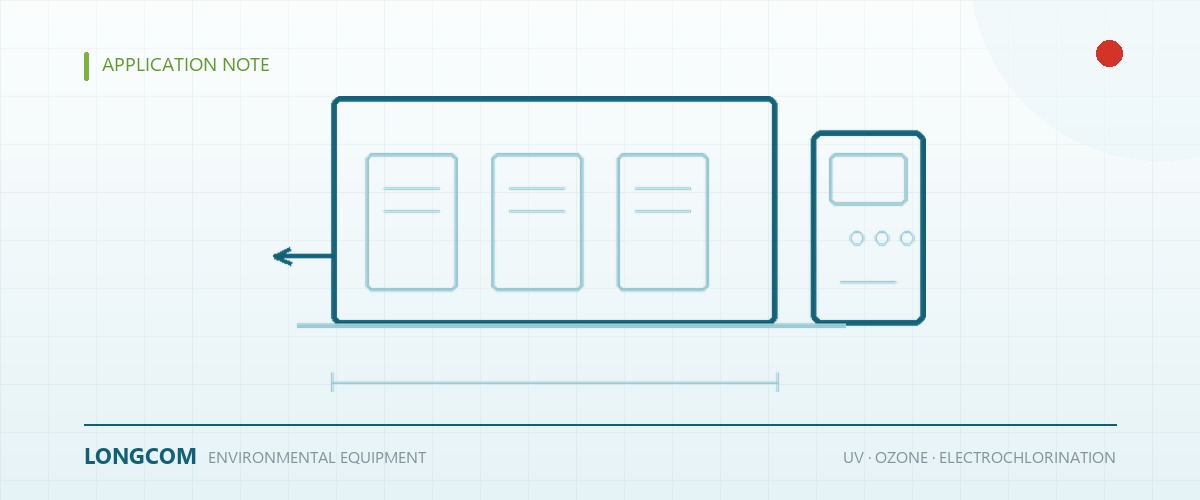
UV-C sits at 185–400 nm with peak germicidal effect near 265 nm. A lamp inside a quartz sleeve sits in a stainless chamber; liquid enters one end and leaves the other. Low-pressure lamps emit a single line at 254 nm; medium-pressure lamps cover 185–400 nm and tolerate sudden temperature swings — useful when CIP rinse water jumps from 10 °C to 80 °C. Either way, contact time is short and no residue remains.
Seven places it belongs
- Ingredient and contact water. Municipal water is not a guarantee; spring and groundwater sources can be contaminated. UV lets process water be reused without chemistry or heat.
- Syrup. High sugar suppresses growth, but dilution wakes dormant spores. Treat syrup and dilution water before use.
- CIP final rinse. Embed UV in the rinse loop so the last water touching the line introduces nothing. MP lamps handle the thermal shock.
- RO and GAC effluent. Both can become bacterial breeding grounds. UV downstream is the standard fix.
- Dechlorination support. Put UV ahead of a GAC dechlorination filter to improve residual chlorine removal and extend carbon life.
- Packaging and surfaces. Cups, cans, lids and foil are irradiated immediately before filling to extend shelf life.
- Tank headspace. Air drawn into a storage vessel carries spores; a submerged or headspace UV unit treats it.
Where it must sit
Because UV leaves no residual, the reactor goes as late as possible — after carbon, after RO, after filtration — so every organism introduced upstream is caught in one pass. Wastewater from the plant can also be treated without discharge chemicals, and reuse of process water cuts the volume needing treatment.
Maintenance is modest: roughly annual lamp replacement, a few minutes per lamp, done by general plant staff. For a plant chasing tighter hygiene standards without adding preservatives, that is a short payback. Send us flow, UVT of each stream and the filling configuration to size the reactors.
Need a system sized for your water? Send us your flow rate, UV transmittance (UVT) and the target log reduction, and our engineers will specify the reactor and validated dose. Explore the product range or browse the Technical Library.
Condensed from our Chinese technical article. Read the full Chinese version.