

How Often Should a UV Lamp Be Replaced?
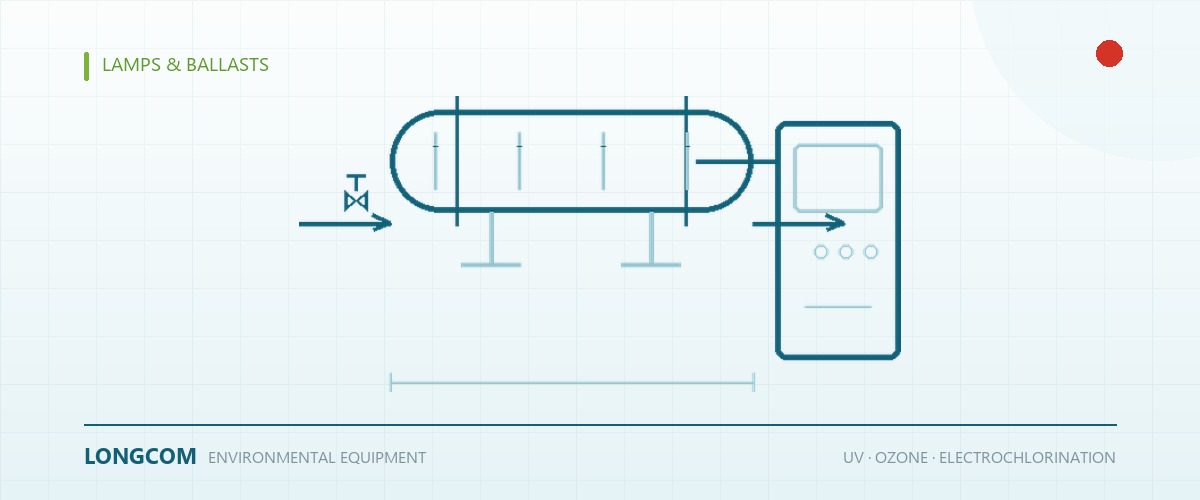
Two triggers, and only two: a fault, or the end of rated life. Waiting for the lamp to go dark is not one of them.
Trigger one: a fault
Most reactors give each lamp an indicator. If it goes out or behaves oddly, isolate power, close the inlet and outlet valves, drain the chamber and inspect. A cracked sleeve, a failed ballast, a loose socket or a dead lamp all present similarly. Fix the cause, then reset the hour count for that lamp.
Trigger two: running hours
Low-pressure germicidal lamps are commonly rated 8,000 or 10,000 hours; low-pressure high-output and some imported types run 12,000 hours and beyond. The reactor should have an hour meter — the unit is hours, and maintenance staff read it directly. At the rated figure, replace the lamp.
The reason is output decay, not burnout. UV-C output falls gradually as the lamp ages, and a lamp at end of life still looks perfectly normal to the eye while delivering too little fluence. Because the reactor’s validated dose is specified at end of lamp life, running past that point takes the system outside its validation.
Practical rules
- Confirm the rated hours with your supplier at purchase; it varies by lamp type.
- Replace the whole bank on open-channel systems where lamps share a service interval, so dose stays uniform across the channel.
- Log the date, hours and intensity reading at each change.
- Clean and inspect the quartz sleeve at the same visit. A new lamp behind a scaled sleeve is wasted money.
- Never touch new quartz with bare fingers.
Frequent on/off cycling shortens lamp life considerably, which is one reason continuous-duty installations simply run continuously (see 24/7 operation). If your plant cycles hard, budget more lamp changes rather than assuming the nameplate hours will hold.
Need a system sized for your water? Send us your flow rate, UV transmittance (UVT) and the target log reduction, and our engineers will specify the reactor and validated dose. Explore the product range or browse the Technical Library.
Condensed from our Chinese technical article. Read the full Chinese version.