

Municipal Wastewater: Open-Channel UV in Practice
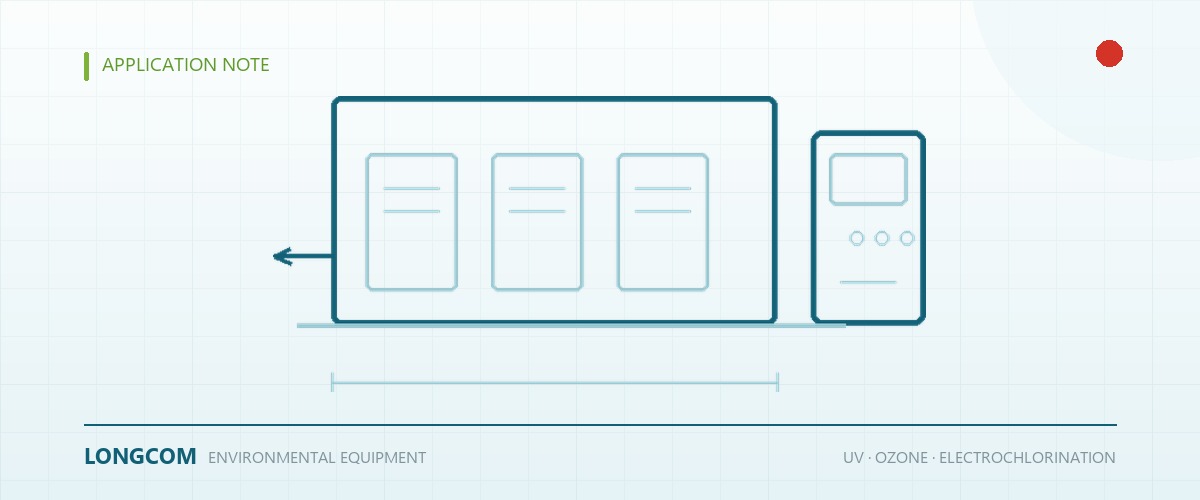
Wastewater is the case where UV earns its keep. Flows are large, water quality is variable, and the discharge standard is written in faecal coliform counts rather than in chemical residuals. A closed pressure vessel would impose head loss and a big footprint; an open-channel UV bank sits in the existing channel and lets gravity do the work.
A representative installation
A wastewater plant in Hebei commissioned six 2,560 W open-channel UV modules in December 2017. The stream was high-volume industrial wastewater carrying a mixed viral and bacterial load. The specification was straightforward: put enough lamp power in the channel to deliver the required fluence at peak flow, with the lamp bank arranged in modular frames so a single module can be lifted for service without draining the channel.
That modularity is the real design point. Each frame carries its own lamps, quartz sleeves, cleaning mechanism, cabling and data acquisition. A plant operating at tens of thousands of cubic metres per day cannot stop for a lamp change, so the ability to isolate one module matters more than the nameplate wattage.
What actually governs performance
- UV transmittance (UVT). Secondary effluent with high suspended solids absorbs UV-C before it reaches the organisms. Design dose must be validated at the measured UVT, not at laboratory water.
- Level control. Every lamp must stay submerged. Overflow weirs, passive flap gates or motorised weirs hold the water level across flow swings.
- Sleeve cleaning. Fouling is the single biggest cause of dose loss online. Automatic mechanical or mechanical-plus-chemical wipers keep output stable without shutdown.
- Intensity monitoring. A submerged UV sensor per bank tracks both lamp ageing and sleeve fouling.
Where UV fits in the train
UV has no residual. It protects the discharge point, not the receiving network downstream, so it is often paired with a small chemical trim where a distribution residual is required. Within the treatment plant, though, it removes the need for a chlorine contact tank, eliminates dechlorination, and avoids the chlorinated by-products that come with chlorinating high-organic secondary effluent.
If you are sizing a retrofit, send us peak and average flow, UVT, SS and the target coliform limit. Those four numbers determine the module count far more than the channel width does.
Need a system sized for your water? Send us your flow rate, UV transmittance (UVT) and the target log reduction, and our engineers will specify the reactor and validated dose. Explore the product range or browse the Technical Library.
Condensed from our Chinese technical article. Read the full Chinese version.