

UV Irradiance: What Reading Is Actually Acceptable?
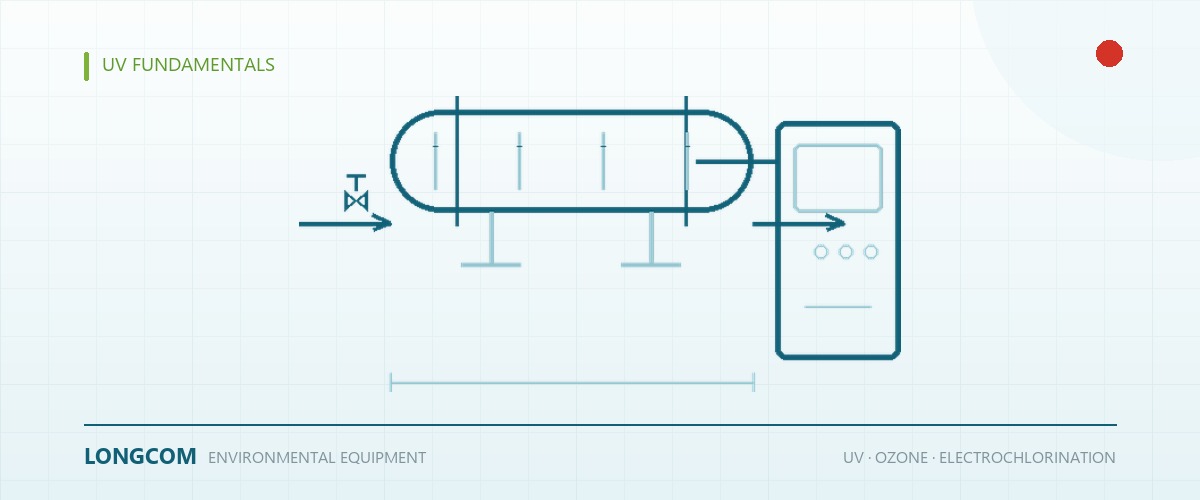
Irradiance is the raw intensity reaching a surface, usually in µW/cm². It is the easiest number to measure and the easiest to misread. Chinese technical guidance gives three useful reference points, measured at one metre from the lamp: a new lamp should exceed 100 µW/cm² to be considered acceptable, an in-service lamp should hold at least 70 µW/cm², and below 40 µW/cm² longer exposure will not produce a satisfactory kill. A lamp still glowing below that threshold is a lamp past its job.
Intensity is half the story
Dose — often called fluence in modern UV literature — equals irradiance multiplied by exposure time. High intensity for a short contact and lower intensity for a longer one can deliver the same fluence, which is why a reactor is sized on flow rate and UVT rather than on lamp wattage alone. Water that moves too fast through the chamber never collects enough energy, no matter how bright the lamp looks.
Wavelength matters just as much. Below about 300 nm the germicidal effect rises sharply, peaking near 260–265 nm where DNA absorption is strongest. Low-pressure lamps concentrate almost everything at 253.7 nm; medium-pressure lamps spread output across 200–400 nm, which is why they are chosen for chloramine reduction as well as disinfection.
Design for the organism, not the catalogue
Different targets need different fluence. Bacterial spores are far more UV-resistant than vegetative bacteria, and some strains carry repair mechanisms. A system sized for general heterotrophic counts will not automatically satisfy a Cryptosporidium or Bacillus challenge. That is why a serious specification names the target organism, the required log reduction, the design UVT, and the end-of-lamp-life dose — then backs it with a third-party validated dose report.
How to use the numbers
- Trend intensity readings over time. A steady decline is normal ageing; a step change means fouling or a power problem.
- Clean the quartz sleeve before condemning a lamp. Scale blocks UV-C far more than people expect.
- Verify at peak flow and at end of lamp life, not on day one with clean water.
If you are comparing offers, ask for the validated dose at your UVT and flow. Two reactors with the same lamp count can deliver very different performance, and irradiance at one metre tells you almost nothing about either.
Need a system sized for your water? Send us your flow rate, UV transmittance (UVT) and the target log reduction, and our engineers will specify the reactor and validated dose. Explore the product range or browse the Technical Library.
Condensed from our Chinese technical article. Read the full Chinese version.