

UV for High-Rise Booster and Secondary Water Supply
Water leaves the municipal plant compliant. Then it sits in a basement tank, gets pumped to the top of a tower, and travels through a building’s own pipework. That last stretch is where secondary supply schemes earn their name — and where a point-of-use barrier makes sense.
The regulatory driver
China’s GB 5749-2006 revision expanded microbiological indicators from two to six, adding Escherichia coli, thermotolerant coliforms, Giardia and Cryptosporidium. Conventional chlorination at the works handles bacteria well but is weak against the protozoan cysts. Those cysts are precisely the organisms UV-C inactivates at modest fluence. The result is a common arrangement: keep chlorine for the network residual, add UV at the building for the chlorine-resistant fraction.
How it is installed
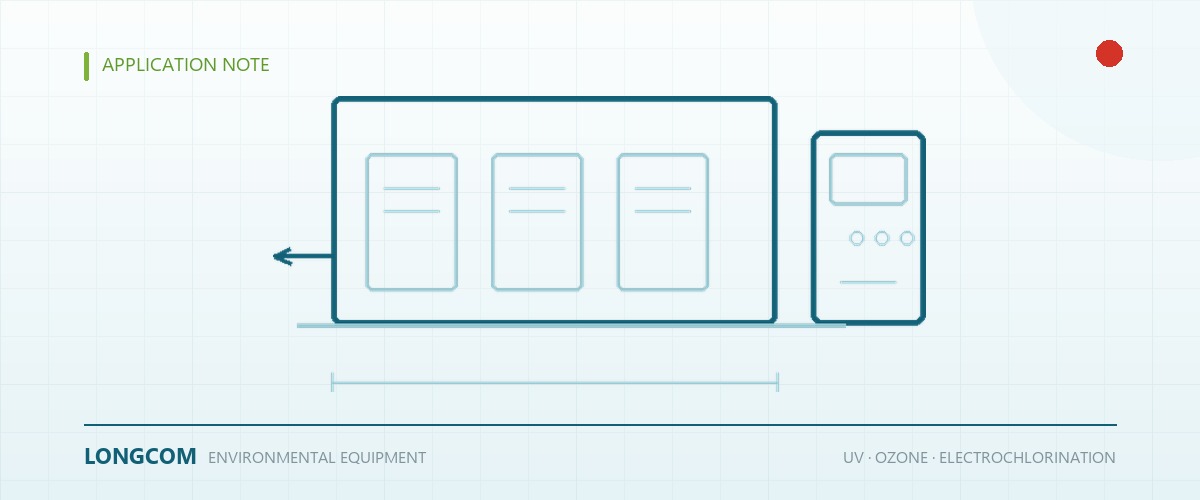
In a residential development or a school, the in-line UV unit is normally fitted on the discharge of the booster set, downstream of the storage tank and upstream of the riser. Sizing follows the pump curve, not the average demand — rated flow must cover the maximum simultaneous flow of the pump group. Where the pump discharge pressure exceeds the reactor’s working rating, the chamber is built to a higher pressure class rather than throttled.
A bypass with isolation valves, a drain, and at least 1.2 m of clearance at one end for lamp withdrawal are the details that decide whether maintenance actually happens. So is an hour meter and a UV intensity alarm wired back to the building management system.
Why physical, not more chemical
UV adds nothing to the water. No taste, no chlorinated by-products, no change in pH or TOC. For a building operator already dosing chlorine, that means the UV stage does not push the residual over the limit at the tap. And because the unit sits after the tank, it treats the contamination the tank introduced — which is the only place a point-of-entry device can usefully act.
What we need to quote
Tank volume and turnover, booster pump rated flow and head, incoming UVT, and whether a residual is required downstream. With those, the reactor size, lamp count and dose monitoring package follow directly.
Need a system sized for your water? Send us your flow rate, UV transmittance (UVT) and the target log reduction, and our engineers will specify the reactor and validated dose. Explore the product range or browse the Technical Library.
Condensed from our Chinese technical article. Read the full Chinese version.