

UV for School Drinking Water: An Application Note
School water supply has an awkward demand pattern. It sits in tanks and long distribution runs overnight, at weekends and through holidays, then sees a sharp morning peak. That combination — stagnation followed by high draw — is exactly where a point-of-entry barrier earns its place.
The arrangement
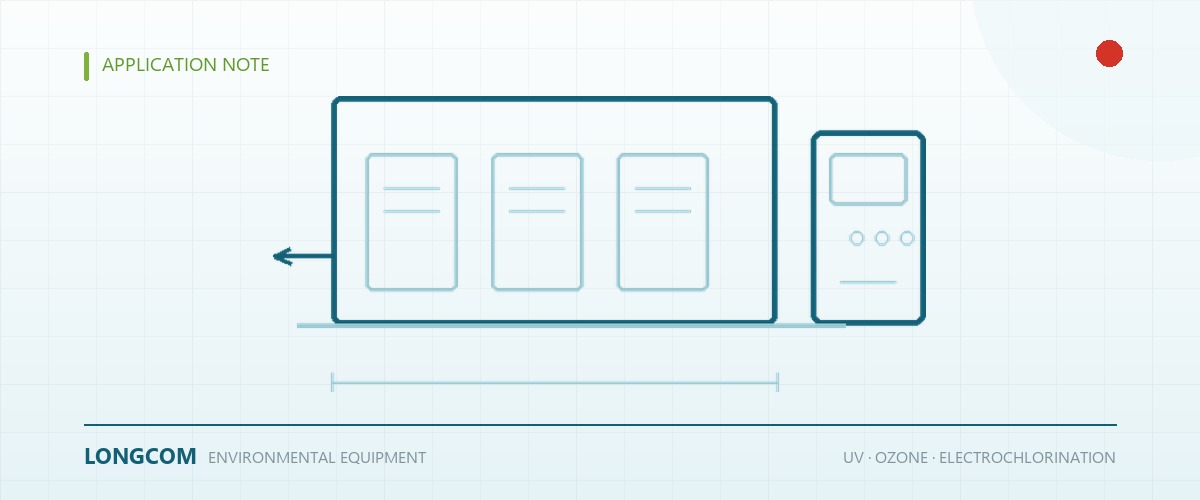
An in-line UV reactor is fitted in the pipe, downstream of the storage or booster set, so all water passing to drinking fountains, kitchens and washrooms is irradiated. UV-C damages the DNA and RNA of bacteria, viruses and protozoa as it flows through the chamber. Nothing is dosed. For a school, that means no chemical storage on site, no dosing pump to calibrate, and no change to taste or odour — which matters when the end users are children.
Why a physical step fits this duty
Chlorine-resistant organisms are the usual justification. A residual disinfectant protects the network, but Giardia and Cryptosporidium respond poorly to it; UV-C inactivates them at modest fluence. Putting UV after the tank also treats any contamination the tank itself introduced, which is the only place a point-of-entry device can act usefully.
The honest limitation is that UV leaves no residual. Water downstream of the reactor can be recontaminated in a dirty dead leg, so the unit should sit as close as practical to the building’s distribution entry, with the downstream pipework kept clean and a residual maintained where the network requires one.
What a school needs to specify
- Peak morning flow, not average daily consumption.
- Incoming UVT and turbidity; pre-filter above about 5 NTU.
- An hour meter, a UV intensity alarm, and lamp-fault indication.
- Isolation valves, a drain, and clearance for lamp withdrawal at one end.
Lamp replacement roughly once a year and periodic sleeve cleaning are the whole routine. For a site with no dedicated water-treatment operator, that simplicity is the main argument.
Need a system sized for your water? Send us your flow rate, UV transmittance (UVT) and the target log reduction, and our engineers will specify the reactor and validated dose. Explore the product range or browse the Technical Library.
Condensed from our Chinese technical article. Read the full Chinese version.