

Temperature and Humidity: What Really Affects UV Performance?
This question is often answered with air-disinfection data and applied to water reactors. They are not the same installation, and mixing them leads to bad specifications.
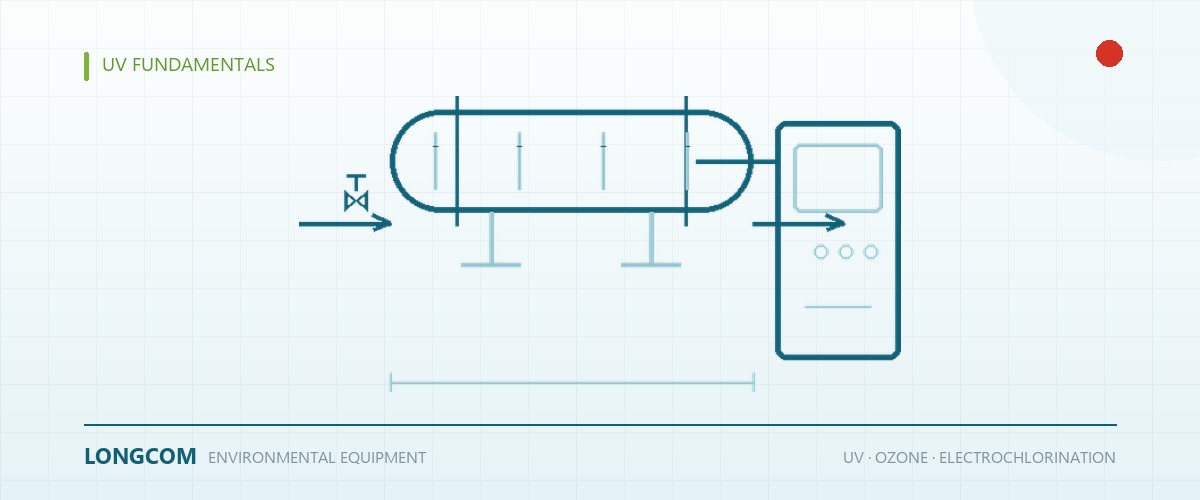
In a closed water reactor
Ambient air temperature and relative humidity around the cabinet matter only to the electronics. What governs delivered dose is water UVT, turbidity, flow rate, lamp ageing and the condition of the quartz sleeve. A sealed 304/316L chamber is not exposed to room air, so the humidity of the plant room does not change the fluence the water receives. If someone quotes a 30–40% kill-rate loss from humidity for an in-line reactor, ask which standard that figure came from.
Water temperature does matter indirectly: hot water drives scale onto the sleeve, and scale blocks UV-C. That is why hot loops use AOT units or automatic wipers rather than a bare low-pressure reactor.
In air and surface disinfection
Here the original data is real. UV-C output and microbial susceptibility both move with ambient conditions:
- Temperature. Around 20–40 °C germicidal output is at its most stable. At roughly 4 °C, irradiance can fall 65–80%, which is a serious loss for a cold room or unheated plant space.
- Relative humidity. Around 55–60% RH gives the strongest kill. Above 60–70%, microbial susceptibility falls; above 80% some organisms can even be photo-reactivated, cutting kill rates by 30–40%. Mopping a floor immediately before a surface UV cycle raises local humidity and reduces the effect.
Mould control is the classic case. Mould needs air, moisture and a nutrient substrate; it thrives on damp, uneven surfaces and does not grow in vacuum or in dry, sunlit conditions. UV-C suppresses it, but the underlying humidity control is what keeps it from coming back.
How to use the distinction
For a potable or wastewater project, specify UVT, pre-filtration, sleeve cleaning and validated dose — and treat ambient conditions as a cabinet-rating question. For an upper-room, in-duct or surface installation, log temperature and RH as process variables and design the cycle around them. Same physics, different control knob.
Need a system sized for your water? Send us your flow rate, UV transmittance (UVT) and the target log reduction, and our engineers will specify the reactor and validated dose. Explore the product range or browse the Technical Library.
Condensed from our Chinese technical article. Read the full Chinese version.