

TiO₂ Photocatalytic Oxidation: How an AOT Reactor Works
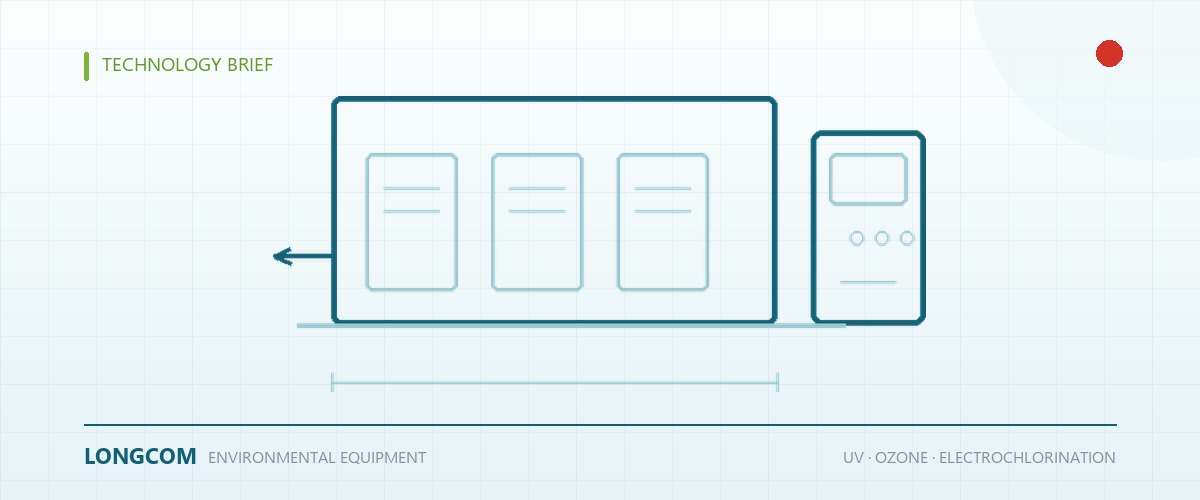
“AOT” is a Chinese-market label for a specific advanced oxidation process: UV light striking a titanium dioxide photocatalyst in contact with water, generating hydroxyl radicals. In international literature you will more often see it described as TiO₂ photocatalytic oxidation or UV/TiO₂ AOP. The mechanism — not the acronym — is what matters.
Two steps, one reactor
First, a UV source with the appropriate wavelength excites a nanostructured TiO₂ coating. The coating has a high surface area and is in direct contact with the water, so the photon creates an electron–hole pair at the catalyst surface. That pair reacts with water to form hydroxyl radicals (·OH), among the strongest oxidants available in water treatment.
Second, those radicals attack whatever is nearby. They disrupt cell membranes, oxidise organic molecules step by step into smaller compounds, and — in the ideal case — carry the reaction through to CO₂ and water. Microorganisms lose both the ability to revive and the ability to reproduce. Unlike plain UV-C, which only damages nucleic acid, this is a combined physical and oxidative attack.
What is inside
- A UV lamp assembly selected for stable output at elevated water temperature.
- A porous nano-TiO₂ coating on a carrier, sized for contact area rather than nominal power.
- A flow-through chamber and a control panel with interlocks and running-hour tracking.
That temperature point is the reason AOT units exist. Conventional low-pressure UV reactors struggle in domestic hot-water and heat-exchange loops because scale forms on the sleeve and blocks UV-C. A photocatalytic reactor is specified for hot-water service — heat-exchange circuits, heating loops, cooling water, central air-conditioning water, fountains and pools — where storage tank treatment and Legionella control are the driving concerns.
Claims worth reading carefully
Vendor data commonly quotes 30–35% higher catalytic activity than a conventional physical method and 99% sterilisation. Treat those as application-specific figures: radical yield depends on UVT, contact time, catalyst surface condition and water matrix. Ask for a test report on comparable water, and ask how the coating is cleaned or replaced over the unit’s life. A catalyst that cannot be serviced is a consumable with no replacement schedule.
Need a system sized for your water? Send us your flow rate, UV transmittance (UVT) and the target log reduction, and our engineers will specify the reactor and validated dose. Explore the product range or browse the Technical Library.
Condensed from our Chinese technical article. Read the full Chinese version.