

Closed-Vessel vs Open-Channel UV Sterilizers
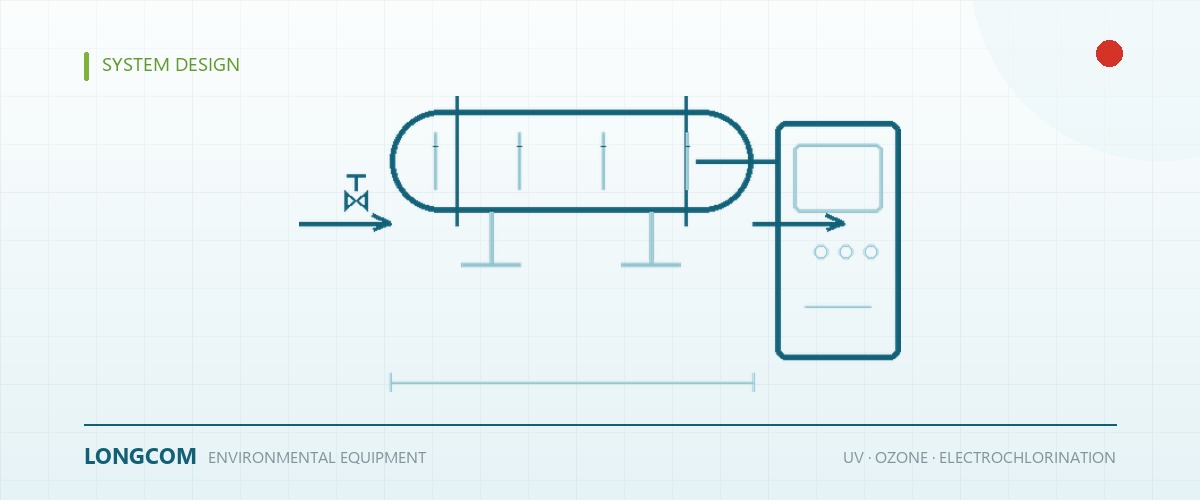
In recent years UV sterilizers have spread across China: manufacturers have deployed them in more than ten industries in over twenty provinces and cities, succeeding in large-flow municipal wastewater disinfection, hospital effluent, reclaimed water reuse, aquaculture water, and swimming pool circulation water, with performance now on par with comparable products from leading international companies. In particular, Chinese suppliers have filled the gap in large-flow drinking water UV disinfection. By form, UV systems divide into pressurized closed-vessel (inline) UV sterilizers and open-channel UV sterilizers.
A closed-vessel UV sterilizer disinfects water inside a pipe: the reactor has a sealed chamber and withstands a certain pressure. An open-channel UV sterilizer disinfects water flowing in a channel: several lamps are mounted on one rack (a lamp rack), several racks are placed along the disinfection channel, and together with ballasts, control, and power systems they form the complete installation. This article details the mechanism, advantages, and disadvantages of the closed-vessel UV sterilizer.
1. Germicidal mechanism
A UV sterilizer kills microorganisms — bacteria, viruses, spores, and other pathogens — by radiation damage that destroys their nucleic acids. UV on nucleic acids causes bond and chain breakage, inter-strand cross-linking, and photochemical products, altering the biological activity of DNA so the microorganism can no longer replicate. This UV damage is lethal damage.
2. Advantages
UV disinfection is generally used where chlorine or hypochlorite supply is difficult, or where strict limits apply to chlorine disinfection by-products after treatment. UV is considered the economical choice when water temperature is relatively low. The advantages:
- No impurities are introduced into the water, and its physical and chemical properties essentially remain unchanged.
- Changes in water chemistry (e.g. chlorine content) and temperature generally do not affect disinfection performance.
- No added taste or odor, and no disinfection by-products such as trihalomethanes.
- Broad, rapid germicidal action with short treatment time: at sufficient intensity most pathogenic microorganisms are killed within seconds; UV kills some pathogens that chlorination cannot inactivate and also controls higher aquatic organisms such as algae and bloodworms to some extent.
- Overtreatment generally causes no water quality problems.
- Integrated, simple equipment that is easy to install, compact and lightweight, with very low head loss and a small footprint.
- Easy to operate, manage, and automate; well-designed systems need very little maintenance work.
- Safe to run: essentially none of the toxicity, flammability, explosion, or corrosion hazards of transporting and storing chemicals.
- Apart from the pumps that must run anyway, the system has no other noise sources.
3. Disadvantages
- Spores, cysts, and viruses are more resistant than autotrophic bacteria.
- The water must be pre-treated, because UV is absorbed by many substances — phenols and other aromatic organics, certain organisms, inorganic matter, and turbidity.
- No residual disinfection capacity, and photoreactivation of microorganisms is possible. It is best suited to water used immediately after treatment, pipes free of secondary contamination, and biologically stable raw water (organics generally below 10 μg/L). Uniform irradiation throughout the treatment space is also hard to achieve, leaving shadow zones.
- No easily detectable residual, so the treatment effect cannot be confirmed quickly and the applied intensity is hard to monitor.
- Treatment capacity is relatively small.
- Short-wavelength UV below 200 nm can convert nitrate to nitrite; use special lamp materials that absorb these wavelengths to avoid the problem.
These are the mechanism, advantages, and disadvantages of the closed-vessel UV sterilizer. Contact Longkang for sizing support and quotations.