

UV Sterilizer Standards and Technical Requirements
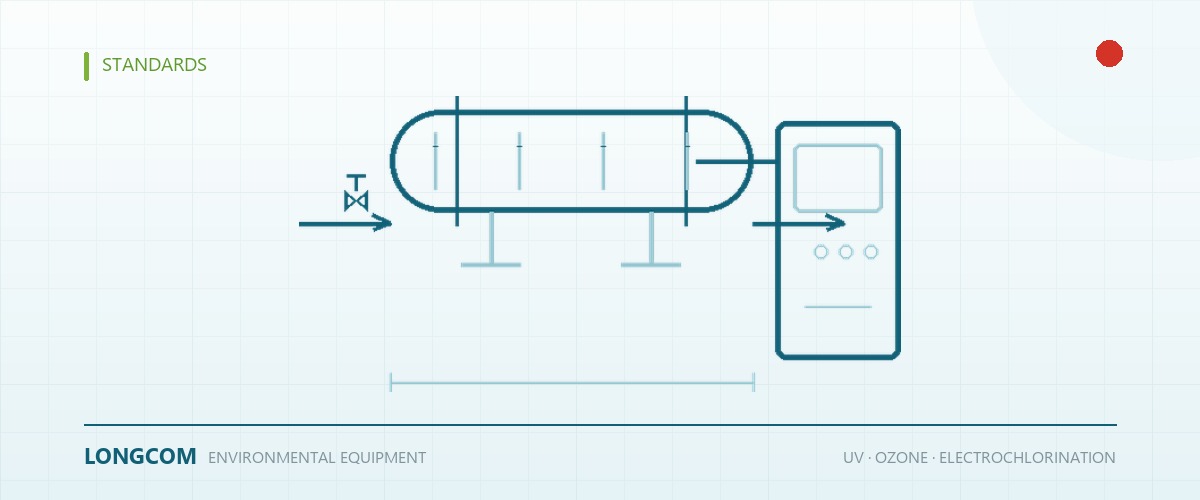
UV sterilizers must work reliably under defined operating conditions and comply with specific technical, appearance and installation requirements. This article summarizes the requirements set out in the standards referenced for UV sterilizers.
1. Operating conditions
1.1 Influent water quality
- Color: ≤15 degrees
- Water temperature: ≥5°C
- Total coliforms: ≤1000 per L
- Total bacterial count: ≤2000 per mL
1.2 Ambient air
Maximum relative humidity in air: ≤90% (equivalent to air at 20°C ±5°C).
1.3 Power supply
Power supply is listed as one of the conditions in which the sterilizer must operate normally; no further parameter is given in the source.
2. Basic technical requirements
- The sterilizer shall be designed in accordance with GB 8988 (Safety Requirements for Mains-Operated Electronic and Related Household and Similar General-Purpose Equipment).
- The sterilizer shall be manufactured to drawings and technical documents approved under the technical management procedure.
- Parts of sterilizers of the same model shall be interchangeable.
- Surfaces exposed to UV irradiation shall be polished.
- Working pressure of the pressure chamber shall be no less than 0.60 MPa; test pressure shall be no less than 0.90 MPa.
- Guide plates should be provided inside the chamber or tank.
- Straight-tube quartz low-pressure mercury UV lamps and their installation shall comply with YY/T 0160 (Straight Tube Quartz UV Low-Pressure Mercury Disinfection Lamps).
- Where environmental requirements are high, low-ozone lamps should be preferred to reduce ozone pollution.
- Lamps shall be arranged so that UV intensity is evenly distributed over the irradiated surface.
- The sterilizer shall provide lamp-on indication, accumulated operating-time indication, or a relative indication of UV irradiation intensity.
- Lamps shall be separated from water by quartz glass sleeves; transmittance of the quartz sleeve at 253.7 nm shall be greater than 85%.
- Low-voltage electrical components shall meet the technical requirements of the corresponding products.
- Inlet and outlet pipes, a drain pipe and a sampling pipe shall be provided. Where a drain pipe cannot be fitted on the sterilizer, it may be installed on the connecting pipeline at the same location.
- Specifications and inlet/outlet pipe diameters should be selected according to the relevant table.
- Under the inspection requirements of this standard, a sterilizer fitted with new lamps shall show a UV irradiation dose of no less than 12000 W·S/cm (filled with water); a sterilizer in normal operation shall show a dose of no less than 9000 W·S/cm.
- Under the service conditions of this standard and at the rated disinfection flow, the bacteriological indices of the effluent shall comply with GB 5749 (Standards for Drinking Water Quality).
- Materials shall comply with GB/T 17219 (Evaluation Standards for the Safety of Drinking Water Distribution Equipment and Protective Materials). 304L and 316L stainless steel are recommended.
- Head loss at the rated disinfection flow shall be less than 0.005 MPa.
3. Appearance requirements
- Surfaces shall be sprayed evenly with a consistent color, free from runs, bubbles, missed paint and peeling.
- The exterior shall be neat and tidy with no obvious hammer marks or unevenness. Panel instruments, switches, indicators and nameplates shall be mounted firmly and squarely.
- Welds on the housing and frame shall be sound, with no obvious deformation or burn-through.
4. Construction and installation points
- Do not install the UV generator immediately after the pump outlet pipe, to prevent water hammer from damaging the quartz sleeve and lamp when the pump stops.
- Install the UV generator strictly in the indicated inlet-to-outlet direction.
- The generator shall have a foundation raised above the building floor, by no less than 100 mm.
- The generator, its connecting pipes and valves shall be fixed firmly; the generator shall not carry the weight of pipes and fittings.
- Installation shall allow for easy dismantling, inspection and maintenance. No pipe connection material that impairs water hygiene may be used.
5. Applicable standards
5.1 Product standards
- UV Sterilizer — QB/T (number not specified in the source)
- UV Disinfection Equipment for Urban Water Supply and Drainage — GB/T (number not specified in the source)
- UV Sterilizer for Drinking Water — CJ/T (number not specified in the source)
5.2 Engineering standards
- Code for Design of Building Water Supply and Drainage — GB (number not specified in the source)
- Code for Design of Outdoor Drainage Engineering — GB (number not specified in the source)
- Discharge Standard of Pollutants for Municipal Wastewater Treatment Plant — GB (number not specified in the source)
- The Reuse of Urban Recycling Water — Water Quality Standard for Urban Miscellaneous Water Consumption, GB/T 18920-2002
- Code for Design of Wastewater Reclamation and Reuse Engineering (with clause explanations), GB 50335-2002
- Code for Acceptance of Construction Quality of Building Water Supply, Drainage and Heating Engineering, GB 50242-2002
5.3 Related standards
- Selection and Installation of Disinfection Equipment for Secondary Water Supply, 02SS104
6. UV bands and germicidal efficiency
According to differences in biological action, ultraviolet light is divided into UV-A (320–400 nm), UV-B (275–320 nm), UV-C (200–275 nm) and vacuum UV. In water treatment the UV-C band is used; within this band, around 260 nm has been confirmed to have the highest germicidal efficiency [1].