

What Types of UV Sterilizers Are Available?
UV sterilizers are attracting growing attention in many fields. As people demand greener, healthier living, the disinfection of the objects, air, and water we come into contact with every day has become ever more important. For disinfecting air, water, and objects, disinfection equipment is the usual answer, covering air disinfection, water disinfection, and surface disinfection.
Among the many types of disinfection equipment, UV sterilizers retain significant advantages. Although UV sterilizers have been introduced into China for some time, far from being phased out, they have evolved into many new types covering the disinfection of objects, air, and liquids.
Counting from the first applications of UV sterilizers abroad, the technology has a history of nearly a hundred years. Early UV sterilizers were developed to replace traditional chemical water disinfection methods and were then widely and rapidly popularized. With more than a century of development, many derivative types have emerged, which is why so many UV sterilizer types exist today.
Without clear classification, so many types would confuse popularization and understanding. Taking the most common water-treatment UV sterilizers as an example, they can be classified by several criteria:
1. By structure: closed and open UV sterilizers
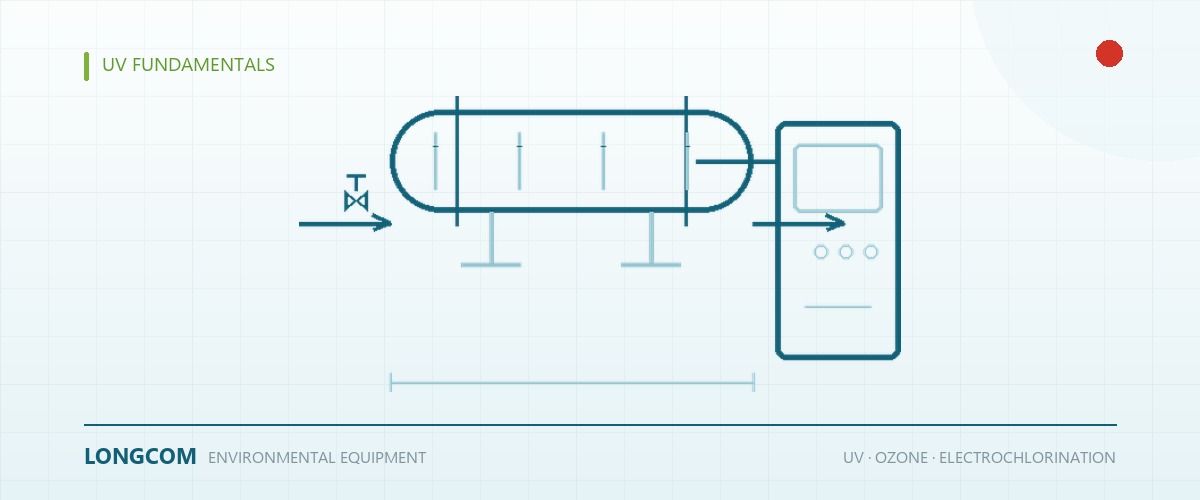
Closed UV sterilizers are pressure-type units: the water to be disinfected is enclosed in a metal cylinder together with UV lamps fitted in quartz sleeves. The cylinder is usually made of stainless steel or aluminum alloy, and the inner wall is mostly polished to improve UV reflectivity and enhance radiation intensity; the number of lamps can be adjusted according to the treatment flow. Some units add helical blades to the inner wall to change the flow pattern, avoiding dead zones and pipe blockages. The resulting turbulence and the sharp edges of the blades break up suspended solids, fully exposing attached microorganisms to UV radiation and improving disinfection efficiency.
In open UV sterilizers, the water to be disinfected flows through the unit under gravity, and microorganisms in the water are inactivated.
2. By application field
- UV sterilizers for urban drinking water
- UV sterilizers for urban wastewater and reclaimed water treatment
- UV sterilizers for aquaculture water
- UV sterilizers for swimming pool circulating water
3. By position of the inlet/outlet and control cabinet
- Top-mounted UV sterilizers
- Bottom-mounted UV sterilizers
- Side-mounted UV sterilizers
4. By pressure class
- Low-pressure (mercury-free) UV sterilizers
- Medium-pressure UV sterilizers
- High-pressure UV sterilizers
UV sterilizers were originally developed for water disinfection. As technology has advanced, they are no longer limited to water treatment: they also give excellent results on object surfaces and indoor air. Today the most common applications are still drinking water and food-processing water, because UV does not change the state, natural color, or taste of water and food, and produces no disinfection by-products. Operating costs are very low, operation and maintenance are simple, and the units are compact, silent, and efficient.