

Tank Self-Cleaning Sterilizer Equipment Manual
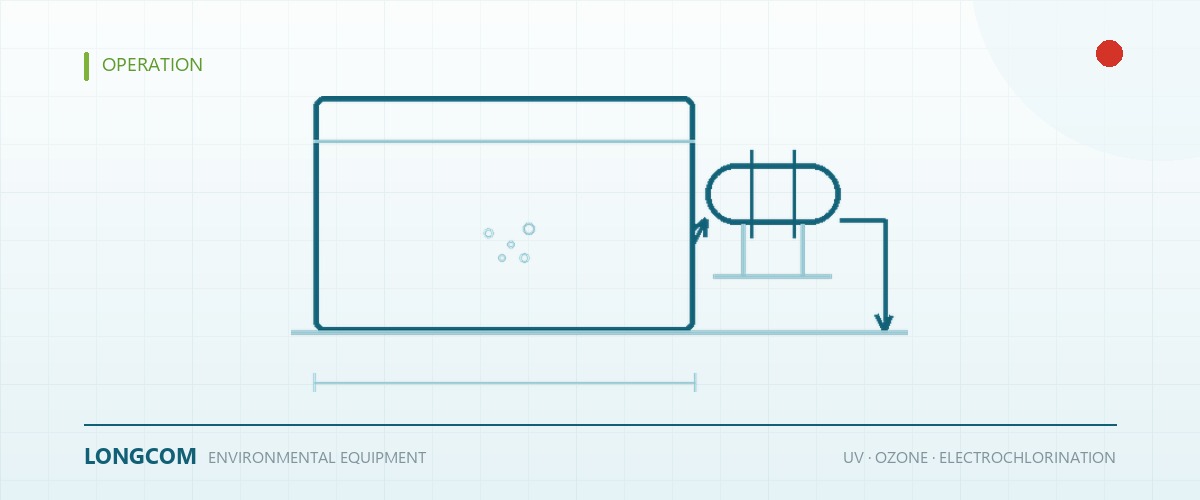
Longkang tank self-cleaning sterilizers are ozone-based units that disinfect stored water through internal circulation. This article covers the WTS-series specifications, installation dimensions, ozone dosage, operating procedures, and routine maintenance.
1. Specifications and dimensions
1.1 WTS-series specifications
| Model | Total power (W) | Supply voltage (V) | Ozone releaser voltage (V) | Ozone output (g/h) | Applicable tank volume (m³) | Weight of ozone releaser (kg) | Weight of controller (kg) | Notes |
|---|---|---|---|---|---|---|---|---|
| WTS-2A | 405 | 220 | 220 | 4 | <20 | 25 | 18 | Internal, single tank |
| WTS-2B | 745 | 220 | 220 | 8 | 20–40 | 50 | 25 | Internal, dual tank |
| WTS-2W | 405 | 220 | 220 | 4 | <20 | – | 45 | External type |
1.2 Installation dimensions (mm)
| Model | φ | h | A1 | B1 | H1 |
|---|---|---|---|---|---|
| WTS-2A | 400 | 520 | 380 | 200 | 560 |
| WTS-2B | 400 | 520 | 430 | 200 | 650 |
| WTS-2W | 300 | 500 | 380 | 200 | 560 |
2. Foreword
For a long time, disinfection of water and air in healthcare, pharmaceuticals, and food processing has relied on UV irradiation, chemical fumigation, and spraying, all of which have notable drawbacks. The advent of ozone sterilization products provides a fast, efficient, safe, reliable, and convenient method, representing a new generation that replaces conventional disinfection equipment and has been widely adopted.
The Longkang tank self-cleaning sterilizer is a new product developed by our R&D department following extensive market research and analysis. The PR-WS-PX series disinfects water through self-circulation combined with the addition of appropriate strong oxidizing substances. It offers low cost, high cost-effectiveness, safety and hygiene, convenience, proven results, and durable economy.
Ozone applications are divided into four fields: water treatment, chemical oxidation, food processing, and healthcare.
2.1 Drinking water and purified water treatment
Mechanism of ozone disinfection. Ozone reacts with the lipid double bonds in bacterial cell walls, penetrates the cell, acts on lipoproteins and lipopolysaccharides, changes cell permeability, and causes cell lysis and death.
Advantages over chlorine. Water plants and beverage producers in China commonly use chlorine disinfectants, which create serious secondary pollution. Chlorination is also sensitive to temperature and pH, and residual chlorine affects taste — in carbonated beverages it can produce an unpleasant chlorine odor and affect product quality.
Application in drinking water plants. An ozone solubility of 0.4–0.5 mg/L meets sterilization and quality-preservation requirements, with a rational design dosage of 1.5–2.0 g/m³. Ozone solubility increases as temperature falls and pressure rises. Under practical production conditions, an ozone gas concentration of 10 mg/L and a water contact time of 5–10 minutes are sufficient when gas–water mixing is good.
2.2 Food industry applications
Ozone’s strong sterilization capacity and lack of residual contamination make it widely useful for disinfection, deodorization, mold prevention, and preservation in the food industry, contributing to better processing practices and food quality.
3. Precautions
- Do not use this product near high-precision electronic equipment; radio interference may cause malfunction. Pay particular attention near hearing aids, pacemakers and other medical electronic devices, smoke detectors, and other precision automatic control devices.
- Do not disassemble or modify the product; this may cause damage, leakage, and circuit failure.
- Avoid excessive moisture. Water or other liquids entering the product may cause leakage and malfunction.
- Do not wipe the equipment with volatile solutions or organic solvents, which may damage the surface.
- Use a proper dedicated grounding wire and a circuit of adequate capacity to eliminate fire hazards. Installation and maintenance personnel must be trained before starting up the equipment.
- When ozone is in use, personnel must not work in spaces with high ozone concentrations. Where ozone levels exceed relevant standards, protective measures are required.
- Always perform maintenance with the power disconnected and all pressure released, to ensure personnel safety.
3.1 Environmental requirements
- For indoor installation, the site must be free of flammable or explosive gases and conductive dust. Do not install in areas prone to ammonia leakage or explosion hazards. For outdoor installation, choose a waterproof, rain-protected location.
- Indoor 380 V / 50 Hz, three-phase five-wire AC power supply
- Ambient temperature: 0–40 °C
- Ambient humidity: ≤55%
- The floor must be level; place the unit steadily on the floor or a support frame.
- Keep the working environment ventilated and the air dry.
| Item | Value |
|---|---|
| Approximate total weight | 120 kg |
| Approximate total power | 3.5 kW |
| Power supply | 380 VAC |
| Rated working pressure | 4 bar |
| Treatment flow | 10–50 m³ |
4. Main applications
The product is widely used for disinfection, sterilization, and algae removal in elevated water tanks, storage reservoirs, domestic water tanks, wastewater pools at treatment plants, fire-water tanks, fountains, ornamental water features, aquaculture, marine parks, food-industry storage tanks, swimming pools and other water-recreation facilities, as well as industrial and medical wastewater.
5. Ozone functions
- The ozone gas produced has strong oxidizing and catalytic effects. Under ozone exposure, proteins in viruses and bacteria dissociate and denature and the activity of nucleic acids and enzymes decreases, giving disinfection, sterilization, and deodorization effects.
- Ozone is a broad-spectrum agent with a very strong lethal effect on all kinds of bacteria and viruses.
- Ozone undergoes complex physical and chemical reactions such as degradation and oxidation with cocci, bacilli, spirochetes, and other harmful bacteria in water. The by-products are non-toxic and harmless, avoiding secondary pollution.
- High-concentration ozone provides chemical oxidation, bleaching, and decolorization.
6. Ozone dosage
National health authorities have established dosage standards: 0.5–1.5 g/m³ for relatively clean water, 3–6 g/m³ for heavily polluted drinking water, and 30–250 g/m³ for wastewater treatment. Ozone kills or destroys microorganisms and molds and removes or degrades harmful substances, improving drinking water quality and effectively avoiding carcinogenic organochlorine compounds formed by chlorine disinfection.
Reference dosages for common ozone applications are listed below. Ozone dosage: 1 ppm = 1.96 mg/m³.
| Application | Dosage | Notes |
|---|---|---|
| Secondary supply from water tanks and reservoirs | 1–2 g/m³ | Depends on hourly water use (periodic) |
| Mineral water and purified water | 2–2.5 g/m³ | Continuous operation |
| Swimming pool circulating water | 2 g/m³ | Periodic; use CuSO4 in summer |
| Tap water plant supply | 1–2 g/m³ | Used together with chloramine |
| Private well water | 3 g/m³ | Intermittent operation |
| Food workshop disinfection | 5 ppm | 40 minutes per day |
| Pharmaceutical workshop disinfection | 10 ppm | 40 minutes per day |
| Hospital wastewater discharge | 10–30 g/m³ | Periodic operation |
| Office and residential building spaces | 0.1–1 ppm | 40 minutes per day |
| Cold storage | 1–2.5 ppm | Intermittent operation |
7. Operating instructions
Note: never place the ozone generator inside the space being disinfected.
Place the generator in a ventilated, dry location free of corrosive gases or liquids, and introduce ozone into the treatment space through the delivery pipe. The following applies to an air-source ozone generator used for water treatment.
- Place the generator at the designated point in the water-treatment process (stable, dry, and well ventilated). Check that the ozone hose is connected to the generator outlet, then connect the delivery pipe to the ozone dosing device.
- Prevent water from flowing back into the generator and damaging its components. Never reverse the check valve.
- Switch on the power. In manual mode, turn the circulation pump switch to “Manual” — the indicator lights and the pump starts — then turn the ozone generator switch to “Manual” — the indicator lights, the generator starts, and gas exits the ozone outlet. In automatic mode, set both switches to “Auto” and configure the timer controller; the unit then runs according to the set schedule.
- Turn on the ozone switch; the indicator lights and the machine starts. Adjust the concentration knob as required (a current of 1 A corresponds to 20 g of ozone output). Ozone gas then flows through the ozone hose.
- Set the timer controller to the disinfection time corresponding to the water consumption.
- Once the set disinfection time elapses, the unit stops automatically or the generator is switched off manually.
8. Timer controller operation
Use the timer controller to program the daily start and stop times of the circulation pump and ozone generator. Once programmed, the system starts and stops automatically according to the schedule, removing the need for continuous manual supervision.
9. Warranty and service
All Longkang products carry a one-year free warranty from the date of purchase. Under the following conditions, the free warranty does not apply and only repair materials are charged:
- Damage caused by excessive humidity (humidity ≥75%) or water entering the machine
- Damage caused by unauthorized modification of the product structure
- Damage caused by natural disasters or other force majeure
- No valid proof of purchase can be provided
You may contact an authorized distributor or Longkang at any time. Units returned with valid proof of purchase can be serviced by Longkang. Technical support is available at any time for questions arising during operation. Longkang is not liable for failures to meet disinfection targets caused by improper operation or equipment malfunction.
10. Troubleshooting and analysis
If the checks below do not resolve the problem, or the issue requires repair, contact Longkang for further support.
10.1 Fault-check list
Check the equipment against the fault-check list supplied in the original manual before requesting service.
10.2 Ozone generator precautions
- Operate the equipment in a clean, dry, oil-free place to extend its service life.
- Handle the equipment with care; do not drop or mishandle it.
- Do not operate the ozone machine inside the disinfection area. For safety, provide a separate work area and deliver the ozone to the disinfection or reaction area through silicone tubing.
- Inspect and maintain the equipment daily. If any abnormality is found, shut it down immediately, identify the cause, and resolve it before further use.
- Ensure the equipment is well grounded before use to protect against lightning.
- Select the correct ozone sterilizer for the working environment and application requirements.
- If the equipment will be idle for a long period, clean both the interior and exterior thoroughly and store it in a ventilated, dry place to prevent moisture damage.
11. Routine maintenance
- Keep the equipment in a dry, ventilated location and clean the dust filter at the fan regularly.
- Non-qualified electricians must not open the cabinet, as it contains high voltage.
- Maintenance must be carried out by qualified electricians.
- The air drying tube contains blue granules during normal operation. If they turn red, replace the desiccant; this will not affect operation.
- Check whether internal connections have loosened and whether the hoses have aged.
- Tighten loose connections with a screwdriver and replace aged hoses promptly.
- Disconnect the main power supply when the equipment will not be used for an extended period.
Any equipment modification must be carried out under the guidance of Longkang professionals. Unauthorized changes will void the warranty. Longkang owns the copyright of this equipment and any illegal reproduction is strictly prohibited. Contact Longkang for sizing support and quotations.