

UV Sterilizers for Domestic Water
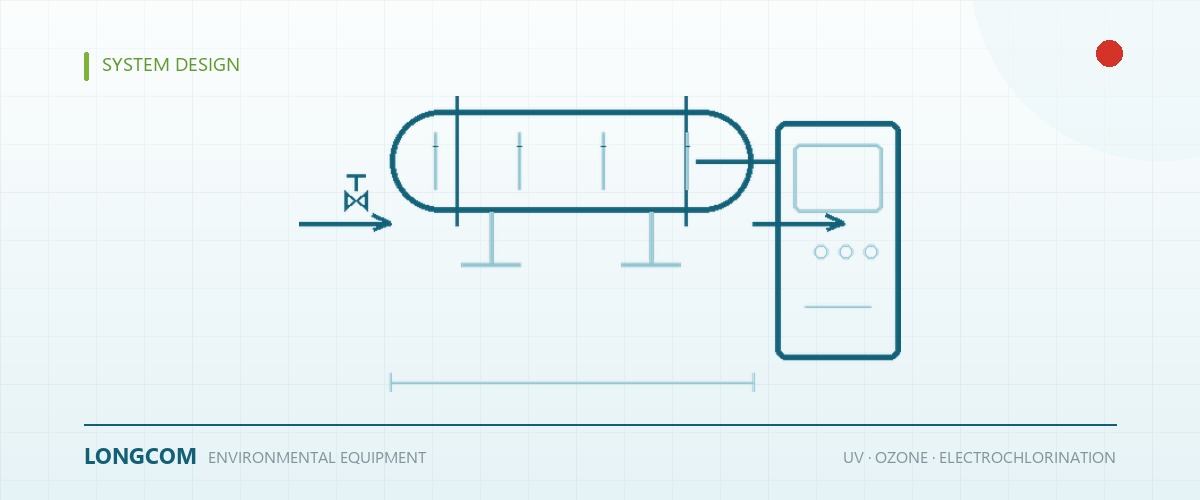
Longkang UV sterilizers for domestic water use a parallel-flow design, in which the lamps are arranged parallel to the water flow. This configuration delivers the highest UV intensity and dose for a given number of lamps. The table below gives technical parameters for the open-channel system, followed by its features and maintenance requirements.
1. Technical parameters (reference values)
| Parameter | Specification |
|---|---|
| Treatment capacity | Modular; per bank based on channel width × water depth (100–5,000 m³/d) |
| UV bactericidal dose | ≥40 mJ/cm² (value per standard for wastewater) |
| Lamp type / quantity | Low-pressure high-intensity mercury lamps; banks configured to treatment capacity |
| Lamp arrangement | Horizontal / vertical modular frames |
| Frame / sleeve material | 304 stainless steel + quartz sleeves |
| Supply voltage / frequency | AC 220 V / 380 V, 50 Hz |
| Water level / control | Level sensor + local electric control cabinet |
| Applicable water sources | Wastewater treatment, reclaimed water reuse, landscape water bodies |
2. Parallel-flow design and working principle
The sterilizer uses a parallel-flow design. In this arrangement, the UV lamps are aligned parallel to the direction of water flow. Long-term experiments and applications by international UV specialists have shown parallel flow to be the most effective lamp arrangement: for the same number of lamps, it provides the greatest UV intensity and dose.
The open-channel UV disinfection equipment uses modules installed in an open channel. Their lamps emit short-wave UV with a central radiation wavelength of 253.7 nm to disinfect the water flowing through the channel. This brings the bacteriological indicators of treated effluent into compliance with, or above, relevant national discharge standards and water quality requirements.
3. Functional features
The open-channel system is supplied with a self-designed and self-manufactured stainless-steel channel gate. The gate controls the flow of water to the disinfection channel, allowing shutdown for inspection, maintenance, and emergency overflow conditions. It is flexible, lightweight, leak-free, durable, and economical.
The flow-straightening grid blocks floating debris such as plastics, fibers, paper, and wood chips in the incoming water, protecting the normal operation of the UV disinfection modules. It has small spacing, good blocking performance, durability, and light weight, and comes with a dedicated small rake for easy debris removal and convenient management.
4. Operating precautions
- Do not start the sterilizer frequently, especially within a short period, so as to preserve UV lamp life.
- Clean the unit regularly. Depending on water quality, the UV lamps and quartz sleeves need periodic cleaning. Wipe the lamps with an alcohol swab or gauze and remove dirt from the quartz sleeves to avoid reducing UV transmission and compromising sterilization.
- When replacing a lamp, first unplug its socket and withdraw the old lamp, then carefully insert a cleaned new lamp into the sterilizer, fit the sealing ring, check for leaks, and finally reconnect the power. Do not touch the quartz glass of the new lamp with your fingers, as fingerprints will affect sterilization.
- Protect against UV radiation. UV has a powerful lethal effect on bacteria and can also harm the human body. Avoid direct exposure when starting the lamp; use protective goggles if necessary and never look directly at the light source, to avoid burning the eye membrane.
5. UV exposure safety
UV sterilizers for drinking-water treatment are powerfully bactericidal but can also harm the human body, with the cornea being the most vulnerable part. Never look directly at a lit lamp. If it is essential to view the light, use ordinary glass (wear glasses) or a transparent plastic sheet as a face shield. Never use quartz glass by mistake — ordinary glass is almost completely impermeable to UV. If injury occurs, there is no need to panic: facial burns heal by themselves after a few days as the skin peels. Eye injuries cause redness, tearing, and stinging and take about three to four days to heal. In any case, seek medical advice promptly after UV injury.
Contact Longkang for sizing support and quotations.