

UV Sterilizers for Industrial Water Treatment
Water treatment is attracting growing attention, and UV sterilizers contribute greatly to the industry. As wastewater volumes keep increasing, UV sterilizers have taken on ever-greater importance. They are no longer limited to domestic water, medical, and catering applications — they are also widely used in industrial water treatment.
What exactly is a UV sterilizer for industrial water? This article first introduces the classification of UV sterilizers. There are two main types: the open-channel UV sterilizer and the closed-vessel UV sterilizer.
1. Open-channel UV sterilizers
The open-channel UV sterilizer, also called a frame-type UV sterilizer, is installed in a channel and disinfects the flowing water in it. It is generally used for wastewater disinfection, offering a high sterilization rate, a high degree of automation, simple maintenance, and low cost.
2. Closed-vessel UV sterilizers
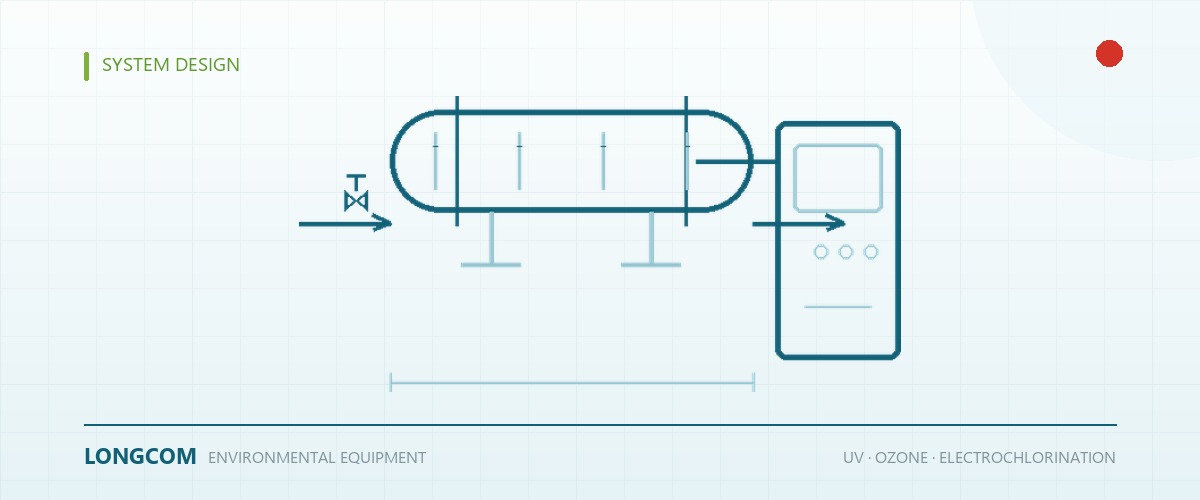
Closed-vessel UV sterilizers are divided into in-line (through-flow) types and pipeline types. In industry, the pipeline-type UV sterilizer is by far the most common.
The pipeline-type UV sterilizer uses low-pressure mercury lamps to disinfect water flowing through a pipe. It offers a high sterilization rate and is energy-efficient and environmentally friendly, covering flow rates from 1 m³/h up to thousands of m³/h. It is suitable for the disinfection of tap water, food, pharmaceutical, industrial water, and many other water types.
Why it suits industrial water
- UV disinfection is relatively economical in areas where chlorine gas or hypochlorite supply is difficult, and in applications with strict limits on chlorine disinfection by-products after treatment.
- It introduces no impurities into the water and leaves the physical and chemical properties of the water essentially unchanged. Other chemicals in the water do not impair disinfection: for example, chloramine residues after chlorine dioxide treatment are effectively decomposed as well, so applicability is good.
- At a sufficient radiation intensity, most pathogenic microorganisms are killed within roughly ten seconds. UV can inactivate some pathogens that chlorine disinfection cannot, and can also control some higher aquatic organisms such as algae and bloodworms. Disinfection is broad, fast, and requires short contact times — well suited to the fast pace of industrial water use.
- Safety is much higher than with chemical methods such as chlorine dioxide or ozone. UV over-treatment generally causes no water quality problems, whereas chlorine dioxide and ozone are hazardous chemicals that are toxic and may explode in an accident. A UV sterilizer is an integrated unit that fully encloses the UV radiation inside, making operation and management safe, with essentially none of the toxicity, flammability, explosion, or corrosion risks involved in using, transporting, and storing other chemicals.
- Ease of operation and a small footprint also suit industrial water. The UV sterilizer has a simple structure, is easy to install, compact and lightweight, causes very little head loss, occupies little space, is easy to operate and manage, and is easy to automate. A well-designed system requires very little operation and maintenance work. Apart from the water pumps that must run anyway, the unit has no other noise source, since the fan is a super-silent type.
The applicable fields of UV sterilizers cover almost all water treatment sectors: domestic water, aquaculture water, tap water supply, building water supply, municipal wastewater, hospital wastewater, industrial wastewater, rainwater, domestic graywater, surface water, well water, river water, groundwater, pure water, landscape water, swimming pool water, seawater, brewery water, beverage plant water, and more — for sterilization, disinfection, and algae control.