

Ozone, Electrolytic or UV Tank Self-Cleaning Sterilizers: Comparison and Selection
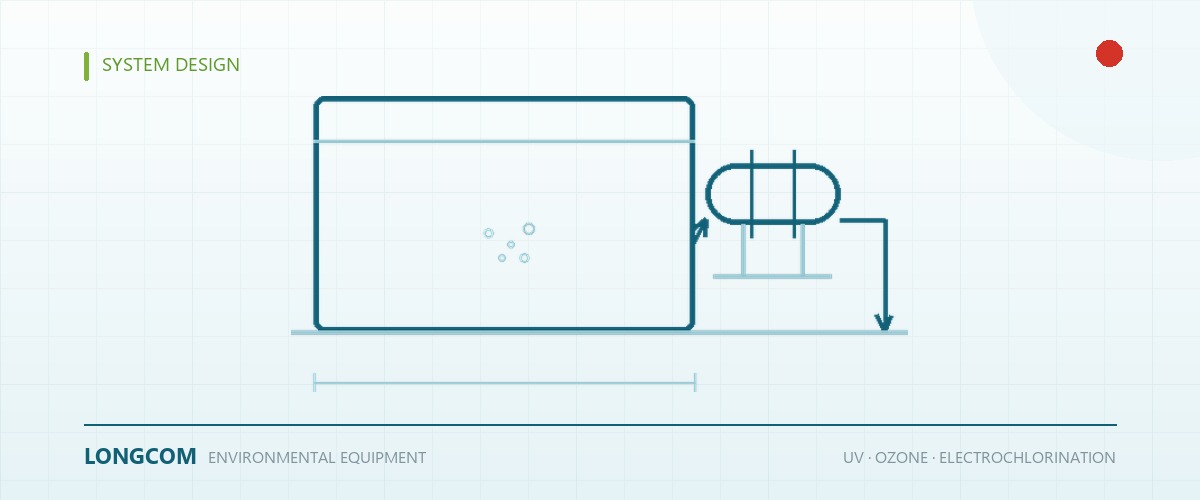
Tank self-cleaning sterilizers fall into three families by disinfection principle: ozone type, micro-electrolytic type (silver / copper-silver ions) and UV type. They attack contamination in different ways — strong oxidation, metal-ion suppression and 253.7 nm DNA damage respectively — and they suit different tanks. This guide compares all three on principle, performance, running cost and safety, and ends with selection advice.
1. Ozone tank self-cleaning sterilizers (the mainstream choice)
1.1 How it works
The ozone unit (Longkang LC-SX-ZJ-N built-in / LC-SX-ZJ-W external) generates ozone by corona discharge, ionising oxygen into O₃ with air or oxygen feed. Ozone dissolves into the stored water through diffusers (built-in) or a gas–water mixer (external), then disinfects the tank volume.
Ozone has an oxidation-reduction potential of 2.07 V — below fluorine (2.87 V) but above chlorine dioxide (1.50 V), hydrogen peroxide (1.78 V) and chlorine (1.36 V). It disinfects by:
- Oxidising unsaturated fatty acids in cell membranes, increasing permeability until the membrane ruptures
- Entering the cell and oxidising enzyme proteins (thiol enzymes, dehydrogenases), blocking metabolism
- Oxidising purines and pyrimidines in DNA/RNA, preventing replication and repair
- Breaking down organic macromolecules (humics, proteins) into small molecules, and oxidising taste, odour and colour compounds (ammonia, hydrogen sulphide, methyl mercaptan, iron, manganese)
Ozone inactivates bacteria, viruses, fungi, algae, spores (at high dose) and protozoan cysts within minutes — hundreds of times faster than chlorine. It is unstable in water: half-life about 25 minutes at 20 °C (roughly 3 h at 0 °C, 10 min at 30 °C), decomposing finally into oxygen with no residue and no chlorinated by-products (THMs, HAAs), while raising dissolved oxygen in the tank.
1.2 Key specifications (Longkang ozone series)
| Parameter | Value |
|---|---|
| Ozone output | 5–50 g/h (built-in 5–20, external 10–50; up to 200 g/h parallel) |
| Ozone concentration | 10–30 mg/L (air feed), 80–120 mg/L (oxygen feed) |
| Circulation flow | 2–20 m³/h |
| Dissolution rate | 30–60% built-in diffuser; 60–85% external jet/mixer |
| Generator life | 8,000–12,000 h (10–15 years at 2 h/day) |
| Power | 0.3–2.5 kW; 220/380 V |
| Noise | ≤50 dB built-in / ≤55 dB external |
| Wetted materials | 304/316L stainless steel, titanium/316L diffusers, fluoroelastomer seals (ozone-resistant) |
1.3 Strengths
- Broad-spectrum, fast, ≥99% inactivation of bacteria, viruses, fungi, algae, spores and protozoa
- Removes odour, colour and organics — something neither electrolytic nor UV units can do
- Strips biofilm and sediment: the ozone-laden circulation scrubs tank walls and oxidises the biofilm matrix
- No residue and no chlorinated by-products
- Raises dissolved oxygen, improving taste and discouraging anaerobic growth
- Mature technology with full model range (5–50 g/h covers 1–2000 m³ tanks) at moderate cost — over 80% market share
- Full approvals: drinking-water hygiene permit, ISO 9001, third-party germicidal and water-quality reports (GB 5749 / GB 17051 / GB/T 17219)
1.4 Limitations
- Slight ozone taste possible at taps if output or run time is excessive; control dosing and run off-peak (ozone decomposes within ~30 minutes)
- Ozone off-gas accumulates in poorly ventilated tank rooms (workplace limit 0.1 mg/m³, GBZ 2.1) — provide ventilation or an ozone alarm with automatic shut-down
- Noise 50–55 dB from pump and air compressor — use low-noise pumps, anti-vibration mounts or acoustic enclosures next to occupied rooms
- Generator replacement every 8,000–12,000 h, plus air filters every 3–6 months
- Poor in hot water — above 40 °C ozone decomposes in minutes; not recommended for hot tanks (choose electrolytic)
- Oxidises ordinary rubber and plastics — use fluoroelastomer seals, 304 stainless or PVDF piping (standard on Longkang units)
1.5 Where ozone fits
- Most potable-water tanks in residential estates, hotels, hospitals, schools and offices (1–2000 m³) — the mainstream choice
- Fire-water tanks prone to water degradation, Legionella and fouling (1–1000 m³)
- Reclaimed-water tanks needing both disinfection and odour control (50–2000 m³)
- Rural and municipal reservoirs (100–2000 m³)
- Tanks with odour, colour or organic loads that need oxidation
- Tanks with established biofilm or sediment that must be removed, not just suppressed
2. Micro-electrolytic (silver / copper-silver) sterilizers
These units release controlled concentrations of silver or copper-silver ions by electrolysis of specially treated electrodes. Ions penetrate cell membranes and bind to sulphydryl groups in respiratory enzymes, suppressing metabolism and reproduction, while copper accelerates membrane damage.
- Strengths: long-lasting residual effect (ions persist in the tank for days), silent operation, no chemicals, unaffected by water temperature (suitable for hot tanks), very low power
- Limitations: no oxidising power (taste, odour, colour and organic matter are untouched); slow kill at low temperatures; electrodes need periodic replacement; ion concentration must be kept within drinking-water limits (GB 5749); effectiveness drops in very hard water where scale coats the electrodes
- Best for: hot-water tanks, small tanks with low organic load, quiet environments (wards, hotels, residences near bedrooms), and as a long-term suppression device paired with periodic shock disinfection
3. UV tank sterilizers
UV units circulate stored water past 253.7 nm low-pressure lamps. UV-C damages microbial DNA/RNA so organisms cannot reproduce.
- Strengths: immediate physical inactivation with no chemicals or residues, no taste or odour change, no by-products, compact and low running cost
- Limitations: zero residual effect — any surviving organism re-grows once water leaves the chamber; no action on biofilm, sediment, taste or colour; performance depends on UVT and lamp/sleeve condition; needs lamp replacement every 9–12 months and sleeve cleaning
- Best for: point-of-use protection at the tank outlet, tanks fed by municipal water with stable quality, and as part of a combined scheme (UV + periodic tank cleaning or ozone circulation)
4. Side-by-side comparison
| Item | Ozone | Electrolytic (Cu-Ag) | UV |
|---|---|---|---|
| Mechanism | Strong oxidation (2.07 V) | Ion suppression of enzymes | DNA damage at 253.7 nm |
| Speed | Minutes | Slow, cumulative | Immediate |
| Residual effect | ~30 min (decomposes) | Days | None |
| Biofilm / sediment | Removes | Suppresses only | None |
| Odour / colour / organics | Removes | None | None |
| Hot water (>40 °C) | Poor | Good | Good |
| Noise | 50–55 dB | Near silent | Low |
| Consumables | Generator + filters | Electrodes | Lamps + sleeves |
| By-products | None | Ion limit compliance needed | None |
5. Selection advice
- General potable tanks with odour, colour or biofilm concerns — ozone (most capable, mainstream)
- Hot-water tanks, quiet locations, or long residual suppression — electrolytic
- Stable-quality municipal water with the priority on point-of-use safety — UV
- Severe biofilm plus taste issues — ozone circulation + UV at outlet combined
Send us the tank volume, water source, temperature range and complaint symptoms, and Longkang will recommend the type and model with sizing calculation.