

Open-Channel UV Disinfection Modules Explained
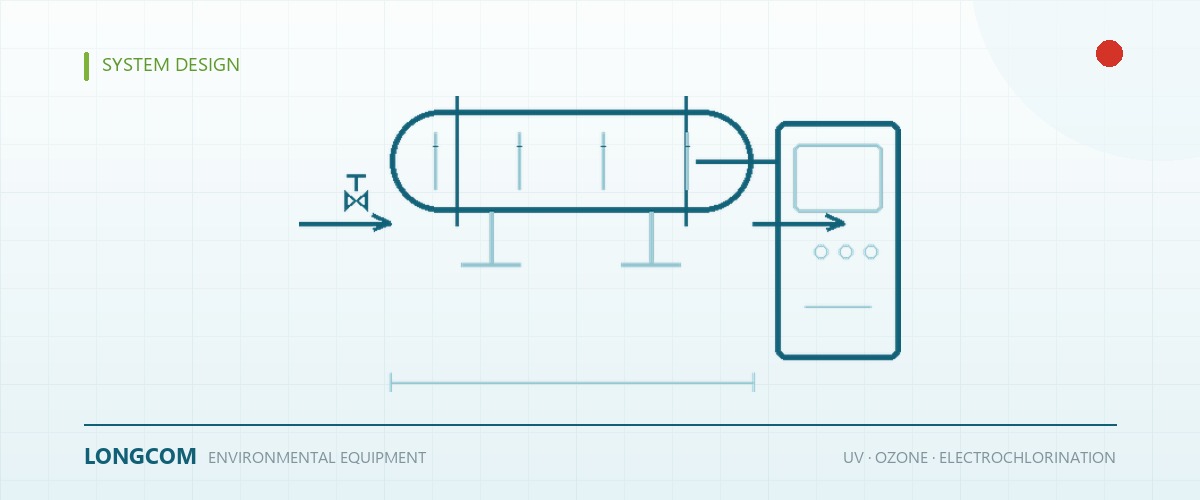
Introduction to open-channel UV disinfection modules
An open-channel UV disinfection module uses UV lamps mounted on modules arranged in an open channel to emit short-wave UV light with a central radiation wavelength of 253.7 nm, disinfecting the water flowing through the channel. It solves the problem of bacterial indicators exceeding limits in treated wastewater, so that the bacteriological indices of the final discharged water meet and exceed relevant national discharge standards and water quality standards.
Performance characteristics of open-channel UV disinfection modules
- System structure: rational design.
- Electronic ballasts: stable performance, good heat dissipation and modular design for easy replacement.
- Monitoring system: UV intensity can be monitored; automatic control greatly reduces equipment repair and maintenance costs.
- Water level control system: multiple water level control methods can be selected according to actual requirements to suit various environments.
- Automatic cleaning system: advanced and efficient hydraulic cleaning completely avoids the inconvenience of manual lamp cleaning and causes no secondary pollution.
- UV lamps: long life and slow ageing, with an expected service life of 12,000–20,000 hours, ensuring reliable disinfection performance.
- Equipment materials: carefully selected materials; all parts in contact with wastewater are made of 304 or 316L stainless steel for a long service life.
- System performance: high overall efficiency reduces power consumption and operating costs and lowers the labour intensity of system maintenance.
- System size: compact and space-saving, easy to install and suitable for engineering upgrades and retrofits.
Technical parameters of open-channel UV disinfection modules
Open-channel UV disinfection modules use a modular design, are easy to install and operate, and can be freely combined according to different treatment capacities and user requirements. They have a wide range of applications and high reliability. They provide fast, effective disinfection with high bactericidal efficiency and low operating cost. They produce no secondary pollution from disinfection, and the low-pressure high-output mercury lamps used have a long effective life, greatly reducing the operating and maintenance costs associated with lamp replacement.
Operating conditions for the UV sterilizer
The UV sterilizer should be able to operate normally under the following conditions:
- Influent water quality: colour ≤15 degrees, water temperature ≥5°C, total coliforms ≤1,000/L, total bacterial count ≤2,000/mL.
- Ambient air: relative humidity ≤90% (equivalent to air at 20°C ±5°C), with power supply provided.
- Components of the same model of sterilizer should be interchangeable.
- Surfaces of the sterilizer exposed to UV irradiation should be polished.
- The working pressure of the pressure vessel should be not less than 0.60 MPa and the test pressure not less than 0.90 MPa.
- Guide plates should preferably be installed inside the vessel or tank.
- The installation requirements for straight-tube quartz low-pressure UV lamps should comply with YY/T 0160 (Straight-Tube Quartz Low-Pressure UV Disinfection Lamps).
- Where the environment has higher requirements, low-ozone lamps should preferably be selected to reduce ozone pollution to the environment.
- Lamps should be arranged so that UV intensity is evenly distributed over the irradiated surface.
- The sterilizer should be equipped with a lamp-on indicator, an accumulated operating-time indicator or a relative UV irradiance indicator.
- Lamps should be separated from the water by quartz glass sleeves, and the transmittance of the quartz sleeves at 253.7 nm should be greater than 85%.
- Low-voltage electrical components used in the sterilizer should meet the technical requirements of the corresponding products.
- The sterilizer should be provided with inlet and outlet pipes, a drain pipe and a sampling pipe. Where a drain pipe cannot conveniently be installed on the sterilizer, it may instead be installed on the connecting pipeline at the same location as the sterilizer.
- The specifications of the sterilizer and the diameters of the inlet and outlet pipes should preferably be selected according to the relevant table.
- In accordance with the inspection requirements of this standard, a sterilizer product fitted with new lamps should have a measured UV irradiation dose of not less than 12,000 µW·s/cm when filled with water; a normally operating sterilizer should have a measured UV irradiation dose of not less than 9,000 µW·s/cm.
- Under the service conditions of this standard and at the rated disinfection water capacity, the bacteriological indices of the effluent should comply with GB 5749 (Standards for Drinking Water Quality).
- Sterilizer materials should comply with GB/T 17219 (Safety Evaluation Standard for Drinking Water Distribution Equipment and Protective Materials). The sterilizer should preferably use 304L or 316L stainless steel.
- The head loss of the sterilizer when operating at the rated disinfection water capacity should be less than 0.005 MPa.
Contact Longkang for sizing support and quotations.