

Dual Media Filters: Structure and Filter Media
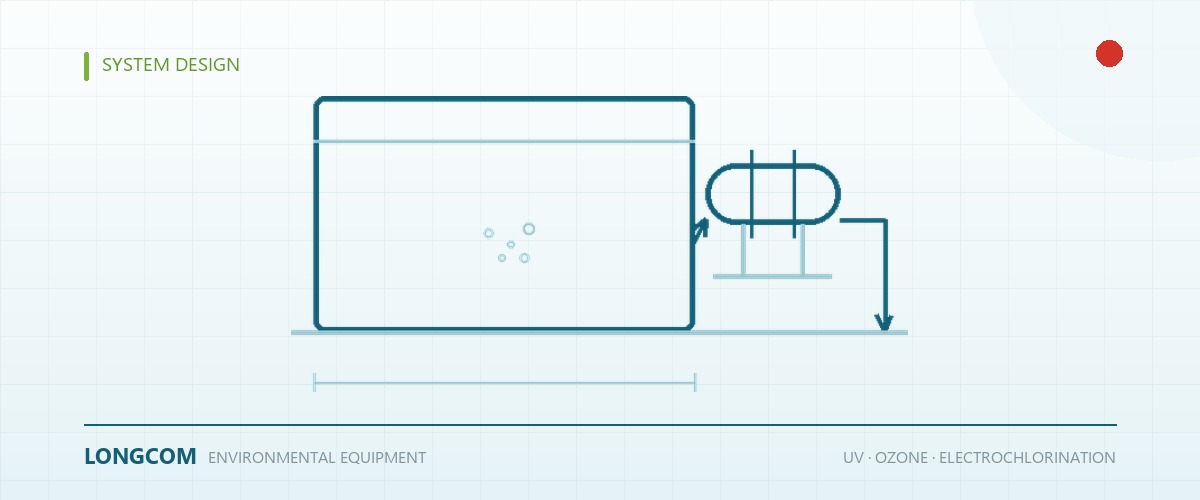
In a water purification system, a dual media filter — also called a dual media (dual filter media) filter or multi-media filter — is a filter filled with two types of filter media. Common media used in water purification systems include anthracite, ceramsite, quartz sand and activated carbon.
1. Structure of the dual media filter
A multi-media filter is generally made of carbon steel or 304 stainless steel, with internal epoxy coating or natural rubber lining for corrosion protection. Water distribution systems include suspended-basket distribution, domed-plate distribution at the bottom, stainless steel pipe-type distribution and flat-plate distribution. Distribution nozzles are of the ABS mushroom type or the wrapped-wire cylindrical type. Pipe-type and domed-plate distribution systems are provided with a support layer made of large pebbles or coarse quartz sand, mainly because their large voids create low resistance and facilitate water collection and backwashing.
When designing the media layers of a dual media filter, the particle size requirements must be considered: the grain size of the lower layer should be smaller than that of the upper layer to ensure the effectiveness and full utilization of the lower media. The upper layer should have a lower density so that the layers re-stratify after backwashing; if the upper layer had a higher density, its media would sink below the lower layer after backwashing. Taking a two-layer bed as an example, the upper layer consists of the largest-grain, low-density lightweight media, such as anthracite or activated carbon, while the lower layer consists of smaller-grain, higher-density media, generally quartz sand. In this arrangement the upper layer performs coarse filtration with low resistance and small head loss, while the lower layer performs fine filtration with a strong dirt-holding capacity. This fully exploits the role of the multi-media bed — small head loss and good filtration performance — and makes the most of the advantages of each medium.
2. Common filter media
2.1 Quartz sand
Quartz sand is generally used as pretreatment for pure water and ultrafiltration systems. It intercepts and adsorbs silt, colloids, metal ions and organic matter through the filter layer. It is widely used in general water treatment because it is non-polluting, inexpensive and has low operating costs.
2.2 Activated carbon
Activated carbon consists of very fine carbon particles with a large number of micropores per unit area, commonly called capillary pores. These capillaries have a strong adsorption capacity, and because the carbon particles present a large surface area in full contact with impurities in the water, the impurities are adsorbed into the micropores, removing colloids and other impurities. Activated carbon also adsorbs chloride ions and ozone from water, has a certain adsorption capacity for organic matter, and can noticeably remove color. In the water treatment industry, an iodine value above 700 mg is generally required for activated carbon with strong adsorption capacity.
2.3 Anthracite
Anthracite is selected from deep-shaft minerals and has the highest carbon content of any filter material. Anthracite used as water treatment filter media is manually classified and also filtered and washed to reduce extraneous minerals and ash content, ensuring its suitability for water filtration. It has a good luster, appears as angular granules, and has high compressive strength and wear resistance. Because anthracite has a good capacity to retain solid particles, it reliably improves suspended solids removal; in addition, its low uniformity coefficient helps increase flow rates.
2.4 Manganese sand
Manganese sand relies mainly on its own catalytic action, together with an iron-based active filter film that gradually forms on the surface of the media during filtration and also acts as a catalyst. The freshly formed iron oxide serves as the active filter membrane material and participates in the new catalytic iron removal process, so active-film iron removal is an auto-catalytic process. It is mainly used for groundwater treatment, circulating water treatment and wastewater treatment.
2.5 Fiber ball
In a fiber ball filter, the voids of the fiber balls account for about 93% of the media layer. During operation, water enters at the top and leaves at the bottom; due to the resistance of the water flowing through the filter layer, the media form an ideal void structure — loose at the top and compact at the bottom — which not only gives a large throughput but also increases dirt-holding capacity. It effectively removes suspended solids and silt from water, and has a noticeable removal effect on organic matter, colloids, iron and manganese. The product is used for fine filtration of oil-bearing wastewater in oilfields and similar applications; with its large filtration throughput and oil-resistant fiber balls, it is widely used in the petrochemical industry.
3. Summary
Overall, quartz sand offers high density, small grain size and low cost. Anthracite offers low density, strong dirt-holding capacity and larger grains at a reasonable price, making it a filtration medium between quartz sand and activated carbon. Activated carbon has a low density and strong odor-removal and decolorizing capacity but is relatively expensive; it is generally used in drinking water treatment, where beyond these functions it also improves the taste of the water. Fiber ball filters are used in high-flow, oil-removal and suspended-solids-removal systems, while manganese sand mainly removes iron and manganese and is commonly used in groundwater and well water treatment systems as well as circulating water systems.
Contact Longkang for sizing support and quotations.