

Tank Self-Cleaning Sterilizers: Principles, Selection and Hubei Project Practice
Across Xianning, Wuhan and Ezhou, domestic water tanks in residential communities, commercial fire reservoirs and hotel storage tanks are being upgraded as part of secondary water supply projects. Tank self-cleaning sterilizers are standard antibacterial equipment in these projects, yet many general contractors and property managers have an incomplete understanding of how the devices work, how to size them, and how to install them. Wrong selection and poor installation lead to weak antibacterial performance and failed water-quality tests. Drawing on Longkang’s experience delivering hundreds of tank disinfection projects in Hubei — Jiayu, Chibi and Tongshan — this article explains the principles, categories, selection rules, installation points and common project mistakes of tank self-cleaning sterilizers.
How it works
A tank self-cleaning sterilizer generates ozone through micro-electrolysis. The strong oxidizing power of ozone continuously suppresses bacteria in the static water of a closed storage tank, oxidizes and decomposes the biofilm on the tank walls, kills bacteria, Legionella and algae, and removes odours. There are two categories: internal immersion types (WTS-2A / WTS-2B) and external circulation types.
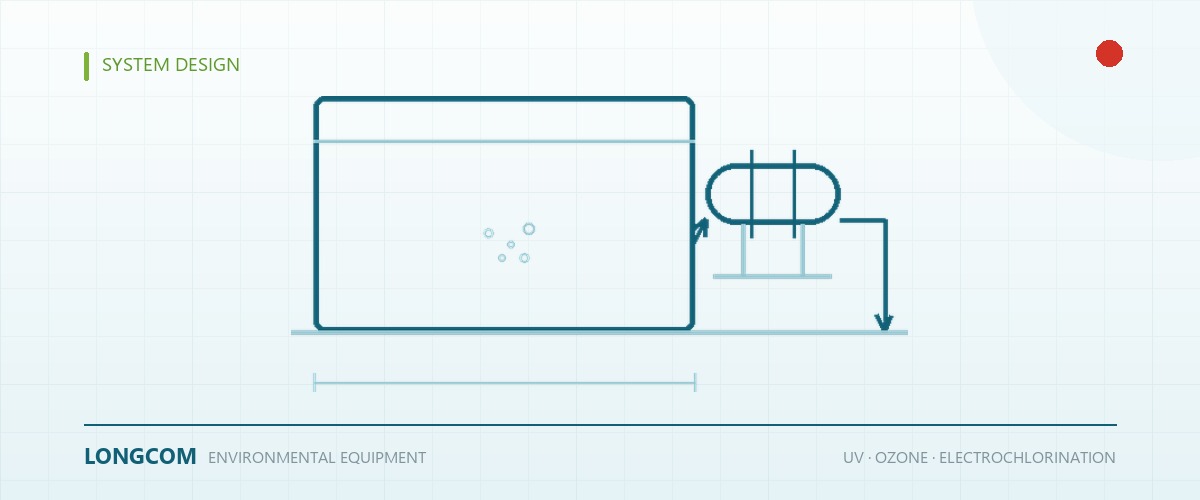
For the internal type, the control unit is mounted on the outside wall of the tank and connected by piping to an aeration release unit inside. Ozone gas diffuses into the water through the diffuser, oxidizing microorganisms and breaking down the biofilm attached to the tank walls. The external circulation type includes a circulation pump that draws water from the tank into the equipment chamber; after ozone disinfection, the water returns to the tank. It suits large reservoirs above 500 m³, where simple aeration cannot distribute ozone evenly — circulation ensures uniform water quality in every corner of the tank.
Ozone has a short half-life in water and decomposes into oxygen in about half an hour at ambient temperature, so it does not accumulate. In domestic tank applications the unit runs intermittently, releasing ozone on a timer to maintain a low antibacterial concentration without excess. Many customers worry about ozone reaching residents’ taps: after each disinfection cycle the system waits for the ozone to break down naturally before supply resumes, so no ozone enters the distribution network.
Selection by effective storage volume
The core basis for selection is the tank’s effective storage volume — the most common pitfall in Hubei projects. The WTS-2A internal model suits 10–50 m³ tanks, typically small domestic tanks in high-rise communities. The WTS-2B internal model suits 50–500 m³ tanks for larger communities and hotels. For fire reservoirs and large storage tanks above 500 m³, an external circulation model is recommended. Some projects cut costs by pairing an undersized unit with a large tank; the ozone output is then insufficient to suppress algae and biofilm, and the water turns green again with microbial counts above the limit. Selection must be based on effective storage volume, not the tank’s external dimensions — deduct internal supports and maintenance space to arrive at the actual water volume.
Domestic drinking-water tanks and fire tanks must be selected differently. Domestic tanks require a national hygiene permit for water-contact products, with materials and ozone output tested by the health authority so the water passes inspection. Fire reservoirs do not supply drinking water, so a hygiene permit is not mandatory; cost-effectiveness and algae suppression (to prevent clogging fire pipes) take priority. We have seen many projects where a fire-rated unit was purchased for a domestic tank, only to fail hygiene acceptance and be stopped for rework.
Installation points
For internal models, an opening must be reserved in the tank side wall for the aeration pipe, with the release head placed near the bottom of the tank and away from the outlet. If the diffuser sits near the outlet, ozone is carried into the supply pipe before it can disperse and decompose, affecting water quality at the tap. Fix the control unit on a dry wall outside the tank, away from standing water; use 220 V single-phase power with waterproof cabling. Use ozone-resistant silicone tubing — ordinary rubber tubing oxidizes and ages quickly, leading to leaks. The control cabinet should be IP54 rated for the humid pump rooms common in Hubei, and must not be mounted directly under the tank where condensation can drip into it.
Operating strategy
Intermittent timed operation is recommended rather than continuous 24-hour running. A typical setting is 2–4 cycles per day, 30–60 minutes each: ozone is generated and disperses to suppress bacteria, then the unit stops and the ozone decomposes naturally. Continuous operation accelerates aeration-tube ageing and raises energy cost without extra antibacterial benefit. Longkang units include a built-in timer module, so no separate controller is needed.
Common mistakes in Hubei projects
- Mistake 1 — thinking a tank sterilizer replaces an in-line UV unit. A tank sterilizer treats only static water inside the tank. Once water is pressurized and travels through long pipes, biofilm still grows on the pipe walls. A complete secondary supply scheme combines tank self-cleaning with in-line UV.
- Mistake 2 — assuming installation means no maintenance. Silicone aeration tubing exposed to ozone needs inspection every 2–3 years and timely replacement; check the diffuser for sludge blockage during the annual tank cleaning.
- Mistake 3 — using a domestic model in a fire reservoir (unnecessary cost), or using a cheap unit without a hygiene permit in a domestic tank (failed acceptance).
Longkang’s local capability
Longkang has worked on storage-tank disinfection in Hubei for many years, delivering tank self-cleaning sterilizers for secondary supply and fire-reservoir projects in Jiayu, Chibi, Chongyang and Jiangxia. Full product documentation is provided, and domestic models come with water-contact hygiene permits to support health and fire acceptance. Local engineers can survey tank dimensions and pump-room space on site, determine the model and opening position, guide the contractor through drilling, piping and wiring, and train property staff in operation.
As secondary supply upgrades continue across older Hubei communities, antibacterial control in storage tanks is a key part of water-quality improvement. Correct selection, proper installation and a sound operating strategy suppress algae and Legionella over the long term, reduce the frequency of manual tank cleaning, and keep stored water within standard. At the planning stage, choose internal or external models based on tank volume, purpose and pump-room conditions, and pay attention to water-contact certification, pipe materials and diffuser placement to avoid acceptance risk. Longkang provides free selection proposals, site surveys, equipment supply, installation guidance and local after-sales service for residential, hotel and hospital tank projects in Hubei.