

What Color Is a UV Sterilizer Lamp
UV sterilizers are now common in many water systems: restaurants and hotels, waterworks, secondary supply in residential communities, and wastewater plants with demanding effluent quality. A frequent question is why the visible light from UV sterilizers appears in different colors. This article explains the color of UV sterilizer lamps and why they look the way they do.
1. UV light itself has no color
Mercury UV lamps contain a small amount of mercury, either free in the tube or embedded on its surface. When current is applied to the electrodes, electrons flow between them and mercury evaporates. Under electron bombardment the mercury emits ultraviolet light; the exact wavelength depends on the vacuum pressure inside the tube, usually categorized as medium pressure or low pressure.
Ultraviolet light is colorless. Human vision covers wavelengths of 380–760 nm, while the light emitted by these UV lamps is at 254 nm, well outside the visible range, so the UV radiation itself cannot be seen.
2. Why the lamps look blue-violet
Most UV lamps on the market appear blue-violet. The spectrum emitted by low-pressure mercury under electron bombardment includes not only the main 254 nm UV line but also blue and violet light in the visible range. This visible glow both delivers the germicidal UV effect and reminds users whether the lamp is on, helping to prevent exposure.
3. Why other colors are seen
Lamps are also seen as green, blue-green, purple and other colors. Ultraviolet light exposes photographic film and produces strong fluorescence: fluorescent tubes, fluorescent lamps and agricultural black-light traps all work by exciting fluorescent materials with UV. What we see is therefore fluorescence, not ultraviolet light itself.
4. Historical milestones
- 1801 — ultraviolet radiation first discovered by Johann Wilhelm Ritter
- 1878 — germicidal action of UV first discovered by Downee and Blunt
- 1901 — the UV lamp first invented by Cooper and Hewitt
- Early UV sterilizers were not very practical because of limitations in filament materials, vacuum technology and quartz purity
- 1982 — the first relatively mature UV disinfection system appeared in Canada
UV sterilizers have been in use for decades, and around 3000 waterworks worldwide now use the equipment.
5. Two forms and safety precautions
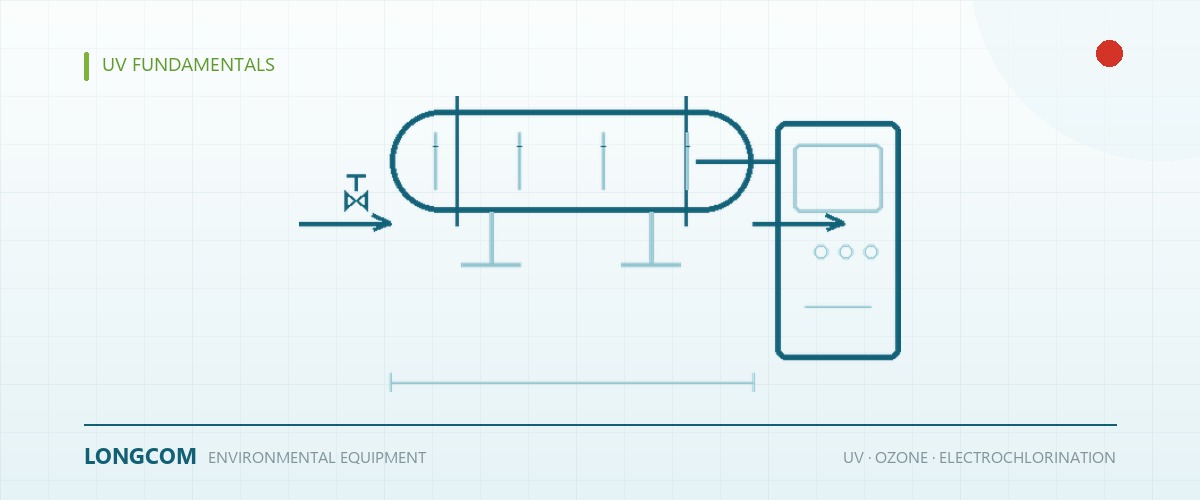
The two forms are in-line and open-channel systems. In an in-line sterilizer the lamp is enclosed, so the color of the light cannot be seen from outside. In an open-channel sterilizer the lamps are exposed, and the visible light seen is mostly blue and violet — not the UV itself, which is colorless. UV radiation is harmful to the human body, so suitable protection should be used during operation and maintenance and direct viewing of the lamps should be avoided.