

Ozone Generator System Design Precautions
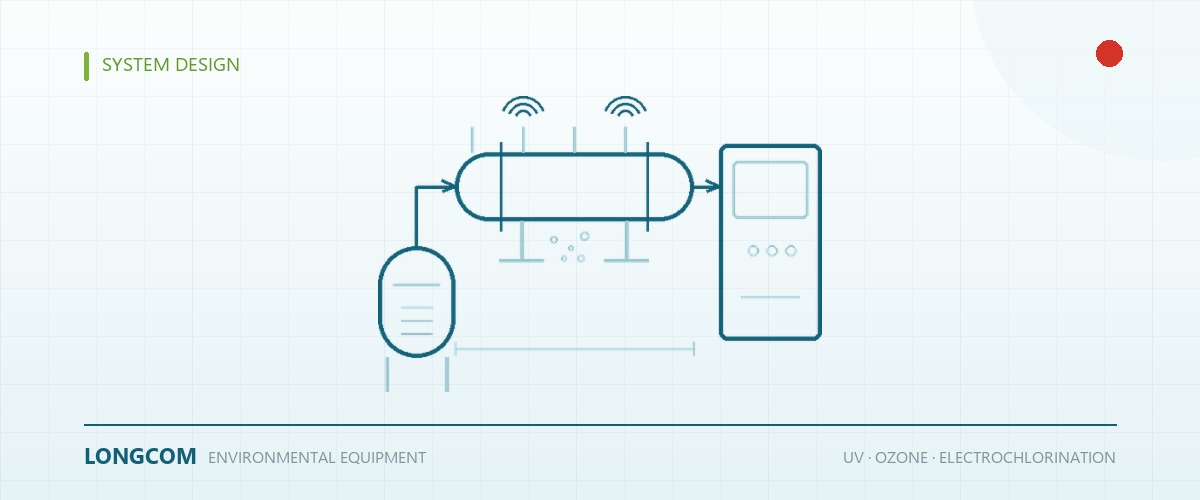
Many factors can affect the efficiency and reliability of an ozone generator in service. When designing an ozone application system, the following issues must be addressed.
1. Feed gas purity
The feed gas must on no account contain hydrocarbons, corrosive gases, or any other substance that can react in an oxygen/ozone/corona environment and endanger or damage the equipment. The three elements of an explosion are fuel, oxidizer and ignition source — and the corona environment of an ozone generator already contains two of them, the oxidizer and the ignition source. The feed gas must therefore be kept free of hydrocarbon fuels; if hydrocarbons may be present, a hydrocarbon analyzer must be installed to cut off the power when the hydrocarbon concentration approaches 25% of the lower explosive limit (LEL).
Fluorocarbons, such as PTFE or refrigerants, can decompose in the corona to form fluorine, which attacks glass dielectric materials and accelerates dielectric failure. The circulating coolant around the corona cell can leak through seals into the corona space, forming a varnish-like coating on the dielectric surface. When this happens, the coating reduces ozone production efficiency and the dielectric must be cleaned periodically. In addition, the feed gas should be filtered to remove particles of about 5 μm, preventing dust from drying agents or other fine particles from entering the corona zone and lowering corona efficiency.
2. Stable supply pressure
The supply gas pressure must not vary without control. Because gas pressure affects the induced corona power and the voltage applied across the dielectric, wide pressure swings make the generator unreliable. Exceeding the corona power range can blow fuses or trip the overload breaker, and exceeding the applied voltage peak can cause premature dielectric failure.
3. Prevent water ingress into the generator
The system design must prevent large amounts of water from entering the generator. A stuck float valve on the feed-gas compressor or a blocked condensate drain on the air dryer can flood the corona chamber. Heavy water ingress causes corona concentration, high current density and localized dielectric heating, leading to premature dielectric failure. Even if the monitoring device cuts the corona power before water enters the chamber, impurities carried by the water deposit on component surfaces and must be removed before operation resumes. Operating faults or errors can force treated water to flow back from the ozone contact tank into the generator, which at minimum contaminates the corona components or damages the dielectric. The system design and operating procedures must also keep flammable, corrosive gases and water vapor backflow from the ozone contact tank out of the generator.
4. Cooling water quality (water-cooled units)
For water-cooled generators, cooling water quality is critical to minimize scaling on heat-transfer surfaces. Scaling reduces heat-transfer efficiency, lowers ozone output and increases maintenance cost. Technically, tap water is the preferred coolant, but at the water consumption required by large industrial generators it is uneconomic — except perhaps when the system serves a water treatment plant. Treated wastewater, by contrast, works poorly as cooling water because it fouls easily. If high-quality water or another fluid is used in a sealed recirculating cooling circuit, and the final heat exchanger is specially designed for minimum fouling and easy cleaning, the wastewater effluent can still serve as the final heat sink. For a good balance between water cost and equipment maintenance, most designs use cooling-tower water or high-quality potable water from a heat exchanger (no suspended solids, chlorides <5 mg/L).
5. Cooling air quality (air-cooled units)
For air-cooled generators, the cooling air must be free of moisture, impurities, corrosive substances, aerosols, oil, conductive materials and visible dust. Under normal conditions — except in extremely dusty industrial atmospheres — the air rarely needs filtration.
Contact Longkang for sizing support and quotations.