

Drinking Water UV Sterilizer Standards
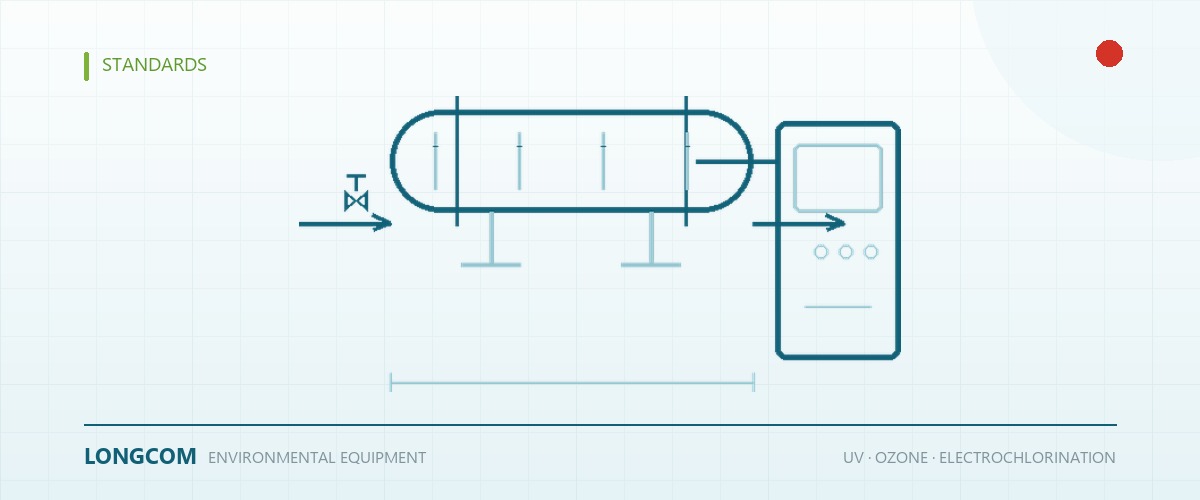
UV sterilizers for drinking water are commonly used, safe devices for killing bacteria, viruses, and other microorganisms in drinking water. They produce no secondary pollutants and effectively improve the hygiene and safety of drinking water. The technical requirements for drinking-water UV sterilizers are set out below.
1. Operating conditions
The sterilizer must be able to operate normally under the following conditions.
1.1 Influent water quality
| Parameter | Requirement |
|---|---|
| Turbidity | ≤5 degrees |
| Total iron content | ≤0.3 mg/L |
| Colority | ≤15 degrees |
| Water temperature | ≥5 °C |
| Total coliforms | ≤1000 per L |
| Total bacterial count | ≤2000 per mL |
1.2 Ambient air
| Parameter | Requirement |
|---|---|
| Ambient temperature | ≥5 °C |
| Maximum relative humidity of air | ≤90% (equivalent to air at 20 °C ±5 °C) |
1.3 Power supply
| Parameter | Requirement |
|---|---|
| Power frequency | 50 Hz ±2.5 Hz |
| Power voltage | 220 V ±22 V |
2. Basic technical requirements
- The design of the drinking-water UV sterilizer shall comply with GB 8988 (Safety Requirements for Mains-Powered Household and Similar General-Purpose Electronic and Related Equipment).
- The sterilizer shall be manufactured in accordance with drawings and technical documents approved under the technical management procedure.
- Components of the same sterilizer model shall be interchangeable.
- Surfaces exposed to UV irradiation shall be polished.
- The working pressure of the pressure-bearing chamber shall be no less than 0.60 MPa, and the test pressure no less than 0.90 MPa.
- A flow guide plate should be provided inside the chamber or tank.
- Straight-tube quartz low-pressure mercury UV lamps and their installation shall comply with YY/T 0160 (Straight-Tube Quartz Ultraviolet Low-Pressure Mercury Disinfection Lamps).
- Where the application has high environmental requirements, low-ozone lamps should be preferred to reduce ozone pollution.
- Lamps shall be arranged so that UV intensity is distributed evenly over the irradiated surface.
- The sterilizer shall have a lamp-on indicator, a cumulative operating-time indicator, or a relative UV irradiation-intensity indicator.
- Lamps shall be separated from water by quartz glass sleeves; the transmittance of the quartz sleeve at 253.7 nm shall be greater than 85%.
- Low-voltage electrical components used in the sterilizer shall meet the technical requirements of the corresponding products.
- The sterilizer shall be provided with inlet and outlet pipes, a drain pipe, and a sampling pipe. Where it is inconvenient to fit a drain pipe on the sterilizer, one may be installed on the connecting pipeline at the same location.
- Specifications and the diameters of inlet and outlet pipes should be selected in accordance with the relevant table.
- Under the inspection requirements of this standard, a sterilizer fitted with new lamps shall have a measured UV irradiation dose of no less than 12000 mW·s/cm (with water filled); a sterilizer in normal operation shall have a measured dose of no less than 9000 mW·s/cm.
- Under the service conditions of this standard and at the rated disinfection capacity, the bacteriological indices of the effluent shall comply with GB 5749 (Standards for Drinking Water Quality).
- Sterilizer materials shall comply with GB/T 17219 (Evaluation Criteria for Safety of Water Supply Equipment and Protective Materials for Drinking Water). The sterilizer should preferably use 304L or 316L stainless steel.
- The head loss of the sterilizer at the rated disinfection capacity shall be less than 0.005 MPa.
3. Appearance requirements
- The equipment surface shall be evenly coated with a consistent color, free from runs, blisters, missed paint, or peeling.
- The equipment shall look neat and tidy, with no obvious hammer marks or unevenness; instruments, switches, indicator lights, and nameplates on the panel shall be firmly and properly installed.
- Welds on the outer shell and frame shall be firm, with no obvious deformation or burn-through defects.
4. Standards and Longkang
These requirements are established in CJ/T 204-2000 (UV Sterilizers for Drinking Water), issued by the Ministry of Construction. Longkang’s drinking-water UV sterilizers are designed and manufactured in accordance with this standard and other relevant technical standards — safe, reliable, and of assured quality. Contact Longkang for sizing support and quotations.