

Inline UV Sterilizers: Principles and Specifications
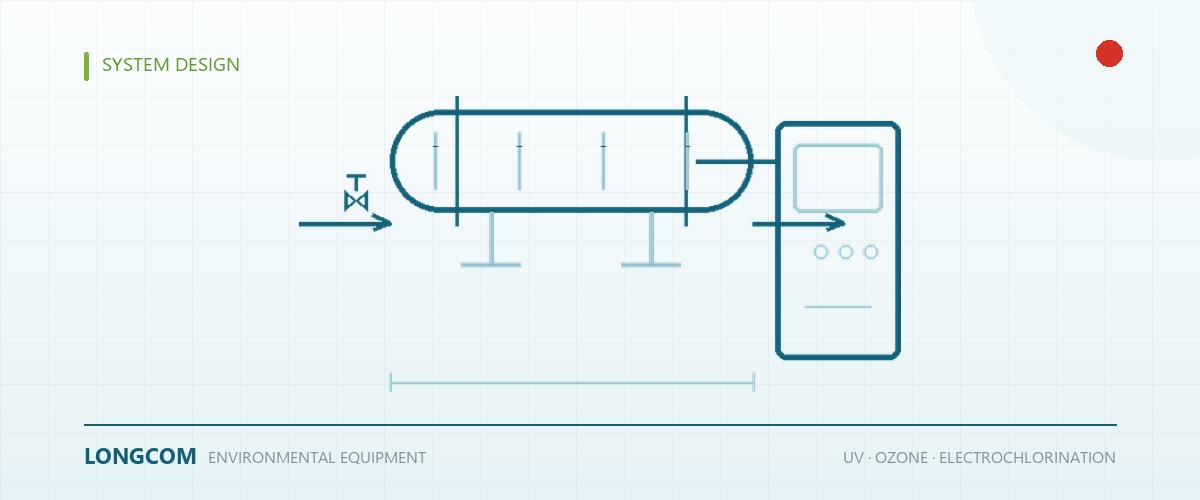
Inline UV sterilizers are used across food and beverage production, aquaculture, swimming pools, landscape water, chemicals, purified water, reclaimed water, wastewater, and effluent treatment. This article gives the LKUV C-series specifications and explains the working principle, features, applications, maintenance requirements, and installation steps.
1. Specifications
| No. | Model | Capacity (m³/h) | Total power (W) | Lamps (qty × W) | Chamber size (mm) | Available connection (DN) |
|---|---|---|---|---|---|---|
| 1 | LKUV C-10/120 | 10–12 | 120 | 1 × 120 | 1200 × 89 | 65 |
| 2 | LKUV C-20/240 | 20–24 | 240 | 2 × 120 | 1200 × 108 | 80 |
| 3 | LKUV C-30/360 | 35–36 | 360 | 3 × 120 | 1200 × 133 | 100 |
| 4 | LKUV C-40/480 | 45–48 | 480 | 4 × 120 | 1200 × 133 | 100 |
| 5 | LKUV C-50/600 | 55–60 | 600 | 5 × 120 | 1200 × 159 | 125 |
| 6 | LKUV C-70/720 | 70–72 | 720 | 6 × 120 | 1200 × 219 | 150 |
| 7 | LKUV C-80/840 | 80–84 | 840 | 7 × 120 | 1200 × 219 | 150 |
| 8 | LKUV C-90/960 | 95–96 | 960 | 8 × 120 | 1200 × 219 | 150 |
| 9 | LKUV C-100/1080 | 100–108 | 1080 | 9 × 120 | 1200 × 273 | 200 |
| 10 | LKUV C-120/1200 | 115–120 | 1200 | 10 × 120 | 1200 × 273 | 200 |
| 11 | LKUV C-130/1320 | 130–132 | 1320 | 11 × 120 | 1200 × 273 | 200 |
| 12 | LKUV C-140/1440 | 140–144 | 1440 | 12 × 120 | 1200 × 273 | 200 |
| 13 | LKUV C-150/1560 | 150–156 | 1560 | 13 × 120 | 1200 × 273 | 200 |
| 14 | LKUV C-160/1680 | 165–168 | 1680 | 14 × 120 | 1200 × 273 | 200 |
| 15 | LKUV C-170/1800 | 170–180 | 1800 | 15 × 120 | 1200 × 273 | 200 |
2. What is ultraviolet light?
Ultraviolet light is a form of electromagnetic radiation released when electrons in an atom drop from a higher to a lower energy level. The stronger the electromagnetic energy, the shorter the wavelength. Humans can see wavelengths from 400 nm to 780 nm (1 nm = 10−9 m): at 400 nm, light appears blue or violet, and at 780 nm it appears orange or red. UV refers to electromagnetic radiation with a wavelength shorter than 400 nm — outside the violet region of the visible spectrum, hence the name ultraviolet (UV). Generally, UV covers 100–400 nm and is invisible to the human eye. By wavelength it is divided into UVA (315–400 nm), UVB (280–315 nm), and UVC (200–280 nm). UVC is the band most readily absorbed by DNA, and UV disinfection systems use UVC.
3. Working principle
An inline UV sterilizer uses a specially designed, high-efficiency, high-intensity, long-life UV-C generator to produce strong UV-C light that irradiates flowing water. When bacteria and viruses in the water receive a certain dose of UV-C light (wavelength 253.7 nm), their DNA structure is destroyed. The organisms die immediately or are unable to reproduce, achieving sterilization. The equipment integrates optics, microbiology, mechanics, chemistry, electronics, and fluid dynamics: when bacteria, viruses, and algae in the water are exposed to UV-C light (253.7 nm), the DNA and RNA structure of their cells is damaged, cell regeneration becomes impossible, and the water is disinfected and purified.
4. Equipment features
- Lamp warranty of more than 9,000 hours, ensuring a long service life.
- High-transmittance, high-purity quartz sleeves giving UV transmission above 91% and reliable sterilization.
- Excellent stability and safety, high compatibility with the lamps, a low failure rate, a long service life, and improved overall reliability.
- Premium stainless-steel reactor (304 or 316) with specially polished inner walls to improve sterilization.
- Professional sandblasting treatment removes surface oxide scale while improving fatigue strength and corrosion resistance, giving a better appearance and longer service life.
5. Main application areas
- Purified water disinfection: tap water, secondary water supply, direct drinking water, purified water, aquaculture, food and aquatic product processing water, beverage production water, pharmaceutical water, and high-purity electronic water
- Wastewater disinfection: municipal wastewater, reclaimed water reuse, hospital wastewater, slaughterhouse effluent, and oilfield reinjection water
- Circulating water disinfection: swimming pool water, landscape water, and industrial circulating cooling water
- Shellfish purification, agricultural irrigation water disinfection, and algae removal in large water bodies
- Water disinfection for military bases, field operations, aircraft, ships, and submarines
6. Sterilization characteristics
- Broad-spectrum action against almost all microorganisms, bacteria, viruses, and algae. It effectively kills parasites that are highly harmful to humans — such as Cryptosporidium and Giardia — which ozone cannot kill or cannot kill effectively.
- Fast sterilization with a high inactivation rate: most microorganisms and bacteria are killed within seconds.
- Environmentally safe: purely physical sterilization with no secondary pollution and no side effects.
- Low operating and maintenance costs.
- Continuous disinfection at high flow rates.
- Compact structure and small footprint.
- Fast, simple installation and easy maintenance.
7. Maintenance precautions
- UV light must not shine directly on human skin.
- Ambient temperature and humidity affect performance: intensity is stable above 20 °C and increases with temperature between 5 and 20 °C. Bactericidal capacity is stronger below 60% relative humidity; at 70% humidity microbial sensitivity to UV decreases, and at 90% humidity bactericidal power falls by 30–40%.
- For water disinfection, the water layer should be less than 2 cm thick and must receive a dose above 90,000 µW·s/cm² as the water passes through.
- Dust and oil on the lamps and sleeves obstruct UV transmission, so wipe them regularly (normally every two weeks) with alcohol, acetone, or ammonia water.
- After startup, a lamp takes several minutes to warm up to a stable state and has a high terminal voltage. Switching it off and immediately on again often makes restarting difficult and can damage the lamp and shorten its life, so frequent starts should be avoided.
- UV has a powerful lethal effect on bacteria and can also harm the human body, most notably the cornea. Never look directly at a lit lamp; if viewing is unavoidable, use ordinary glass (wear glasses) or a transparent plastic sheet as a face shield. Never use quartz glass by mistake — ordinary glass is almost completely impermeable to UV. If injury occurs, there is no need to panic: facial burns heal by themselves after a few days as the skin peels. Eye injuries cause redness, tearing, and stinging and take about three to four days to heal. In any case, seek medical advice promptly.
8. Installation steps
- Take out all parts and check them carefully.
- Fit the sealing sleeve onto the open end of the quartz tube as shown.
- Insert the quartz tube into the stainless-steel housing, then fit the sealing ring onto the closed end of the tube.
- Screw the large perforated stainless-steel nut onto the open end of the quartz tube that carries the sealing sleeve.
- Slip a sealing ring onto the closed end of the quartz tube. If it is tight, lubricate with soapy water; do not force it, as the quartz tube is fragile and easily damaged.
- Screw the large stainless-steel nut onto the closed end of the quartz tube.
- Connect the lamp to the ballast. Check the orientation of the connector — it is rectangular, not square — and do not force the plug in, to avoid damage.
- Energize the ballast and check that the lamp lights. The indicator on the ballast is green when the lamp works; if the lamp or ballast is faulty, the lamp will not light and the indicator will be red. During later operation, the indicator color shows whether the lamp is working.
- Insert the tested lamp into the open end of the quartz tube — the end with the perforated stainless-steel nut.
- Fit the protective cover. Installation is complete and the unit is ready for use.
Contact Longkang for sizing support and quotations.