

Conventional UV Disinfection Equipment and Specifications
| Parameter | Specification |
|---|---|
| Treatment capacity | Modular; per bank based on channel width × water depth (100–5000 m³/d) |
| UV germicidal dose | ≥ 40 mJ/cm² (value per standard for wastewater) |
| Lamp type / quantity | High-output low-pressure mercury lamps; number of banks configured to suit capacity |
| Lamp arrangement | Horizontal / vertical modular frame |
| Frame / sleeve material | 304 stainless steel + quartz sleeves |
| Operating voltage / frequency | AC 220 V / 380 V, 50 Hz |
| Level / control | Level sensor + local control cabinet |
| Applicable water source | Wastewater treatment, reclaimed water reuse, landscape water bodies |
1. Overview
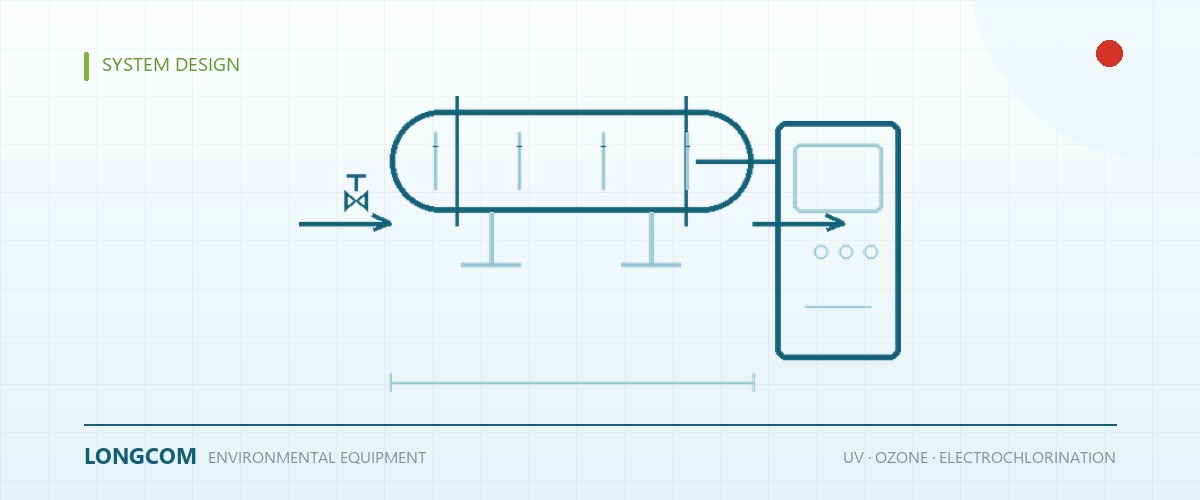
LK UV sterilizers use internationally advanced high-intensity, ozone-free UV germicidal lamps. The inner wall of the chamber is made of food-grade 304 stainless steel with special treatment, so that pretreated water flowing through the chamber receives an adequate UV dose and is disinfected effectively. Because the unit does not change the physical or chemical properties of water, it is an indispensable and ideal device for drinking water, food, beverages, chemicals, electronics, pharmaceuticals, wastewater and reclaimed water. UV at 253.7 nm is used specifically for germicidal treatment in all types of water, while UV at 185 nm is applied to special fields such as TOC degradation. The equipment is small, light, low in power consumption, long-lived and low in cost, with clear advantages over other germicidal methods, and is therefore widely used. It consists of UV lamps, quartz tubes, ballasts, seals, the tank, inlet and outlet, flanges, a drain valve and a control cabinet; some series also include timers, elapsed-time counters and remote-control systems.
2. Product advantages
- High germicidal efficiency: UV generally achieves a germicidal rate above 99.9% against bacteria and viruses in one to two seconds.
- Broad germicidal spectrum: UV kills almost all bacteria and viruses efficiently.
- No secondary pollution: no chemical agent is added, so the water and surrounding environment are not polluted a second time and no component of the water is changed.
- Safe and reliable operation: conventional disinfection technologies such as chlorination or ozone use disinfectants that are themselves highly toxic and flammable; a UV disinfection system has no such safety hazard.
- Low operating and maintenance cost: UV equipment occupies little space and needs simple structures, so the initial investment is small and running cost is also low; at a throughput of one thousand tonnes of water its cost is only one-third to one-tenth that of chlorine disinfection.
3. Equipment features
- High-output low-pressure UV lamps produce UV-C band light with high germicidal efficiency; lamp life is guaranteed at more than 8000–10000 hours.
- High-transmittance, high-purity quartz sleeves keep UV transmittance above 90%.
- World-advanced constant-output, high-intensity dedicated UV ballasts keep the whole system running under complex conditions; advanced soft-start function extends the life of both lamps and ballasts.
- The main body is made of food-grade 304 stainless steel, with the inner wall specially polished to improve the germicidal effect.
4. Application range
- Disinfection of drinking water for food, beverages, alcohol, edible oil, canned goods, cold drinks and similar products.
- Ultrapure water for the electronics industry, military camps and field water-supply systems.
- Germicidal treatment of purified water, pure water, ultrapure water, domestic water and softened water.
- Disinfection of water for hospitals, biochemical pharmaceuticals and laboratories, and of wastewater with a high pathogen content.
- Drinking water for residential buildings, communities, office buildings, hotels, restaurants and waterworks.
- Municipal wastewater treatment and final removal of bacteria.
- Purification and disinfection in aquaculture, shellfish and fish processing.
- Disinfection of swimming pools, landscape water and other recreational water.
- Disinfection of cooling water for thermal power and industrial production and for central air-conditioning systems.
- Seawater and freshwater breeding, aquaculture, and livestock and poultry water; total treated water can exceed 200000 tonnes per day.
- Agricultural and greenhouse water and drip-irrigation disinfection.
5. Technical parameters of conventional UV disinfection equipment
| Model | Capacity (t/h) | Chamber diameter (mm) | Flange center distance | Equipment length (mm) | Flange (DN), customizable |
|---|---|---|---|---|---|
| LK-UVC-40 | 1.5–3 | 76 | 630 | 950 | 50 and below |
| LK-UVC-75 | 1.5–6 | 76 | 630 | 950 | 50 and below |
| LK-UVC-120 | 4–12 | 76 | 920 | 1250 | 50 and below |
| LK-UVC-150 | 4–15 | 108 | 630 | 950 | 80 and below |
| LK-UVC-225 | 15–25 | 133 | 630 | 950 | 100 and below |
| LK-UVC-240 | 5–25 | 108 | 920 | 1250 | 80 and below |
| LK-UVC-300 | 20–30 | 159 | 630 | 950 | 125 and below |
| LK-UVC-360 | 15–35 | 133 | 920 | 1250 | 100 and below |
| LK-UVC-375 | 25–40 | 219 | 630 | 950 | 150 and below |
| LK-UVC-480 | 28–45 | 159 | 920 | 1520 | 125 and below |
| LK-UVC-600 | 35–60 | 219 | 920 | 1250 | 150 and below |
| LK-UVC-720 | 40–70 | 219 | 920 | 1250 | 150 and below |
| LK-UVC-960 | 50–95 | 273 | 920 | 1250 | 200 and below |
| LK-UVC-1200 | 70–120 | 273 | 1210 | 1250 | 200 and below |
| LK-UVC-1500 | 80–160 | 273 | 1210 | 1650 | 200 and below |
| LK-UVC-2100 | 100–250 | 300 | 1210 | 1650 | 250 and below |
| Further customization | Custom | Custom | Custom | Custom | Custom |
Note: the parameters above are for standard models. Changes arising from customization requirements will not be notified separately; the nameplate markings shall prevail.