

Introduction to UV Sterilizers
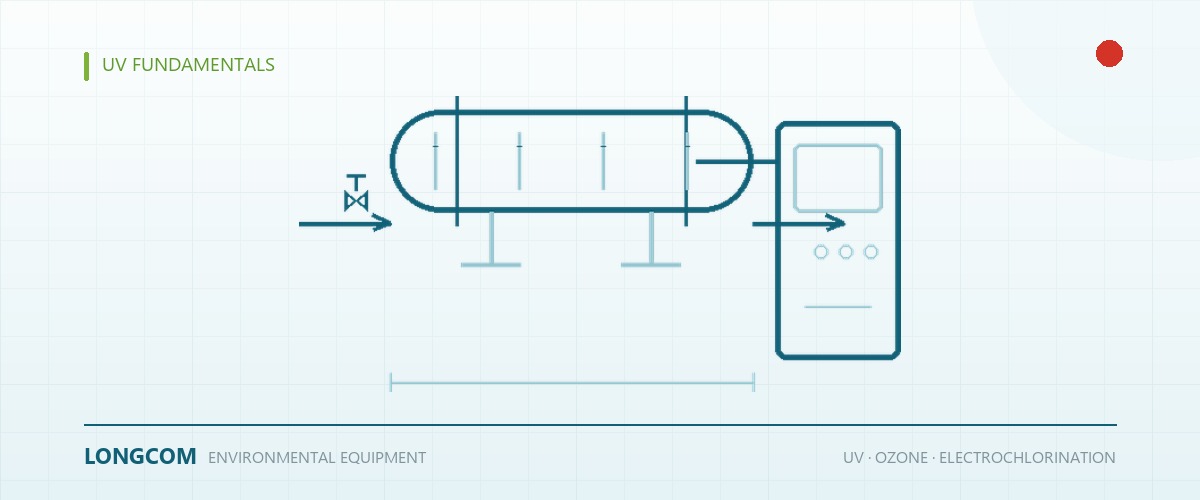
UV sterilizers offer significant performance advantages. Before UV disinfection technology appeared, daily water disinfection mostly relied on chlorine dioxide. Since the advent of UV sterilizers, UV has been widely adopted not only for water disinfection but also for air disinfection. UV disinfection technology first appeared in Europe, around 1906–1909, when a 200 m³/d water plant in Marseille, France, applied UV technology to drinking water treatment. UV technology then spread rapidly across Europe. In China, its first practical use was at the Daqing Dongfeng Water Plant, which had previously used chlorine dioxide for disinfection and switched to domestically produced UV disinfection in order to reduce operating costs.
Many people have questions about UV disinfection, so here is a brief introduction. UV disinfection technology may be unfamiliar to some, so let us explain simply what it is.
1. What is ultraviolet light?
Ultraviolet light is a wavelength invisible to the human eye. Some may wonder: if it cannot be seen, why call it “ultra-violet”? In fact, it is called ultraviolet because it lies just beyond the violet end of the visible spectrum. It is the general term for radiation in the electromagnetic spectrum with wavelengths of 10–400 nm. It was discovered as early as 1801 by the German physicist Ritter.
UV can be used for disinfection and sterilization, but excessive exposure of the human body to UV is harmful and may even carry a cancer risk.
Why then use UV that may pose a cancer risk to make UV sterilizers? During manufacture, the surfaces exposed to UV are strictly required to be polished, which prevents radiation leakage and protects people. Simply disconnect the power before replacing a lamp; there is no need to worry about a UV sterilizer radiating the human body.
UV disinfection uses the irradiation intensity of a UV lamp: the intensity emitted by a germicidal UV lamp is inversely proportional to the distance to the object being disinfected. At a given intensity, the longer the object remains exposed and the closer it is to the lamp, the better the germicidal effect, and vice versa. Such equipment can be applied in direct-drinking-water systems to achieve good purification.
2. Comparison with chemical disinfectants
There are many disinfection and sterilization methods, and many disinfectants on the market, but none is ideal — either costly or ineffective:
- Acid and alkali products such as nitric acid, sodium hydroxide, and quicklime are widely used in food processing, but only for pre-disinfection or sanitary cleaning of pipelines.
- Oxidizing disinfectants are efficient, safe, leave no residue, and are easy to use, but some individual products are unstable, decompose easily, are costly, and have an odor.
- Aldehydes such as formaldehyde, glutaraldehyde, and ethylene oxide are used mainly for disinfecting medical instrument surfaces and air, but cannot be used in the food sector.
- Alcohols are easy to use, safe, fast, and volatile, but costly.
For drinking water there are also many methods — boiling, UV irradiation, ozone injection, and others. At present, large-scale drinking water disinfection in China mostly uses liquid chlorine. Water disinfected with liquid chlorine may, however, develop an odor: chlorine chlorinates organic matter in the water, producing organochlorides such as CHCl3 that are potentially carcinogenic to human health. Chemical disinfection methods are generally either expensive or unsatisfactory in effect.
Compared with these chemical methods, UV disinfection technology has major advantages. It is a physical disinfection technology that adds no substance to the water; unlike other chemical methods, it does not require adding chemicals such as chlorine dioxide. UV disinfection therefore has no side effects.
Working with Longkang
Contact Longkang for sizing support and quotations.