

How UV Sterilizers Kill Microorganisms
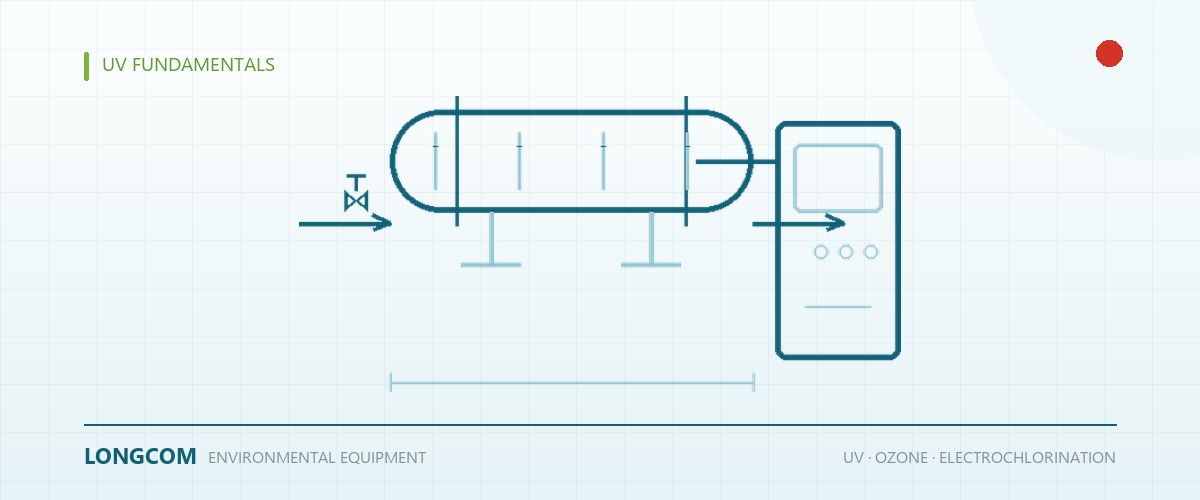
UV disinfection works by destroying the genetic material of bacterial nucleic acids so that the organisms can no longer reproduce. The most significant reaction is the conversion of pyrimidine bases within the nucleic acid molecule into dimers. In practice, low-pressure mercury discharge lamps (germicidal lamps) are used to deliver artificial UV energy at a wavelength of 253.7 nm. The principle of a UV germicidal lamp is the same as that of a fluorescent lamp, except that the inside of the tube is not coated with phosphor and the tube is made of quartz glass with high UV transmittance. UV devices are generally divided by application into irradiation, immersion and flow-through types.
In haemodialysis dilution-water systems, the UV lamp is installed in the line between the storage tank and the dialysis machine, so that all dialysis water receives one UV exposure before use, achieving thorough sterilisation. Microorganisms most sensitive to UV are Pseudomonas aeruginosa and E. coli; by contrast, Bacillus subtilis spores are more resistant. Because UV disinfection is safe, economical, lightly selective towards bacterial species and does not alter water quality, it is widely used — for example, drinking water on ships is often treated this way. It kills waterborne organisms such as Yigela, Basila and Salmonella, reaches the centre of the water for 360-degree sterilisation, and delivers three times the effect of a surface-mounted sterilisation lamp. It eliminates green algae in water with a marked effect and is easy to use. UV germicidal lamps are suitable for filtration in fish farms of all sizes, water treatment, pools and ponds of all sizes, swimming pools and hot springs. Sterilisation efficiency can reach 99%–99.99%.
UV water treatment technology — sterilisation
UV germicidal treatment mainly uses UV light at a wavelength of 254 nm. Even at a low irradiation dose, UV light at this wavelength can destroy the core of a cell’s life — its DNA — thereby preventing cell regeneration. Once the ability to reproduce is lost, the bacteria become harmless and sterilisation is achieved. As with all other UV application technologies, the size of such a system depends on UV intensity (the strength and power of the irradiator) and contact time (the length of time the water, liquid or air is exposed to UV).
UV water treatment technology — ozone elimination
In industrial production, ozone is often used to disinfect and purify water. However, because ozone has extremely strong oxidising power, residual ozone left in the water may affect the next process stage. Water treated with ozone must therefore have its residual ozone removed before entering the main process. UV light at 254 nm is highly effective at destroying residual ozone, decomposing it into oxygen. Although the required scale varies between systems, a typical ozone-elimination system generally requires about three times the UV dose of a conventional disinfection system.

UV water treatment technology — total organic carbon reduction
In many high-technology and laboratory installations, organic matter interferes with the production of high-purity water. There are many ways to remove organic matter from water, the most common being activated carbon and reverse osmosis. UV light at a shorter wavelength (185 nm) can also reduce total organic carbon effectively, because shorter-wavelength UV carries more energy and can break down organic compounds. The UV oxidation of organic matter is a very complex reaction process; the main principle of UV water treatment technology is to generate highly oxidising free hydroxyl radicals that oxidise organic matter into water and carbon dioxide. As with ozone-elimination systems, a UV system for degrading organic carbon uses a UV dose three to four times that of a conventional disinfection system.
UV water treatment technology — residual chlorine reduction
In municipal water treatment and supply systems, chlorination is very necessary. In industrial production, however, removing residual chlorine is often a necessary pre-treatment to avoid adverse effects on products. Basic methods for eliminating residual chlorine include activated-carbon beds and chemical treatment. The drawback of activated carbon is that it needs continual regeneration and often suffers from bacterial growth. UV light at both 185 nm and 254 nm has been shown to break the chemical bonds of residual chlorine and chloramines effectively. Although a large UV dose is required, UV water treatment has the advantage of adding no chemicals to the water, requiring no chemical storage, being easy to maintain, and providing sterilisation and organic-matter removal at the same time.
Features
- Pulsed UV sterilisation with a broad spectrum and strong energy, preventing photoreactivation of microorganisms.
- Full stainless-steel housing with a long service life.
- Lamps can be cleaned manually or by automatic mechanical cleaning.
- Fully automatic control system with intelligent operation.
Contact Longkang for sizing support and quotations.