

UV Disinfection in Municipal Wastewater Plants
Since GB 18918-2002 (Discharge Standard of Pollutants for Municipal Wastewater Treatment Plant) classified microbiological indicators as basic control parameters and required wastewater treatment plants to disinfect their effluent, common disinfection methods have included liquid chlorine, chlorine dioxide, ozone, sodium hypochlorite, and UV. Considering persistence, ease of transport and preparation, disinfection by-products, and cost, UV disinfection has been widely adopted in wastewater treatment plants.
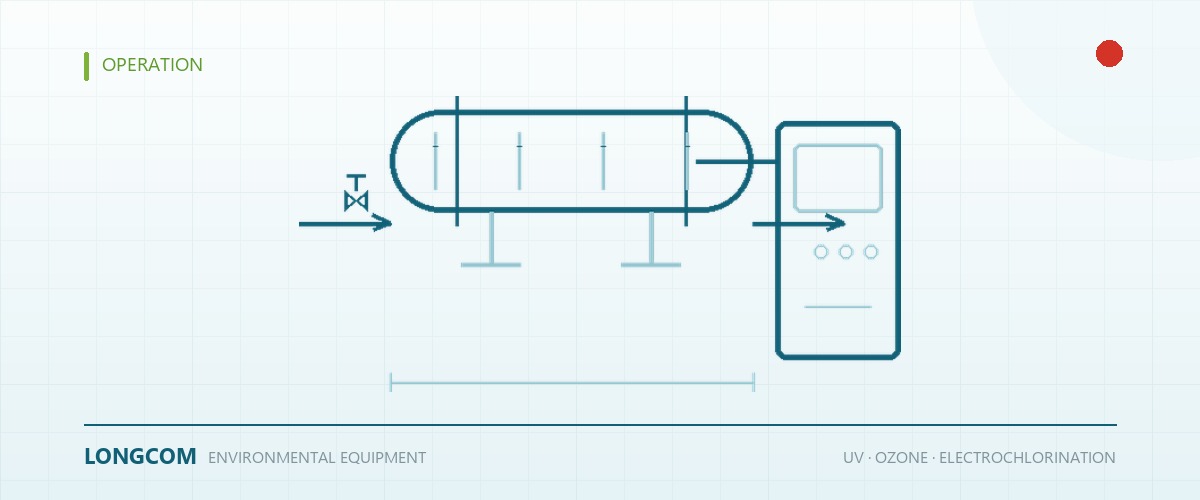
UV disinfection destroys the nucleic acids of cells or viruses. As pyrimidine dimers form, the photochemical products of nucleic-acid lesions inhibit gene replication and transcription, causing cells or viruses to lose their ability to reproduce. According to UV inactivation kinetics, in a well-mixed zone with a short optical path, UV disinfection follows first-order reaction kinetics. A UV system usually consists of UV lamps, quartz sleeves, support structures, ballasts that provide stable power, and the power supply. Structurally, systems are divided into closed-pipe types and open-channel types; more than 95% of installations are open-channel UV systems.
Researchers analyzed wastewater treatment plants in a southern Chinese city to understand the application of UV sterilizers and the problems encountered, and proposed corresponding improvements. The main issues are low disinfection efficiency, no residual disinfecting capacity after treatment, and unstable test results.
1. Low UV disinfection efficiency
1.1 Intensify cleaning and replace lamps
Perform mechanical and chemical cleaning every 1–3 weeks and manual cleaning every 2–3 months, depending on site conditions. Promptly replace lamps that are damaged or beyond their service life.
1.2 Control suspended solids concentration
Reduce suspended solids during pre-treatment and strictly keep the concentration in the inlet channel below the effluent quality standard.
1.3 Lamp installation requirements
Do not install UV lamps immediately downstream of a pump discharge pipe, so that water hammer on pump shutdown does not damage the quartz sleeves and lamps. Lamps, connecting pipes, and valves must be firmly fixed and must not bear the weight of piping and fittings. Installation should allow easy removal for inspection and maintenance, and no material that affects water quality hygiene may be used at pipe connections.
1.4 Control inorganic ions and humic acid
Control the concentration of inorganic ions, keeping iron salts below 0.057 mg/L, and keep humic acid below 50 mg/L.
2. No residual disinfecting capacity
2.1 Select an appropriate UV dose and contact time
The UV dose range is 30–45 mJ/cm². Design dose and disinfection time should be considered together: a longer contact time increases reactor volume and capital cost, while too short a time tends to cause short-circuiting at the walls and lower inactivation rates.
2.2 Chill samples and test promptly
After sampling, place samples immediately in an insulated bag with a coolant and store at around 4 °C. Testing should begin within 12 hours, with the interval from sampling to testing and the storage conditions recorded.
2.3 Discharge in the dark
Discharge under light-shielded conditions to control photoreactivation of microorganisms.
3. Unstable test results
3.1 Use third-party verification
Referenced to GB/T 32091-2015 (Terminology of UV Disinfection Technology) and the Test Method for UV Dose of UV Water Disinfection Equipment, standardize biological validation methods and introduce third-party verification.
3.2 Conduct standardized testing promptly
Testing personnel should collect instantaneous effluent samples every 2 hours. Before sampling, sterilize the container by dry heat at 160 °C for 2 hours; do not rinse the container with the sample. Use the average of 24 hourly instantaneous samples as the result for evaluating that day’s effluent quality.
3.3 Investigate testing problems
When results differ significantly, first check whether equipment performance meets requirements and whether the lamps, ballasts, cleaning system, and power output are operating normally, and whether suspended solids, flow rate, and UV transmittance are within the design range. Check that sampling is performed correctly, using a sterile depth sampler at the middle of the channel and mid-depth of the water. Finally, verify that the test method is complete.
3.4 Establish a results database
Set up a database to identify and correct anomalous data.
These are the common problems and solutions for UV disinfection in municipal wastewater treatment plants. Overall, using UV sterilizers for disinfection is an efficient and low-cost approach. Contact Longkang for sizing support and quotations.