

How to Clean a Tank Self-Cleaning Sterilizer
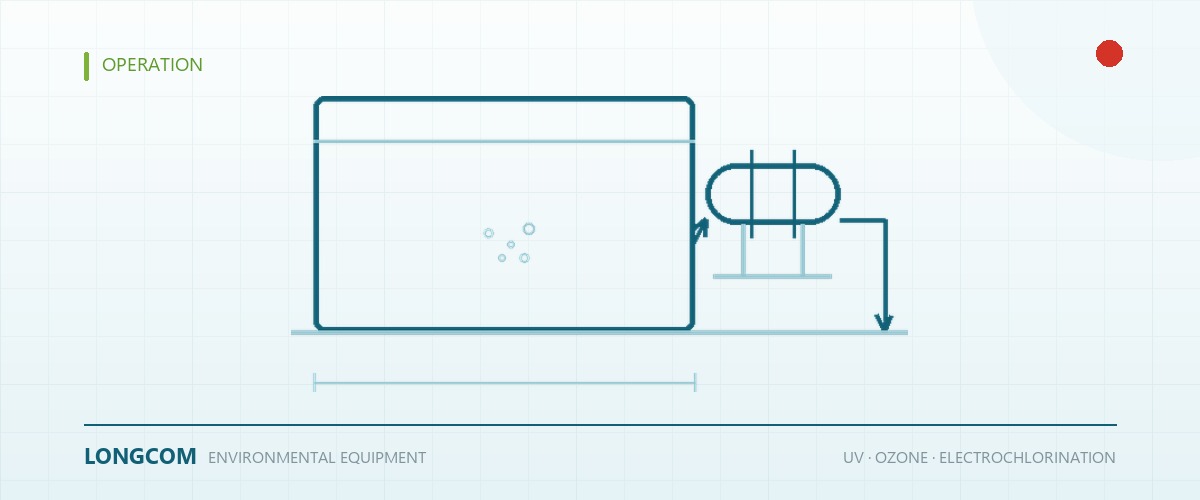
Cleaning a tank self-cleaning sterilizer is half about the equipment and half about the tank. Cleaning only the unit but not the tank is like putting a water purifier into a dirty vat; cleaning only the tank but not the unit leaves the aeration head blocked, so ozone cannot enter and water quality keeps deteriorating again.
How often to clean
On the equipment side, the interval depends on water quality: for municipal tap water, inspect quarterly and clean every six months; for groundwater or hard water, scaling is faster and the cycle shortens to 2–3 months. For the tank itself, GB 17051-2025 (Hygienic Standard for Secondary Water Supply Facilities) requires cleaning and disinfection at least once a year. This is the minimum requirement, not a recommended value.
How to disassemble and clean the unit
First cut the power, close the inlet valve and hang a warning tag. For built-in auxiliary units located inside the tank, entry is through the manhole: ventilate and test the oxygen content before work, and never enter alone. Remove the aeration head, check whether the air holes are blocked by scale or biofilm, backflush with clean water, then soak in diluted citric acid for 20 minutes and brush gently with a soft brush.
For micro-electrolysis types, white scale on the electrode plates is treated the same way with citric acid; do not scrape with a blade, because once the coating is damaged the chlorine-generating capacity drops. The ozone generating unit generally does not need dismantling; simply check whether the inlet air is damp and whether there are tracking marks on the high-voltage cable.
How to clean the tank itself
Draining, ventilation and sludge removal are three steps that cannot be skipped. First remove the settled silt and rust scale at the bottom manually, then high-pressure wash the inner walls, focusing on welds, corners and the back of the ladder. Disinfect by spraying or soaking with a chlorine-based solution at 200–300 mg/L available chlorine, leave it to act for half an hour, then rinse thoroughly until no residual chlorine can be detected.
Incomplete rinsing is a common mistake. Residual chlorine makes the measured residual chlorine after water restoration falsely high — the test data look good, but the actual water quality has not been verified. The correct procedure is to refill and soak after rinsing, then take samples to test the total bacterial count and total coliforms.
Reset and verification
Refit the aeration head, noting its position: 150–200 mm above the tank floor, away from the inlet and outlet, and not facing the float valve. If the return pipe slope is insufficient, add an air vent at the same time. After switching on, run one cycle manually first — listen to the pump, check the return flow and smell for any abnormal odor — then switch back to automatic.
Keep a cleaning record: date, operator, disinfectant concentration, contact time and retest results. If a problem occurs next time, this record is the starting point for investigation. Most complaints that “cleaning did not help” can be traced in the records — either the concentration was insufficient, rinsing was inadequate, or the tank was not cleaned at all and only the equipment was wiped.
How to prepare the disinfectant solution
Take a 50 m³ tank as an example: at a target concentration of 250 mg/L, 12.5 kg of available chlorine is needed. Using a 10% sodium hypochlorite solution, about 125 kg is required, roughly 110 L (density taken as 1.1). This sounds like a large amount, but it is calculated for the whole tank; if spraying is used instead of soaking, the amount can be reduced to one third.
When preparing the solution, add water first and then the chemical, not the other way round. Pouring the concentrate directly into a small amount of water creates an excessive local concentration and corrodes the tank wall coating. Operators should wear goggles and gloves, keep the site ventilated, and open at least two manholes at the same time.
Commonly overlooked points
First, the breather filter element. If this part is not replaced for a year, it leaves the tank with an undefended opening, and the tank becomes dirty again soon after cleaning. Second, the overflow pipe insect screen: once damaged, mosquitoes and crawling insects can enter. Third, the manhole sealing ring: when it ages and hardens, the cover no longer seals tightly and rainwater seeps in. These three items cost less than CNY 100 in total, yet they are often overlooked.
Fourth, the cleaning window. Schedule it during a period of low water use, notify residents in advance to store water, and after water is restored flush the pipes before drinking to discharge the residual disinfectant. Some property managers, having failed to notify residents, received a string of complaints the next day about “odd-tasting water,” when in fact it was only elevated residual chlorine.
When to call a professional team
Where the tank capacity exceeds 100 m³, the work is confined-space entry, or a cleaning and disinfection certificate is required for health supervision, a qualified team is recommended. Self-cleaning is not impossible, but the issues are ventilation, supervision and records — if any one of these three is missing, an incident becomes a serious one.
Season also matters. In summer, water temperature is higher and biofilm grows faster, so the cleaning interval should be shorter than in winter. In northern regions, winter cleaning must prevent freezing: drain the pipelines promptly after work and do not leave standing water in the aeration head.
Contact Longkang for a cleaning worksheet sized to the tank volume, or for disinfectant quantity calculations.
Keep the logbook at the door of the plant room where anyone entering can consult it; this is more useful than files locked in an office.
A follow-up visit the day after cleaning — checking odor and water color — saves far more trouble than waiting for a complaint before returning.
If the tank has not been thoroughly cleaned for more than three years, recheck the water quality one month after the first cleaning. After sediment is disturbed, indices often rebound, and this is not a problem with the sterilizer.