

The Principles of UV Sterilization and Disinfection
Ultraviolet light was discovered in 1801, when the German physicist Johann Ritter identified an invisible form of light just beyond the violet end of the visible spectrum. It could expose photographic plates containing silver chloride, make platinum cyanide compounds glow green, turn acidic quinine sulfate solutions blue, and make many substances fluoresce. These observations showed that beyond the violet region of the spectrum there exists a kind of light invisible to the naked eye, which later became known as ultraviolet light.
A UV sensor responds only to ultraviolet light in the narrow range of 185–260 nm and is insensitive to light in other parts of the spectrum, which makes it suitable for detecting UV radiation in flames. It is a sealed glass tube that transmits ultraviolet light and is filled with a special gas. Inside the tube is a pair of electrodes connected to metal leads — an anode and a photocathode. The photocathode is made of a metal sensitive only to ultraviolet light and emits photoelectrons when irradiated with UV.
UV disinfection and sterilization has a wide range of uses: in hospitals, schools, nurseries, cinemas, buses, offices and households it can purify air, remove musty odors and disinfect water, and it also generates a certain amount of negative oxygen ions, so rooms disinfected with UV feel especially fresh. In public places, UV disinfection can prevent some pathogens from spreading through the air or via object surfaces.
1. The principle of UV sterilization and disinfection
UV sterilization works by using ultraviolet light of an appropriate wavelength to destroy the molecular structure of DNA (deoxyribonucleic acid) or RNA (ribonucleic acid) in microbial cells, causing the death of growing cells and/or regenerative cells and thereby achieving disinfection. Tests show that the effective bactericidal wavelength range of UV can be divided into four bands:
| Band | Wavelength range | Bactericidal characteristics |
|---|---|---|
| UVA | 400–315 nm | Outside the microbial absorption peak; very slow, taking hours to be effective |
| UVB | 315–280 nm | Outside the microbial absorption peak; very slow, taking hours to be effective |
| UVC | 280–200 nm | Within the microbial absorption peak; destroys DNA structure and kills viruses and bacteria within 1 second |
| Vacuum UV | 200–100 nm | Extremely weak penetration; not used for disinfection |
Only the UVA and UVB portions can pass through the ozone layer and clouds and reach the Earth’s surface. In terms of germicidal speed, UVC lies within the microbial absorption peak range and can destroy the DNA structure of viruses and bacteria within 1 second, whereas UVA and UVB, being outside the absorption peak range, act very slowly and often take hours to have a bactericidal effect; within the few seconds of hydraulic residence (irradiation) time in actual engineering, this portion is effectively inactive UV. Vacuum UV has extremely weak penetrating power and requires lamps and sleeves made of quartz with very high transmittance; it is generally used to degrade TOC in water in the semiconductor industry, not for sterilization. Therefore, what is called UV disinfection in water supply and drainage engineering actually means UVC disinfection. UV disinfection technology, based on modern epidemiology, medicine and photodynamics, uses specially designed high-efficiency, high-intensity, long-life UVC lamps to irradiate flowing water and directly kill bacteria, viruses, parasites, algae and other pathogens in the water, achieving the purpose of disinfection.
2. Water and public health
Water is one of the essential conditions for life. Water makes up about 65% of human body weight, and under normal conditions each person needs to take in about 2–3 liters per day. Water is also a medium for the transmission of many diseases: cholera, typhoid, dysentery, leptospirosis and infectious hepatitis can all spread through water. Water is also easily polluted by industrial wastewater, domestic sewage and human and animal waste, leading to the deterioration of source water quality.
3. Structure of a UV disinfection unit
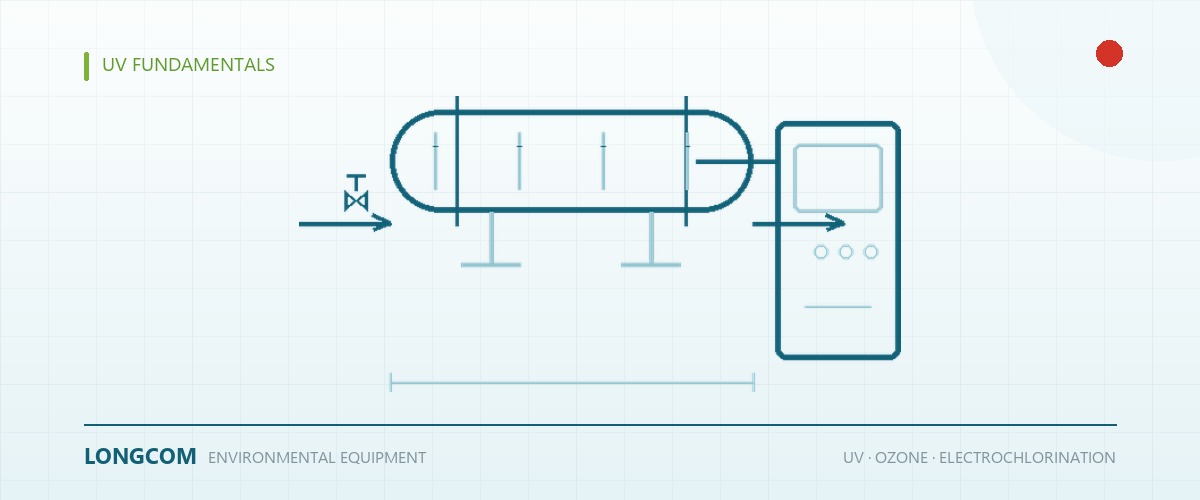
A UV disinfection unit typically consists of a UVC lamp (UV-C lamp), a quartz protective sleeve, an inlet, an outlet, protective caps and a stainless steel housing. Most units are installed horizontally, with the inlet and outlet on one side of the stainless steel housing. Horizontal installation of the UVC lamp has the following drawbacks: first, horizontal installation limits the scope of application of the UV disinfection unit; second, the positions of the inlet and outlet in existing units result in uneven irradiation of the water inside the quartz tube, so sterilization by the UVC lamp is incomplete; third, existing UV disinfection units of the same power are relatively bulky, difficult to apply to small water treatment equipment, and unable to meet the requirements of special situations — such as wartime water contamination, remote islands, earthquake relief and rescue operations — where mobile water treatment equipment is needed to produce drinking water quickly.
Two UV sensors suitable for drinking water dispenser disinfection, imported from Korea by a leading domestic online sensor marketplace, are the UV sensor GUVC-T10GD-L and the UV sensor GUVC-T10GD. Both are large-area sensing products with a main detection band around 254 nm and a sensing chip area of 1.536 mm2. The output of a UV sensor depends mainly on its responsivity, sensing area and light intensity, so large-area products can detect weak UV radiation. They are mainly used for UVC lamp monitoring, germicidal lamp monitoring and UV disinfection applications.
4. Features of drinking water UV sterilizers
- Compared with other disinfection methods: fast disinfection, no change to the physical and chemical properties of the water, no added odor or taste, no harmful halogenated methane compounds, and no side effects; simple to operate, easy to manage, safe and reliable.
- Elapsed-time counter: after 10,000 hours of operation the UV intensity of the lamp can be measured; if the irradiance is still sufficient the lamp can continue in use, saving cost and making full use of materials.
- Optional timer control: automatic on/off programs can be set as required, and a flow-sensor control device can also be added.
5. Installation notes for drinking water UV sterilizers
- Choose an installation position so that the pipework through which the disinfected water flows is not excessively long.
- The drinking water UV sterilizer should be installed horizontally.
- When choosing the installation position, leave an operating clearance of ≥1.2 m and ≥0.6 m extending outward from the two ends of the unit for lamp replacement or maintenance.
- To monitor and control the disinfection water flow, a flow meter can be installed at the same time.
- If a very large disinfection flow is required, several drinking water UV sterilizers can be installed in parallel.
- For ease of maintenance, install a bypass pipe together with the unit.
- In the room where the unit is installed, the relative humidity of the air should not exceed 89%, with no corrosive gases, no conductive dust, and no strong vibration or shock.
UV disinfection is a chemical-free way to safeguard drinking water quality. Contact Longkang for sizing support and quotations.