

Can a UV Sterilizer Treat Stormwater and Wastewater?
Reports estimate that in around 772 communities wastewater and stormwater discharge into the same treatment system, making them vulnerable to combined sewer overflows. These are a major source of water pollution. At the same time, as communities grow, the number of impervious surfaces — pavements, streets, parking lots and roofs — increases, adding to the volume of runoff entering stormwater systems. Chemical disinfection may not be a viable option: residual chlorine from chlorination can be prohibited in receiving waters as growing concerns about health and safety drive the use of less hazardous alternative disinfectants. A UV sterilizer can in fact treat stormwater and wastewater. It is an environmentally friendly, chemical-free solution: no metering pumps or chemical storage are needed, and no hazardous by-products are formed by adding chemicals.
1. UV disinfection as an alternative to chlorine conversion
Municipal wastewater has traditionally been disinfected with chlorine. Recognising the environmental cost of chemical disinfection and its long-term public-health implications, the U.S. Environmental Protection Agency has introduced regulations on residual chlorine limits and disinfection by-products. When chlorine is added to wastewater, it alters organic matter by forming disinfection by-products. The EPA identifies dibromodiphenyl ether and other potential health hazards as requiring regulation. UV disinfection does not produce these by-products, and unlike chlorine it does not depend on water temperature or pH.
UV disinfection also removes the need to generate, handle, transport or store toxic, hazardous or corrosive chemicals, and requires less space than other methods. In addition, UV leaves no residual effects harmful to humans or aquatic life and is safer for plant operators.
2. The clear advantages of enclosed-vessel UV disinfection
The earliest UV systems were open-channel UV sterilizers using lamp racks immersed in open channels. These open gravity channels have many drawbacks: poor hydraulic mixing, a very large footprint, high cost, difficult maintenance and susceptibility to flow fluctuations.
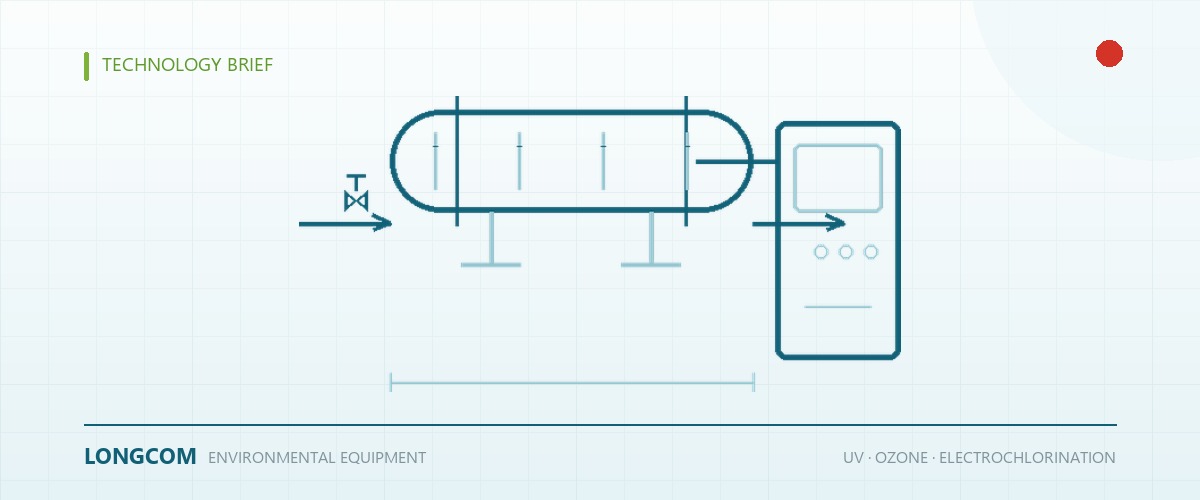
Enclosed-vessel UV systems are easy to install in existing pipelines and require no large concrete channels for new structures. Disinfection in a closed pipe ensures optimised hydraulics and prevents operators from being exposed to wastewater and UV light.
3. Product design and continuous improvement
We believe good design should make a product safe, understandable, innovative and useful. Through ongoing service relationships we examine wear throughout the product life cycle and rely on feedback from field service technicians for product improvements. We also use a range of design tools to simulate system performance, resulting in many innovative features that become sources of advantage.
4. Advanced software tools for simulation
Finite element analysis is used to understand the stresses a UV chamber experiences under hydraulic load.
Computational fluid dynamics is used to predict weak points in the design.
5. Performance and design advantages
- Energy saving: variable power delivers a precise dose.
- Superior design: the chamber is designed with simulation models to minimise head loss.
- Quality materials: the chamber is made from materials able to withstand the powerful effects of the UV process without generating harmful carcinogenic by-products.
- Flexible design: the compact chamber can be installed vertically or horizontally, and the system can serve as a retrofit solution or in new structures.
- Automatic wipers: the wiper keeps the optical path free from fouling on the lamps.
6. Maintenance and operational advantages
- Quick replacement: the wiper ring can be replaced without removing the wiper carriage from the chamber.
- Small maintenance footprint: single-sided access for lamp replacement.
- Safety: plug-and-play connections, lamps with twist-lock plugs that automatically centre the lamp, and UV and electrical isolation through waterproof connections.
Contact Longkang for selection support and quotations.