

UV Sterilizer Installation Tips and Servicing
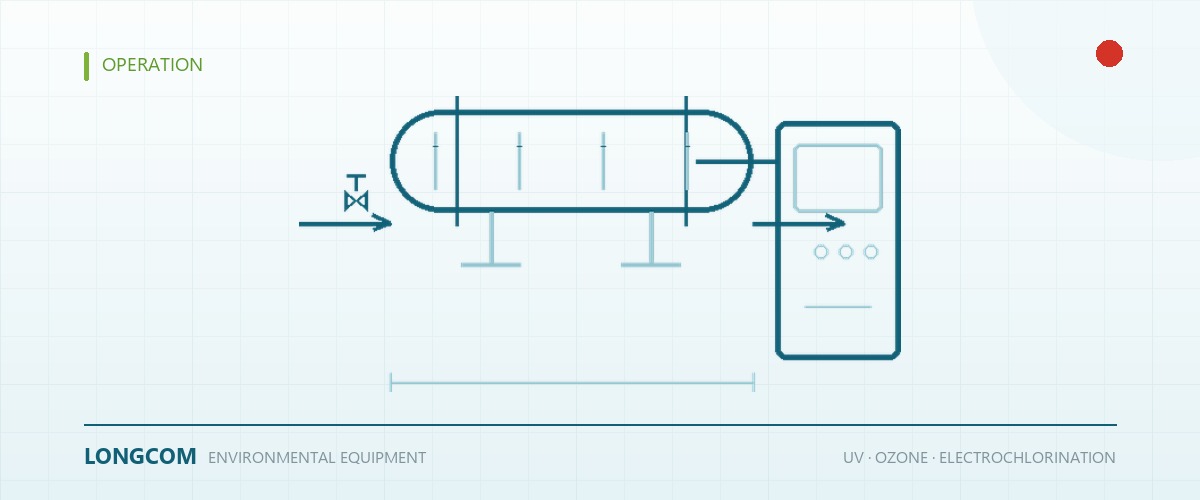
You will notice that a UV sterilizer always sits after the pump and the filter. The pump obviously needs to move the water first. The filter should come first for two reasons: first, a filter removes particles that would otherwise impede effective UVC radiation; second, having the filter first allows the necessary nitrifying bacteria colonies to establish in the filter. Below are some installation tips for frame-type UV sterilizers.
1. Installation tips
1.1 Placement relative to the filter
As just noted, a UV sterilizer works best placed after the filter.
1.2 Chiller connections
If an in-line chiller is used, the UV sterilizer is best placed on a separate plumbing loop; if that is not possible, the UV should come before the chiller.
The reason: if the chiller runs with its thermostat probe inside the aquarium, it cools the water in its own internal loop below the temperature of the aquarium itself until the temperature drops. This is a problem because UV sterilizers run more effectively at higher temperatures, and the water inside a running chiller can be much cooler than the aquarium water.
1.3 Outdoor (pond) installations
For pond use, keep any UV sterilizer as sheltered as possible from weather and from contact with external water or snow. Based on experience with more than 1,000 installations, even UV units designed for pond use fail prematurely when poorly sited.
1.4 Consider your aquarium temperature
Before adding a UV, know your aquarium temperature. Although a UV sterilizer does not control the tank temperature, it does add some heat to the water.
A good way to think about it: treat a 15 W UV sterilizer as a 15 W space heater running continuously. Is that a problem for a 100-gallon aquarium or pond? No. For about 10 gallons, it can be.
1.5 Use quick disconnects
Not essential to the sterilizer’s function, but quick disconnects often make life much easier when servicing any in-line UV unit — whether it is connected via a canister filter, a pump, or other filter/pump equipment.
Also, based on considerable experience plumbing aquariums, be wary of most disconnects sold by pump, filter, or aquarium supply makers: although simple, they are usually lightweight and more prone to leaking than the more durable PVC compression-fitting disconnects, which use more reliable tightening methods and better O-rings.
2. Maintenance of the UV sterilizer
Maintaining a UV sterilizer is quite straightforward: keep the outside of the unit dry, and for pond use try to protect it from harsh weather. Most quality sterilizers tolerate outdoor conditions, but if allowed to sit in water, water will seep in and damage the electrical parts.
2.1 UV lamp replacement
Check your UV lamp monthly if possible. More importantly, replace the lamp every 6 months for aquariums, and every 6 months for ponds in warm climates without freezing weather.
In cool climates a pond UV lamp can be changed once per season (usually late spring/early summer), but when your pond UV lamp approaches a year old it only emits about 25% of the correct UVC energy — so changing a one-year-old pond UV bulb in September yields little benefit, because by then it has been highly inefficient during the months you needed it most (the warm/hot summer months).
Use long-life high-output UV lamps/lights, and do not restart your UV unnecessarily: every restart cycle consumes lamp life. Beyond causing poor UV disinfection on a daily timer, restarting every day can reduce your UV lamp’s life by 50–75%.
This is due to the inrush voltage needed to excite a high-output UV lamp.
2.2 Lamp replacement warnings!
- Beware of medium-pressure UV lamps, which emit only about 7–10% true UVC wavelengths, rather than the roughly 3.5 times more important UVC output (about 35% UVC) of the better low-pressure UV lamps. Medium-pressure lamps were originally designed for “nail curing”, where lower output is actually wanted, but many are now sold for aquariums/ponds because they cost far less — very common with discount, Amazon, and eBay sellers. Buying these lamps makes the UV sterilizer far less efficient (sometimes no better than a clarifier), so a USD 10 saving can turn your UV sterilizer into little more than a “pretty blue light” filter.
- Beware of so-called “long-life” UV replacement lamps — a marketing tactic. The truth is that while they may “burn” longer, they are also lower-output UV-C lamps, defeating the purpose of use.
Contact Longkang for sizing support and quotations.