

Why Open-Channel UV Systems Use Enclosed Vessels
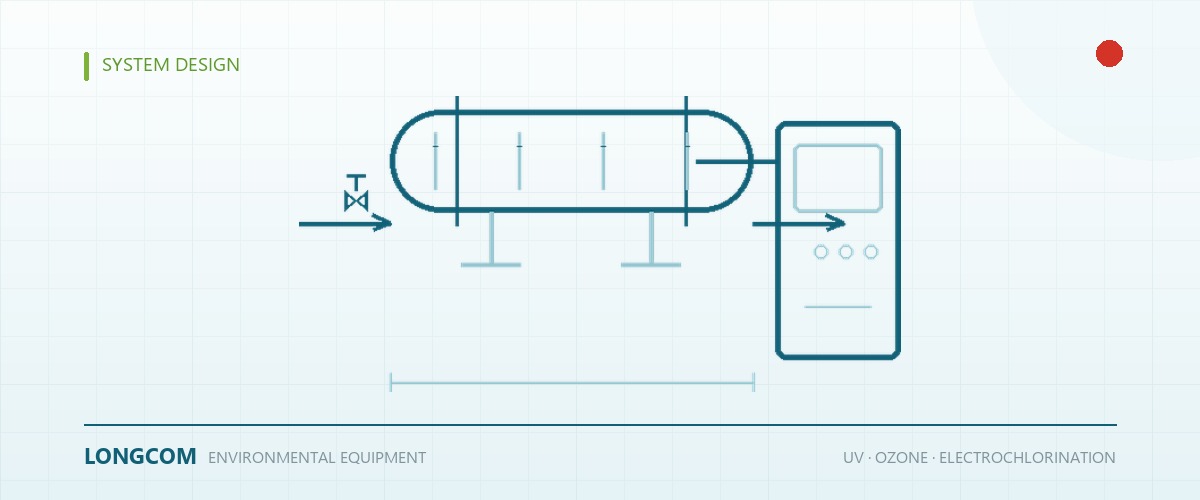
UV sterilizers are now standard equipment in most wastewater disinfection systems. Drinking water utilities have also adopted UV as a barrier against chlorine-resistant species such as Cryptosporidium and Giardia. The technology is widely favoured for its non-chemical nature, the absence of any subsequent dechlorination step, and the non-selective nature of its disinfection performance. Many experienced engineers routinely include UV water treatment in their processes; however, they overlook the progress made in recent years in understanding the effect of hydraulics on UV system performance, and continue to place UV lamps in open channels. In fact, containing the waste stream in a pipe and disinfecting the fluid in a closed vessel is a more effective approach.
1. How UV disinfection works and why validation matters
UV causes permanent damage to the DNA of nearly all biological species. Once DNA is damaged or dimerised, an organism can no longer carry out normal cellular functions such as respiration, food assimilation and replication; the cell loses activity and the organism dies rapidly. With the advent of bioassay validation of UV systems, differences in efficiency between systems from different UV sterilizer manufacturers are small. Bioassay involves introducing a non-pathogenic organism (a biological dosimeter) into the fluid stream ahead of the UV system. The whole process takes place under controlled conditions, with every system variable — flow, transmittance, power load and lamp intensity — carefully recorded as samples are collected before and after the UV system. When sample data return from the analytical laboratory, actual system disinfection capability can be compared with the manufacturer’s claims. Such bioassays can of course also be conducted under the auspices of a credible third party. As bioassay validation becomes standard, water engineers have begun to appreciate how hydraulic design plays an important and often overlooked role in system performance. In essence, if a UV system design allows short-circuiting or poor turbulence, water receives varying UV doses. In extreme cases water short-circuits straight through the system, resulting in very low efficiency. Most UV systems need to handle a range of flow rates, so operating flow ranges are usually considered in design.
2. Typical problems with open-channel systems
a. Reduced retention time for adequate UV dose delivery — the situation is worse if the channel is designed for average dry-weather flow rather than peak wet-weather flow, in which case head loss affects upstream processes and can damage channel walls.
b. Poor hydraulic performance leading to unstable or reduced inactivation — density currents can form, causing incoming wastewater to flow along the top or bottom of the lamp array, resulting in short-circuiting and poor disinfection. Inappropriate inlet and outlet conditions are common; these create eddies that produce uneven velocity distributions and short-circuiting.
c. Spaces or dead zones form within the channel, causing short-circuiting.
d. Baffles introduce new problems — submerged perforated diffusers with open areas of less than 20% of the channel cross-section are not uncommon, creating potential head-loss and overflow problems. Angle plates are sometimes required to direct flow back towards the lamps in a rectangular channel.
e. Level control is critical but fragile — channel water level must be carefully controlled, often by a sliding gate mechanism, which is prone to clogging. Counterweighted gate systems need frequent hinge lubrication and often struggle to meet tight height tolerances.
f. Construction risk and overall cost — open-channel systems require precise alignment of channel floors and walls. This is labour-intensive, expensive and slow. Open channels are usually covered, so gratings and substantial safety railings are also needed.
g. Safety — UV can burn exposed skin within seconds, causing erythema (sunburn). Internal eye burns, sometimes called arc eye or welder’s flash, are extremely painful, and prolonged exposure can lead to retinopathy, cataracts and yellowing of the lens.
h. Cold-weather maintenance — design engineers often overlook that although the waste stream will not freeze, the air above it can be far below freezing. In colder climates, UV racks removed for maintenance freeze in the cold air, making maintenance time-consuming and uncomfortable for operators.
i. Large open water surfaces — these attract flies and mosquitoes, and increased humidity corrodes electrical components; operators also commonly drop tools into the water. Sunlight promotes algae growth and stimulates an enzyme that repairs UV-induced DNA damage, a phenomenon known in the industry as photoreactivation.
Contact Longkang for selection support and quotations.