

Chlorine vs UV Disinfection: Key Differences
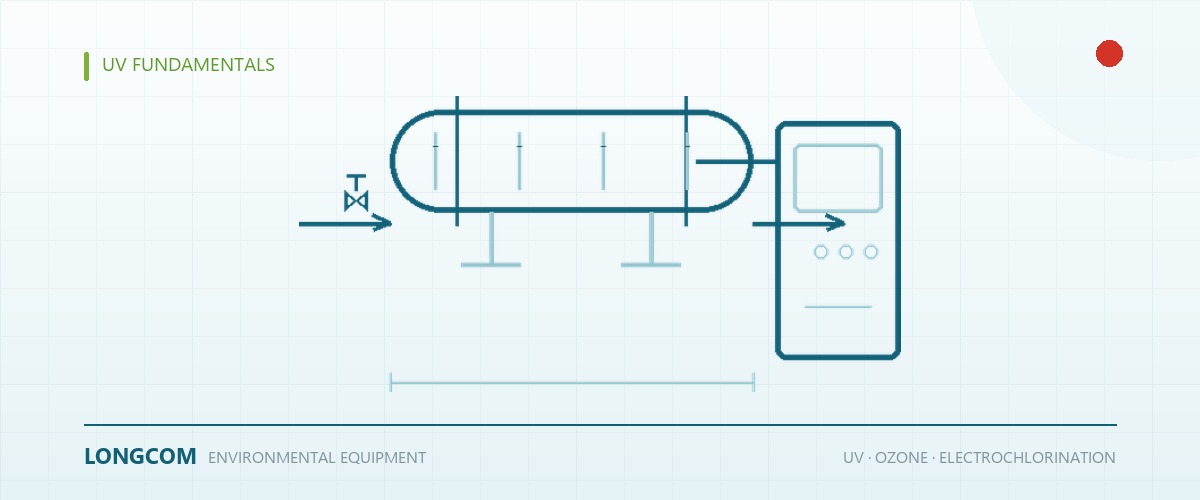
Chlorine and ultraviolet light are the two mainstream disinfection methods for water systems, but they differ fundamentally in performance and limitations. This article compares chlorine disinfection with UV disinfection, first outlining the features of the medium-pressure UV sterilizer.
1. Features of the medium-pressure UV sterilizer
- Quartz sleeves: each UV lamp is protected by a quartz sleeve, whose quality largely determines the disinfection result. High-quality sleeves ensure a UV transmittance above 90%.
- UV lamps: advanced medium-pressure UV technology eliminates bacteria at the root while reducing the number of lamps. Only one lamp per 1–1.5 years needs replacing (as indicated by the LCD prompt on the control cabinet), greatly cutting routine operating cost, and a lamp change takes only 5 minutes.
- Automatic cleaning: over time, water quality and UV exposure cause crystals to form on the quartz sleeve surface; once thick enough they reduce UV penetration, so sleeves need regular cleaning. Based on the UV intensity monitor reading, the sleeves are cleaned automatically — the system keeps running, with no water shutdown and no manual work, greatly reducing the workload of site staff.
- UV intensity monitor: responds only to the germicidal wavelengths and can be linked to a computer or PLC, saving energy by adjusting system output.
2. Overview of conventional chlorination
Water supply systems must strictly control certain parameters, especially microorganisms and bacteria, to guarantee the safety of the water. On 1 July 2007 the Ministry of Health and the Standardization Administration of China revised the former drinking water standard (GB 5749–85) and jointly issued the new mandatory national standard GB 5749 (Standards for Drinking Water Quality). The new standard tightened requirements on microbiology, organic matter, and disinfection: microbiological indicators grew from two to six, with explicit limits for Cryptosporidium and Giardia — the “two parasites” that cause abdominal pain and intestinal illness and are hard to eliminate with conventional disinfection. This underlines the importance of the disinfection stage for drinking water safety.
Under the standard, thermotolerant coliforms, total coliforms, and E. coli must not be detectable in drinking water; total bacterial counts must be strictly limited to 100 CFU/mL, and Giardia and Cryptosporidium to fewer than 1 organism per 10 L of water.
Most hotels, enterprises, and office buildings use municipal water as the raw supply, and to date most Chinese waterworks still use chlorination alone. Chlorination has instabilities and limitations:
- It is difficult to control all microorganisms; chlorination has no significant removal effect on the “two parasites”.
- Waterworks must keep chlorine residual ≥0.3 mg/L at the plant outlet and ≥0.05 mg/L at the pipe network ends to sustain disinfection and protect against secondary contamination, but surveys show an overall compliance rate below 85% for secondary supply and below 82% for chlorine residual (some system ends show no detectable residual at all).
- Secondary supply water is re-pumped and stored, so it is exposed to further contamination and deteriorates (chlorine evaporation and insufficient residual create conditions for microbial growth).
- Because of secondary supply design and falling chlorine residual, disinfection effectiveness is hard to guarantee; management is imperfect, with 70% of secondary supply systems not cleaned and disinfected on schedule.
UV disinfection closes this gap: as a physical method it inactivates chlorine-resistant organisms such as Giardia and Cryptosporidium without chemicals. Contact Longkang for sizing support and quotations.