

How to Use a UV Sterilizer in an Aquarium
This article gives basic answers to common questions about using UV sterilizers in aquariums, based on extensive experience using and even designing true UV sterilizers as well as the UV clarifiers often sold as sterilizers. Below are the most common UV sterilizer questions and answers.
1. What is a UV sterilizer?
A UV sterilizer is a germicidal filtration device that filters water with UV-C light, clarifies the water, lowers disease pathogens, removes oxidizers from the water, and improves the redox balance in an aquarium or pond.
2. What can a TRUE level-1 or level-2 sterilizer do for my tank or pond?
A correctly installed, well-designed TRUE level-1 or level-2 UV sterilizer kills most suspended bacteria and many viruses in the water column, without affecting the bacterial colonies in the filter media and substrate.
A UV sterilizer/clarifier also clears green/cloudy water in an aquarium or pond.
A QUALITY UV-C sterilizer further improves the redox balance in the aquarium or pond by lowering oxidizers and therefore oxidative stress in the water column, which in turn improves the fish’s ability to resist disease.
UV sterilizers help control parasites such as Ich or Cryptocaryon by improving immune function and disease resistance (through redox). At very low flow rates (below 8–12 gph per watt), a UV sterilizer can more directly help kill parasites in the water column.
Unfortunately, many UV sterilizers fail to improve the redox balance adequately by lowering oxidizers in the water column, which can harm fish.
This is due to poor unit design, insufficient 254 nm UVC exposure inside the unit, incorrect dwell time, and medium-pressure lamps that produce poor UVC — which most low-cost UV units now use to keep prices down. Unfortunately this applies to many low-cost, imported models sold by discounters, which in turn give true UV sterilizers a bad name.
3. How does a UV sterilizer work?
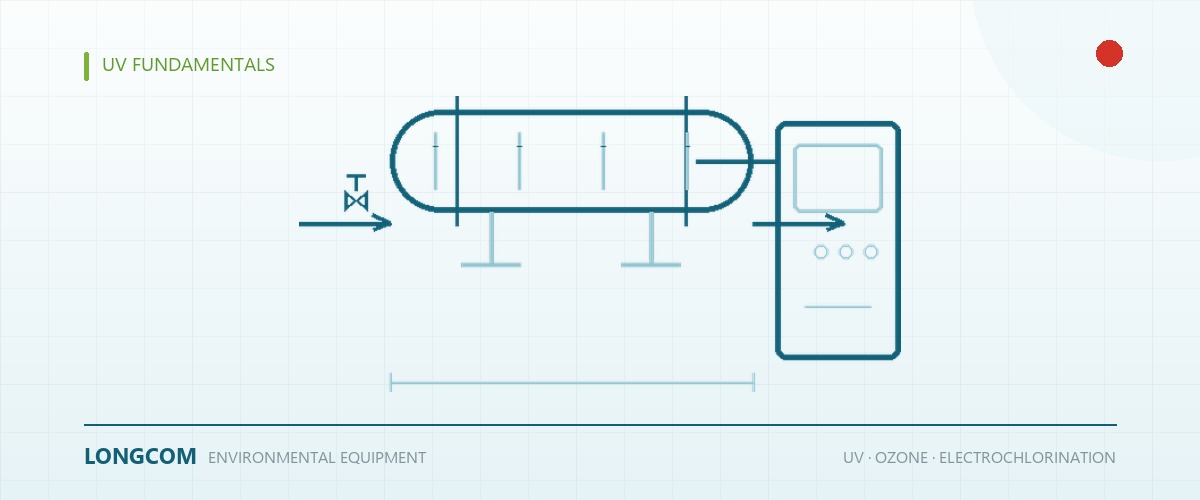
A pump pushes water through the UV sterilizer at a specific flow rate; the water contacts the UV-C-producing light directly or indirectly through a quartz sleeve. The UV then disinfects the water by altering the DNA of organisms as well as “clumping algae” in the water, before returning it to your tank or pond.
4. How should I determine my flow rate?
Your flow rate depends on the level of disinfection you want from the tank. The slower the water passes the UV lamp, the more UVC is produced per unit of water and the longer the UV-C contacts the water. The slower the speed, the more disinfection you can achieve. This is closely tied to turnover rate.
5. What is turnover rate?
Your turnover rate is the rate at which all the aquarium water is filtered in one hour. For UV sterilization you want at least 1½ turnovers per hour. So with a 10-gallon tank you need a turnover rate of at least 15 GPH. Assuming the other criteria are met, this achieves level-1 sterilization when combined with the correct flow rate.
6. What other criteria determine UV sterilizer or clarifier effectiveness?
Flow rate is the important factor, along with turnover rate, which is easy to measure.
Even so, while flow rate may be important, the next most important factor is not turnover but water turbidity, including pre-filtration.
High water turbidity from poor or no pre-filtration can halve the flow rate needed for rated performance. Put another way, a UV sterilizer/clarifier rated for a 100-gallon aquarium (or pond) may only be effective on a 50-gallon one!
The problem is that water turbidity is not easy to measure, so it is usually not included in the ratings.
The way to ensure pre-filtered water is to run the UV sterilizer after a good filter, including a simple pump pre-filter.
However, most UV units sold today through discount websites and stores include little in the way of pre-filtration. Combined with poor design — such as the gap between the UV lamp/quartz sleeve and the housing wall — the result is a UV sterilizer effective at as little as 1/4 or less of the rated flow rate!
Other factors include:
- Water temperature between 20 °C (68 °F) and 40 °C (104 °F)
- A gap of 3 cm or less between the lamp or quartz sleeve and the unit wall
- Reasonable dwell time, since most low-cost filter-equipped and submersible UVs have poor dwell time
- Good circulation patterns in the aquarium or pond
- A clean quartz sleeve/lamp
7. Are UV sterilizers hard to maintain?
If the aquarist has a general understanding of the sterilizer and has gotten past the initial installation, it should become very easy to maintain. Apart from changing the UV lamp every 6 months (and possibly cleaning the quartz sleeve), no real maintenance is needed.
If installed correctly, a UV sterilizer will clear your aquarium/pond within hours/days and needs no extra attention from the keeper.
8. Will a UV sterilizer kill my good bacteria?
The simple answer is no — but this must be qualified, because it applies to a healthy, cycled aquarium.
When a biological load or other factors cause a “bacterial bloom” in the aquarium water, even the “good” aerobic bacteria found in the biological filter become a problem, causing a white or gray “cloud”. A UV sterilizer kills these bacteria while they are free-floating in the water column.
In a healthy, established aquarium, however, aerobic nitrifying bacteria should be found in the biological filter, the substrate, the live rock, etc. — not in the water column. So a UV sterilizer cannot remove these beneficial bacteria.
9. Can a UV sterilizer be used in a tank with live rock?
As with the question above, the simple answer is yes.
However, if you are curing “dead” rock — such as freshly imported live rock — or using sterile/quarried calcium-based rock, switch off your UV for a few weeks.
Once your aquarium and live rock are established, the nitrifying and denitrifying bacteria will be — and should be — not in the water column but only in your live rock. So UV sterilization is safe, and in fact should be run around the clock rather than switched off for a few hours when using live products such as live plankton or infusoria.
Contact Longkang for sizing support and quotations.