

UV Disinfection Replacing Conventional Chemical Disinfection
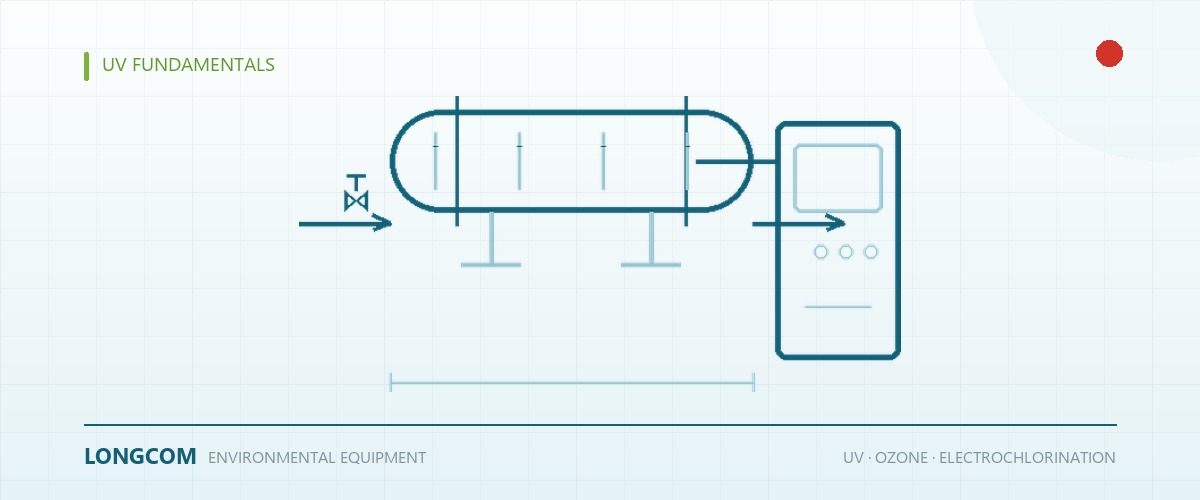
In wastewater treatment, disinfection is an essential step. UV disinfection has developed into a mature and reliable technology, widely used in many fields abroad, and has become a mainstream alternative to conventional chemical disinfection. Because it is a physical process, using UV disinfection equipment and UV germicidal units in wastewater treatment offers advantages such as broad-spectrum germicidal action and no secondary pollution.
1. Origins of UV disinfection technology
From the 1960s onward, UV disinfection began to be applied to municipal wastewater treatment. At the time, it was already recognized that residual chlorine from chlorination was toxic to fish and other aquatic life, and that chemical disinfection methods such as chlorination generate carcinogenic, mutagenic and teratogenic by-products including trihalomethanes. Practice showed that UV disinfection does not produce disinfection by-products in municipal wastewater treatment. After the turn of the 21st century, UV disinfection was expected to see wider adoption; domestically, it was estimated that 50% of wastewater treatment plants with suitable conditions would adopt UV disinfection in the future.
2. How UV disinfection works
UV disinfection used in water supply and drainage engineering refers to UVC disinfection. In principle, based on modern epidemiology, medicine and photodynamics, the technology uses specially designed, high-efficiency, high-intensity and long-life UVC-band ultraviolet light to irradiate flowing water, directly killing bacteria, parasites, viruses, algae and other pathogens in the water to achieve disinfection. UV disinfection is a physical method that requires adding no substances to the water and has no side effects, which is where it outperforms chlorination. It is often combined with other agents; common combined processes include UV+H2O2 and UV+H2O2+O3, which can deliver better disinfection results.
3. Applications in water supply and drainage
After years of research and practice, UV-centered disinfection technology has become a preferred option for advanced drinking water purification thanks to its good treatment performance. Applying UV disinfection to the effluent of secondary municipal wastewater treatment can meet the requirements for landscape and greening water. UV-disinfected wastewater can be effectively reused for irrigating farmland, woodland and lawns, avoiding damage to plants caused by chemical disinfectants; for groundwater recharge, it prevents formation blockages caused by microorganisms adapting to chemical disinfectants and regrowing. UV disinfection is set to become the mainstream technology replacing conventional chemical disinfection.
4. Disinfection and photochemical functions
Disinfection: through direct irradiation, ultraviolet light (mainly UVC) destroys the DNA and RNA in the cell tissue of bacteria, viruses, microorganisms, parasites and other pathogens, preventing cells from reproducing and thus providing a powerful germicidal effect.
Photochemistry: oxygen in the air undergoes photolysis under UV irradiation, generating ozone, an effective oxidizing agent that can kill bacteria and viruses in water or air. Water molecules, ozone, oxygen and hydrogen peroxide in water undergo complex photochemical reactions under UV radiation, forming hydroxyl radicals with an oxidizing capacity stronger than that of ozone and chlorine, which can thoroughly degrade organic pollutants and microbial contamination in the water.
5. Advantages of UV sterilizers
5.1 Broad-spectrum germicidal action
Among all current disinfection technologies, UV offers the greatest germicidal breadth. It can efficiently kill almost all bacteria and viruses, as well as parasites that pose great harm to humans but cannot be effectively killed by chlorine, such as Cryptosporidium and Giardia.
5.2 No secondary pollution
Because UV technology can be controlled to perform sterilization only and no chemical agents are added, it causes no secondary pollution to the water body or the surrounding environment.
It does not alter any component of the water. With chlorination, the organochlorine compounds formed with organic matter in the water are widely recognized as carcinogenic to humans, and chlorine compounds in water can in some cases act adversely, harming aquatic life and the water environment.
5.3 Safe and reliable operation
Conventional disinfection technologies using chlorides involve disinfectants that are themselves highly toxic, flammable and explosive substances. Their use poses potential threats to on-site personnel, the surrounding environment and residents, requiring great care. Health, fire safety and environmental authorities impose strict rules on the transport, storage and handling of such hazardous substances. These requirements greatly increase the psychological burden and sense of insecurity among managers, operators and nearby residents at user facilities. Modern UV disinfection systems have no such safety hazards and are a far safer and more reliable disinfection technology for both the surrounding environment and operating personnel.
5.4 Simple operation and low cost
Usually an efficient technology comes with high capital and operating costs, but UV is an exception. Thanks to refinements in core UV technology during the 1990s, UV disinfection not only achieves the highest disinfection efficiency of all methods, but also has the simplest operation and maintenance and the lowest running cost, reaching as low as 0.004 RMB per ton of water at a 1,000-ton treatment scale. It therefore offers the best cost-performance ratio among all disinfection technologies. It combines the high efficiency of other disinfection technologies with low capital and operating costs. At a 1,000-ton treatment scale, its cost is only half that of chlorination and two-fifths of chlorination followed by dechlorination; even at a 100,000-ton scale, the investment and operating costs of UV equipment remain far below those of other disinfection technologies.
Contact Longkang for selection support and quotations.