

Drinking Water UV Disinfection Technology and CJ/T 204
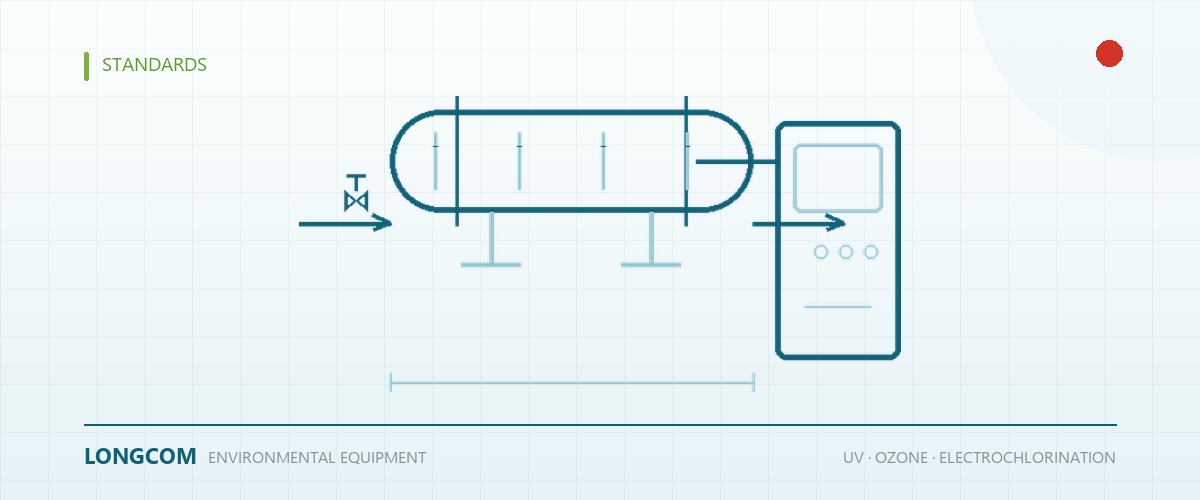
Reference standard: CJ/T 204-2000, UV Sterilizers for Drinking Water. A drinking-water UV sterilizer is a device that uses a UV mercury lamp as its light source: the 253.7 nm ultraviolet radiation emitted by the discharge of mercury vapor inside the lamp is the main spectral line used to disinfect drinking water. It is referred to below simply as the sterilizer.
1. Operating conditions
The sterilizer shall be capable of normal operation under the following conditions.
1.1 Influent water quality
| Parameter | Requirement |
|---|---|
| Turbidity | ≤5 degrees |
| Total iron content | ≤0.3 mg/L |
| Colority | ≤15 degrees |
| Water temperature | ≥5 °C |
| Total coliforms | ≤1000 per L |
| Total bacterial count | ≤2000 per mL |
1.2 Ambient air
| Parameter | Requirement |
|---|---|
| Ambient temperature | ≥5 °C |
| Maximum relative humidity of air | ≤90% (equivalent to air at 20 °C ±5 °C) |
1.3 Power supply
| Parameter | Requirement |
|---|---|
| Power frequency | 50 Hz ±2.5 Hz |
| Power voltage | 220 V ±22 V |
2. Technical requirements
- The design shall comply with GB 8988 (Safety Requirements for Mains-Powered Household and Similar General-Purpose Electronic and Related Equipment).
- The sterilizer shall be manufactured in accordance with drawings and technical documents approved under the technical management procedure.
- Components of the same model shall be interchangeable.
- Surfaces of the stainless-steel chamber exposed to UV irradiation shall be polished.
- The working pressure of the pressure-bearing chamber shall be no less than 0.60 MPa, and the test pressure no less than 0.90 MPa.
- A flow guide plate should be provided inside the chamber or tank.
- Straight-tube quartz low-pressure mercury UV lamps and their installation shall comply with YY/T 0160 (Straight-Tube Quartz Ultraviolet Low-Pressure Mercury Disinfection Lamps).
- Where the application has high environmental requirements, low-ozone lamps should be preferred to reduce ozone pollution.
- Lamps shall be arranged so that UV intensity is distributed evenly over the irradiated surface.
- The sterilizer shall have a lamp-on indicator, a cumulative operating-time indicator, or a relative UV irradiation-intensity indicator.
- Lamps shall be separated from water by quartz glass sleeves; the transmittance of the quartz sleeve at 253.7 nm shall be greater than 85%.
- Low-voltage electrical components shall meet the technical requirements of the corresponding products.
- The sterilizer shall be provided with inlet and outlet pipes, a drain pipe, and a sampling pipe. Where it is inconvenient to fit a drain pipe on the sterilizer, one may be installed on the connecting pipeline at the same location as the disinfection system.
- Specifications and the diameters of inlet and outlet pipes should be selected in accordance with the relevant table.
- Under the inspection requirements of this standard, a sterilizer fitted with new lamps shall have a measured UV irradiation dose of no less than 12000 mW·s/cm (with water filled); a sterilizer in normal operation shall have a measured dose of no less than 9000 mW·s/cm.
- Under the service conditions of this standard and at the rated disinfection capacity, the bacteriological indices of the effluent shall comply with GB 5749 (Standards for Drinking Water Quality).
- Materials shall comply with GB/T 17219 (Evaluation Criteria for Safety of Water Supply Equipment and Protective Materials for Drinking Water); 304L or 316L stainless steel should preferably be used.
- The head loss at the rated disinfection capacity shall be less than 0.005 MPa.
3. Appearance requirements
- The equipment surface shall be evenly coated with a consistent color, free from runs, blisters, missed paint, or peeling.
- The equipment shall look neat and tidy, with no obvious hammer marks or unevenness; instruments, switches, indicator lights, and nameplates on the panel shall be firmly and properly installed.
- Welds on the outer shell and frame shall be firm, with no obvious deformation or burn-through defects.
4. Construction and installation points
- Avoid installing the UV generator immediately next to a pump outlet pipe; water hammer when the pump stops can damage the quartz glass sleeve and the lamps.
- Install the unit strictly in accordance with the indicated inlet and outlet directions.
- Provide a foundation raised above the building floor, by no less than 100 mm.
- Securely fix the disinfection equipment together with its connecting pipes and valves; the UV system must not bear the weight of the piping and fittings.
- Install the unit so that dismantling, inspection, and maintenance are convenient, and use no material at pipe connections that would impair water quality hygiene.
5. Applicable standards
5.1 Product standards
- QB/T 1172-1999 — UV Disinfection Systems
- GB/T 19837-2005 — UV Disinfection Equipment for Urban Water Supply and Drainage
- CJ/T 204-2000 — UV Sterilizers for Drinking Water
5.2 Engineering standards
- GB 50015-2003 — Code for Design of Building Water Supply and Drainage
- GB 50014-2006 — Code for Design of Outdoor Wastewater Engineering
- GB 18918-2002 — Discharge Standard of Pollutants for Municipal Wastewater Treatment Plants
- GB/T 18920-2002 — Reuse of Urban Recycling Water: Water Quality Standard for Urban Miscellaneous Water Consumption
- GB 50335-2002 — Code for Design of Wastewater Reclamation Engineering, with Explanatory Notes
- GB 50242-2002 — Code for Acceptance of Construction Quality of Building Water Supply, Drainage and Heating Engineering
5.3 Standard reference drawings
- 02SS104 — Selection and Installation of Disinfection Equipment for Secondary Water Supply
Contact Longkang for selection support and quotations.