

Aquaculture UV Sterilizer: Introduction and Features
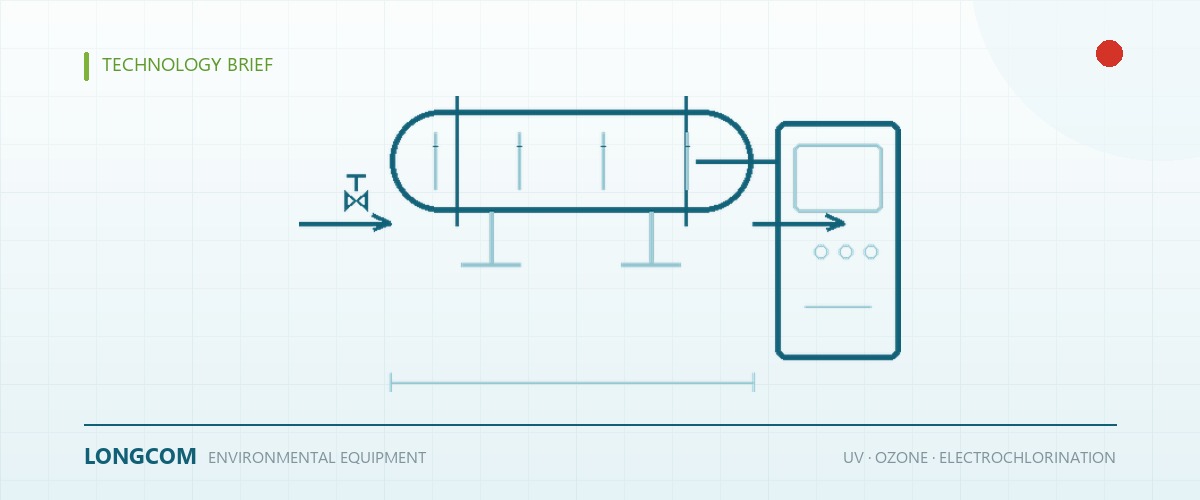
Aquaculture UV sterilizers use internationally advanced UV disinfection technology: UV-C radiation at 253.7 nm briefly irradiates the air or water and penetrates the nuclei and cell membranes of bacteria and viruses, breaking the molecular bonds of their nucleic acids so the organisms die or lose the ability to replicate. This rapidly kills all bacteria and viruses in the water. The strong UV radiation also destroys the cell tissue of algae, preventing cloudy landscape water and fish disease outbreaks. UV additionally decomposes ozone, making it an indispensable device in aquaculture and landscape water treatment. Longkang supplies medium-pressure UV sterilizers, aquaculture UV sterilizers, frame-type UV systems, and open-channel UV systems; this article focuses on the aquaculture UV sterilizer.
1. Why aquaculture needs UV disinfection
Industrial recirculating aquaculture systems (RAS) are now widely promoted. They offer high output, a small footprint, water savings, and easy management. Because a RAS reuses more than 90% of its water and takes in less than 10% makeup water each day, feed residues and fish excreta inevitably accumulate during recirculation. Without suitable treatment, this accumulation creates an unhealthy water environment, lowering feed conversion efficiency, slowing fish growth, and raising disease and mortality rates. Disinfection is an essential part of the solution. Compared with conventional disinfection, UV sterilization requires no chemical dosing, produces no toxic by-products, offers high efficiency, and is simple to operate and manage.
Longkang designs its aquaculture UV sterilizers for the actual conditions of the industry and can tailor the scheme to each customer’s situation, ensuring water quality safety in recirculating systems.
2. Functions in aquaculture
2.1 Water clarification
Circulating water through the UV sterilizer significantly reduces algae in the water and prevents green, turbid water in the farm.
2.2 Bacteria control
As water circulates through the unit, UV efficiently inactivates viruses and bacteria and kills the parasites that cause fish disease, promoting healthy fish growth. Water in fish tanks is full of bacteria and viruses; without proper treatment the water turns dirty and turbid and directly harms the fish.
2.3 Algae and disease control
Under sunlight or artificial light, algae such as blue-green algae multiply rapidly, consuming oxygen and nutrients and hindering normal growth. Passing the culture water repeatedly through a closed sterilizer with a UV lamp destroys the algae under strong UV-C radiation; they recombine into large molecular chains that can be removed by the filter system. Flow rate and lamp power selection matter: in summer, when algae multiply quickly, the flow should not be too fast and lamp power somewhat higher; in winter the reverse applies.
Fish disease is the other constant challenge. UV is highly effective against the bacteria that cause fish disease — for example, white spot pathogens are killed within 3 seconds of irradiation. When new fish are introduced, they may bring new pathogens, and fresh makeup water may also carry pathogens; in both cases the UV system provides the required disinfection. More than 99% of bacteria and viruses are killed, fish rarely fall ill, output rises, and ornamental fish show brighter colors in clean, sterile water.
3. Lamp types
- Quartz germicidal lamps: made of quartz glass, effectively kill viruses, harmless to humans; used for air, water, and aquarium disinfection.
- Ozone-free germicidal lamps: made of special glass; disinfect effectively without producing ozone.
- Ozone-producing germicidal lamps: made of high-borosilicate glass; produce ozone, which is harmful to humans but kills bacteria in places the UV cannot reach.
- Submersible germicidal lamps: used in aquaculture to kill bacteria, fungi, and filterable viruses in the water; they alter single-celled microorganisms and destroy DNA, eliminating fine suspended organisms and suppressing algae in the tank.
4. Features
- Fully closed flow path with sight glass for inspection
- Photolysis effectively degrades chlorides in the water
- Standard enclosure sizes, with custom dimensions available on request
- Enclosure in high-quality stainless steel (316L/304) or premium PVC, corrosion-resistant and durable
- Original imported UV-C lamps with high-purity quartz sleeves for long-lasting disinfection
- Simple operation and easy maintenance; small footprint with large treatment capacity
- Unique audible and visual alarms; safe, reliable operation with low maintenance cost
- No chemical reactions and no secondary pollution
- Special inner-wall treatment based on optical principles maximizes UV utilization in the chamber, multiplying the disinfection effect
- Inlet and outlet pipe diameters can be adapted to customer needs
- Rapid, effective inactivation of bacteria, viruses, and other microorganisms
5. Optional equipment
Fully automatic timer, UV intensity monitor, elapsed-hour counter, manual wiper system, automatic wiper system.
6. Applications
Disinfection of seawater hatchery raw water, freshwater aquaculture raw water, freshwater hatchery raw water, industrial-scale aquaculture raw water, industrial recirculating aquaculture water, and marine farming raw water.
Contact Longkang for sizing support and quotations.