

Open-Channel vs. In-Line UV Sterilizers
At a recent international conference on wastewater treatment technology, participants discussed why more and more wastewater treatment plant operators are now choosing in-line UV sterilizers over open-channel UV sterilizers. This shift is due in part to the drawbacks of open-channel systems and the advantages of in-line systems.
The disadvantages of open-channel disinfection include the hazard of personnel exposure to UV light; algae growth in the open channel; and the difficulty of cleaning the lamps, which must either be cleaned manually — a laborious process — or physically lifted out and moved to an acid bath. In addition, the hydraulic movement of liquid through an open channel is not particularly turbulent, so some portions of the wastewater may not pass close enough to the UV lamps to receive the required minimum UV dose.
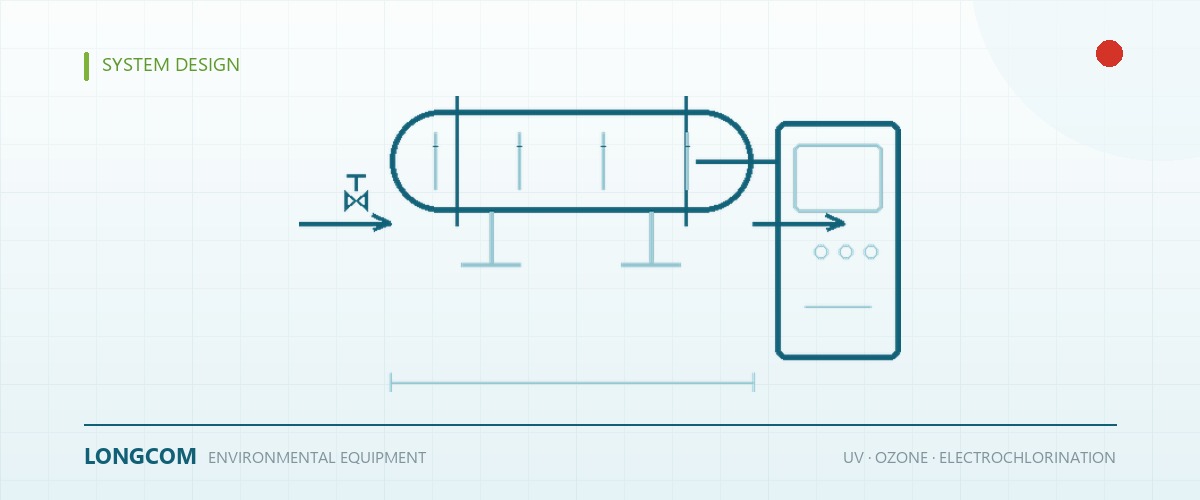
In-line UV systems, on the other hand, pose no hazard to staff because the UV lamps are enclosed in a stainless steel chamber; this also eliminates the problem of algae growth. Each lamp is fitted with a mechanical wiper on its protective quartz sleeve to keep it clean. If needed, periodic chemical cleaning is simple and can be performed “in-line” without removing the lamps. Lamp replacement is also easy and can be completed in minutes. The hydraulic design of in-line systems also means flow through the treatment chamber is more turbulent than in an open channel, ensuring that all wastewater passes close enough to the lamps to receive the required minimum UV dose.
1. Lamp technology
In addition to in-line UV systems, many engineers also choose medium-pressure “polychromatic” UV lamps. These produce UV over a broad wavelength range and have been shown in independent trials to cause permanent inactivation of pathogenic and non-pathogenic microorganisms such as E. coli and Cryptosporidium parvum (1, 2, 3). Low-pressure “monochromatic” lamps, on the other hand, produce a single peak of UV output. Many microorganisms have been shown to be able to repair themselves after exposure to UV from these low-pressure lamps, especially when subsequently exposed to sunlight, which frequently happens at wastewater treatment facilities. In addition, only a few medium-pressure lamps do the same work as many low-pressure lamps — making medium-pressure systems easier to operate, monitor and maintain. For these reasons, low-pressure UV lamp technology should be avoided in wastewater treatment.
2. Quartz sleeve cleaning
A major consideration for UV wastewater treatment plants is fouling of the protective quartz sleeves surrounding the UV lamps. Suspended solids and minerals in the wastewater adhere to the sleeves and must be removed regularly to ensure maximum UV output. This occurs with both low-pressure and medium-pressure UV lamps, and in both open-channel and in-line systems.
There are two main methods of controlling fouling: mechanical cleaning of the sleeves (with O-rings or brushes) and chemical cleaning with acid. Even with mechanical cleaning, the sleeves still need chemical cleaning from time to time. As noted above, in open-channel UV systems the lamps must be physically lifted from the channel and transferred to an external chemical bath.
For in-line UV systems, the cleaning agent simply needs to be added to the UV chamber, and the cleaning is carried out internally.
To assist this process, an integrated mechanical and chemical cleaning system has been developed. When the UV system is switched on, an automatic wiper moves up and down the quartz sleeves to remove deposits, while a small amount of low-concentration acid is applied directly to the sleeves. This “direct dosing” means far less chemical is needed to keep the sleeves clean than with conventional dosing. The chemicals used pose no hazard to the environment or to the plant’s piping infrastructure.
3. Conclusion
In-line UV wastewater treatment systems are becoming increasingly popular with wastewater treatment plant operators. These systems are now replacing older open-channel systems for a number of reasons. In-line systems are safer. Cleaning the protective quartz sleeves of the UV lamps is straightforward — whether mechanically or chemically — without removing the lamps. Third, the hydraulic design of in-line systems ensures that most wastewater receives the minimum required UV dose. An in-line system combined with medium-pressure UV lamps ensures permanent inactivation of microorganisms so that they cannot repair themselves.
Contact Longkang for selection support and quotations.