

Why a UV Sterilizer Goes After the Pump
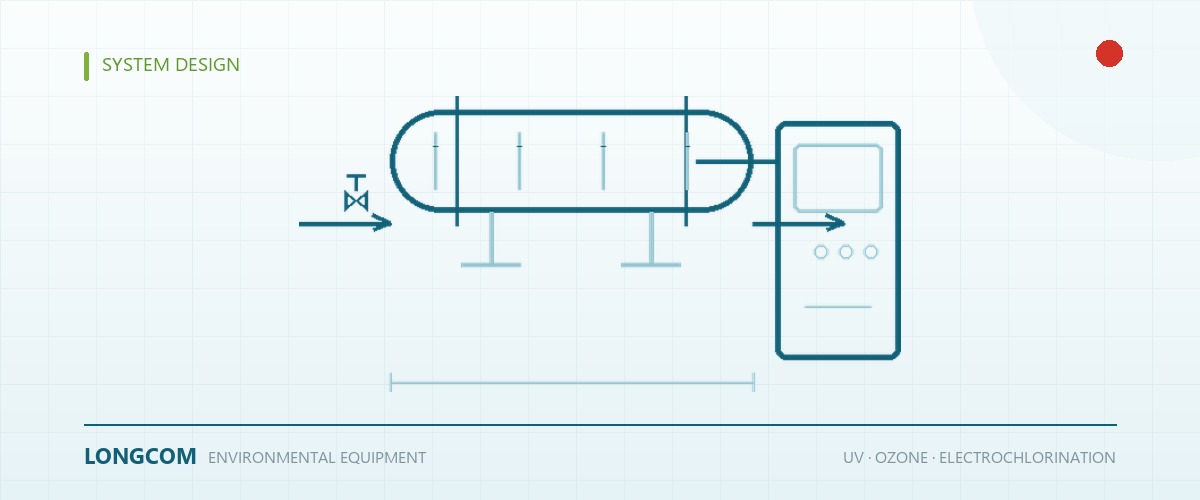
The position of an inline UV sterilizer in a secondary water supply system is a strict requirement. For multi-story buildings the placement matters less, but for high-rise buildings the rules are much stricter.
1. Construction of an inline UV sterilizer
The sealed reaction chamber of a UV sterilizer is machined from 304 stainless steel, with the UV lamp and quartz sleeve passing through from both ends. Because the lamp must be kept away from moisture and immersion, the lamp is isolated from the water by the quartz sleeve plus sealing assemblies. Under uniform pressure a quartz sleeve withstands very high pressure, but quartz is fragile and breaks easily under uneven pressure.
2. Water hammer and why the unit goes after the pump
Water hammer is a severe pressure surge produced when a water pump starts and stops and the flowing water impacts the pipework. The instantaneous pressure of water hammer can reach tens or even hundreds of times the normal working pressure in the pipe. Such large pressure fluctuations can cause violent vibration and noise in the pipe system and can destroy valves and joints — very destructive to the system.
So when a pump loses power suddenly, water hammer can shatter the quartz sleeve and the UV lamp. Install the unit exactly as required: a UV sterilizer is normally installed between the water tank outlet and the variable-frequency pump, never at the pump outlet. Mounted on the pump suction side, the water hammer passes through the pipes, valves, and pump impeller, which buffer the surge and greatly reduce its destructive force, so high pressure in the network does less damage to the UV sterilizer. This is why the unit is installed at the pump inlet side.
3. Installation requirements
To ease later maintenance, leave a space at either end of the sterilizer (either end) at least equal to the lamp length, for lamp replacement and quartz sleeve cleaning. Install the UV sterilizer last, after all other equipment has been commissioned, because other equipment may leak or spurt during commissioning and the sterilizer must not take in water and short-circuit.
Points summarized from years of installation experience:
- A UV sterilizer is normally the terminal disinfection step. If it is placed too far upstream, secondary contamination in the network will re-contaminate the disinfected water.
- Never install the unit directly on the pump discharge pipe, to prevent water hammer at pump stop from breaking the quartz sleeve and lamp.
- The installation should allow easy removal for inspection and maintenance; no materials that affect water hygiene may be used at pipe connections.
- Provide a foundation above the floor: typically 30–50 cm above ground for large units; small units without a foundation should be fitted with support brackets.
- Install according to the inlet and outlet orientations.
- The sterilizer, connecting pipes, and valves must be firmly supported; the UV sterilizer must not carry the weight of pipework and fittings.
- Leave a clearance of at least 1 meter on either side of the unit.
- For long idle periods, store the equipment in a dry, rain-protected place (recommendation: start and run the equipment periodically to prevent part and lamp life degradation).
4. Use and maintenance
- Never look directly at a UV lamp while the unit operates.
- Repeated switching while on severely shortens lamp life.
- If vertical installation is necessary, use low-inlet, high-outlet configuration to slow the flow and increase UV exposure.
- When the water pressure exceeds 3 kg/cm², install a check valve at the outlet to protect the quartz sleeve.
- If the flow is too fast, add flow and pressure limiting devices.
- When used with a normally closed solenoid valve, install the valve at the inlet.
- Every two to three months, remove the quartz sleeve and check for scaling, to determine the next cleaning interval.
- If raw water turbidity exceeds 5 NTU, install a pre-filter to guarantee the UV sterilization effect.
Contact Longkang for sizing support and quotations.