

Water Tank Self-Cleaning Disinfection Devices
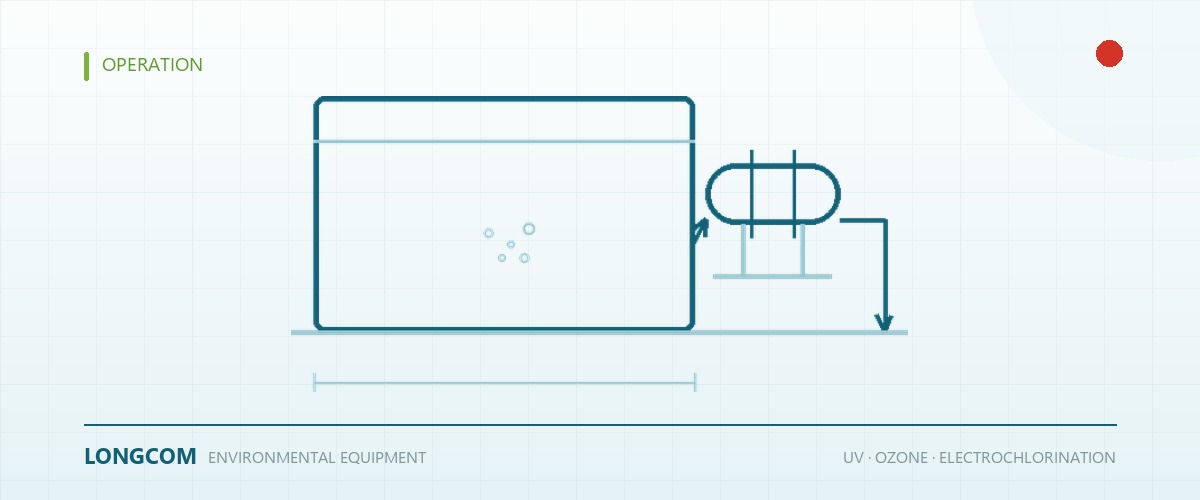
Water tank self-cleaning disinfection devices solve secondary water pollution by circulating tank water and adding an appropriate strong oxidant. The Longkang WTS-2A water tank disinfector introduces ozone at a timed, metered rate to circulate and treat water throughout the tank, disinfecting and purifying both the tank and its contents economically and conveniently.
1. Overview of the water tank disinfector
The Longkang WTS-2A water tank disinfector treats water in every part of a tank or reservoir by feeding ozone at set intervals and in set amounts, so that the tank and the water within it are effectively disinfected and purified. It provides a convenient and economical solution to water quality pollution in secondary water supply.
2. Principle and construction
The WTS-2A consists of a main controller and a disinfection circulator. The main controller uses advanced circuitry to generate ozone and microcontroller technology to control ozone output and output periods, ensuring a reasonable ozone concentration in the water and an appropriate disinfection time. The disinfection circulator drives tank water through a circulation pump; ozone-disinfected water is diffused and circulated to disinfect the water and to clean the tank itself.
Based on the pattern of the user’s water consumption periods, microcontroller technology determines the timing and amount of ozone output, or stops ozone output during selected periods. Operating status can be set according to the specific situation of the user.
- Bactericidal principle: ozone acts on the bacterial cell membrane and damages it, disrupting metabolism and inhibiting growth until the bacteria die.
- Virus inactivation principle: ozone destroys viral ribonucleic acid or deoxyribonucleic acid, causing death.
- Pesticide degradation principle: ozone breaks the chemical bonds of pesticides, removing their toxicity and achieving detoxification.
3. Functions and treatment performance
Within the rated water volume, treatment results are as follows:
- Bactericidal rate: 99 percent.
- Algae removal rate: 99 percent.
- Degrades pesticides, removes residual chlorine and eliminates odour.
After treatment by the WTS-2A, the total bacterial count, total coliforms and free residual chlorine of the treated water meet Standards for Drinking Water Quality, GB 5749-2022, and the tank or reservoir meets the Hygienic Standard for Secondary Water Supply Facilities, GB 17051-1997.
4. Construction and installation key points
- External type: install the electric control cabinet in a dry, well-ventilated place with waterproof and rainproof measures.
- Internal type: place the disinfector at the bottom of the tank or reservoir, one unit at the centre for a single installation, or evenly distributed for multiple units. Install the controller in a dry, ventilated place with waterproof and rainproof protection. Water level must cover the internal clean-water device, and the 220 V main power supply is switched on at the set time to start operation.
- Refer to the product manual for the specific installation requirements of each model.
5. Applicable standards
Product standards: the water tank self-cleaning disinfector has passed appraisal organised by the national health authorities and is produced to enterprise standards.
- Hygienic Standard for Secondary Water Supply Facilities, GB 17051-1997
- Safety Requirements for Electrical Equipment for Measurement, Control and Laboratory Use — Part 1: General Requirements, GB 4793.1-2007
Engineering standards:
- Code for Design of Building Water Supply and Drainage, GB 50015-2003
- Code for Acceptance of Construction Quality of Building Water Supply, Drainage and Heating Engineering, GB 50242-2002
Relevant standard drawing: 02SS104, Selection and Installation of Secondary Water Supply Disinfection Equipment.
6. Why self-cleaning disinfection is needed
Water in tanks and reservoirs sometimes remains stationary for long periods and becomes contaminated by microorganisms and bacteria, so water quality indicators fall below hygienic standards and secondary pollution occurs. As high-rise apartments and office buildings proliferate, the volume of water drawn directly from tanks keeps growing; serious secondary pollution threatens people’s daily lives. Stagnant water does not circulate, and algae can proliferate under favourable conditions. Eliminating secondary pollution requires proper disinfection and regular cleaning, yet conventional measures are cumbersome, costly and sometimes require water supply interruptions that inconvenience users. A self-cleaning disinfector achieves disinfection through water self-circulation together with the addition of a suitable strong oxidant.
7. Working principle
The circulation cylinder of the disinfector is placed in the middle-to-lower part of the tank to ensure even water circulation. When the water level reaches the high level set by the level gauge, the electric control cabinet starts the high-voltage power supply and the submersible pump. The strong oxidant gas generated passes through piping to the aeration section and disinfects the water by aeration; at the same time the submersible pump returns disinfected water to the tank, so stagnant water circulates and the whole body of water is thoroughly disinfected. The timer is preset before the product leaves the factory and needs no adjustment by the user.
8. Application scope
- Elevated tanks, storage reservoirs and domestic water tanks
- Clear-water tanks and fire water tanks at wastewater treatment plants
- Fountains and ornamental water storage ponds
- Aquaculture, fish farming and marine parks
- Storage tanks in the food industry
- Swimming pools and other water recreation facilities
9. Classification of the WTS-2A
By disinfection method: ozone type and micro-electrolysis type. Ozone equipment is a nationally recognised disinfection and sterilisation product: high-frequency, high-voltage discharge ionises oxygen and three oxygen atoms combine to form ozone. The ozone-type WTS-2A uses this principle and delivers ozone directly into the tank through piping. Micro-electrolysis uses an electrochemical reaction to produce strong oxidants from dissolved chloride ions and water molecules: hypochlorous acid (HClO), chlorine dioxide (ClO2), ozone (O3), active oxygen (O) and molecular chlorine (Cl2). Groundwater, which contains no chloride ions, can generate only ozone and active oxygen. For a groundwater tank, the ozone type must be used because little disinfectant is produced by electrolysis. For secondary supply tanks, either type is suitable. The ozone type is broad-spectrum, while the micro-electrolysis type has certain limitations.
By installation method: internal type and external type. The internal WTS-2A is usually of the ozone type and consists of a main unit (ozone generator) and an auxiliary unit (high-efficiency ozone-water mixing device). The main unit is normally fixed beside the tank and the auxiliary unit inside it, with the two connected by cable and gas pipe. The external type is installed outside the tank, with two to three ports — inlet, outlet and drain, commonly 20, 25, 32, 40 or 50 mm — and is available as ozone or micro-electrolysis models. Water is disinfected as it enters through the inlet and returns to the tank through the return pipe.
10. Advantages of the Longkang WTS-2A
The Longkang WTS-2A is a high-technology product developed to address long-term stagnation of water in tanks and reservoirs and the resulting contamination by pathogens and microorganisms. It is one of the more effective products for sterilising and disinfecting water in tanks and reservoirs, offering automatic control, marked results, economy and durability.
11. Installation method for the internal type
The internal water tank self-cleaning disinfector consists of a main unit (control cabinet) and an auxiliary unit (mixing device). The main unit is installed outside the tank, hung on a wall or placed on the ground; the auxiliary unit is placed inside the tank and, because of its own weight, needs no fixing. The procedure is as follows:
- Place the auxiliary unit (mixing device) inside the tank, as close to the centre as possible.
- Hang the main unit (control cabinet) on a wall or place it on the floor, keeping it dry, ventilated and protected against water and rain.
- Connect the auxiliary and main units with a soft pipe (10 mm internal diameter), preferably enclosed in a sleeve for a neat installation.
- Connect the 220 V, 50 Hz power supply, then start, test and run the unit.
- If the tank needs cleaning, always cut off the power first.
- The power cable is supplied with 1.5 m from the factory; the soft pipe length must be purchased to suit site conditions.
The device is available in external and internal versions. The internal model is installed inside the tank, while the external model is installed outside, with water entering through 25, 32, 40 or 50 mm pipes and returning to the tank after disinfection. With diverse installation options and product configurations, Longkang can help you choose ideal equipment. Contact Longkang for selection support.