

Open-Channel UV Wastewater Disinfection System
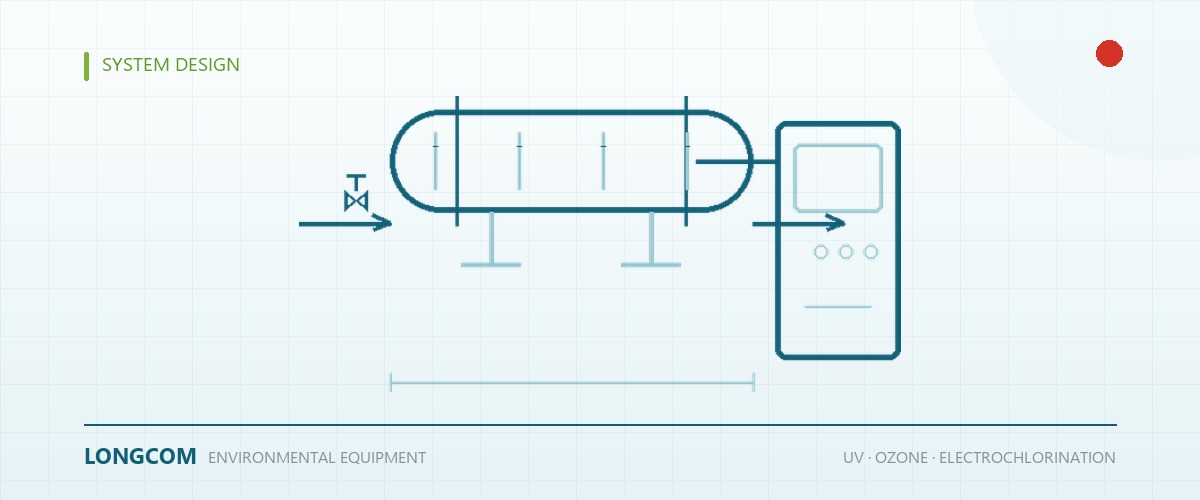
Open-channel UV wastewater disinfection systems are used mainly in municipal wastewater treatment plants, community wastewater treatment, reclaimed water reuse and industrial wastewater disinfection. Longkang describes the system layout, the UV module design and the environmental factors that determine disinfection performance.
1. System overview
Depending on the application and structural characteristics, open-channel systems are divided into parallel-flow channel and vertical-channel types. Water level control is provided in three ways: overflow weir discharge, passive flap-gate water level control and motorised weir gate control.
A complete UV disinfection system consists of UV disinfection modules, an automatic control centre, a power distribution centre, an automatic cleaning system, a water level control system and auxiliary equipment.
2. UV disinfection module
The low-flow-resistance UV disinfection module has been carefully engineered and is protected by proprietary intellectual property, giving lower hydraulic resistance and higher reliability. Each standard module comprises a stainless steel lamp rack, UV lamps, quartz sleeves, a cleaning mechanism, a power distribution system and a data acquisition system. A complete UV disinfection system is built from several modules, making installation, operation and maintenance straightforward.
3. Types of UV disinfectors and influencing factors
As water pollution increases and environmental awareness grows, water quality requirements continue to rise. In the water treatment industry, UV disinfectors have moved closer to everyday use and become a widely accepted disinfection method.
UV disinfectors fall into several categories: pipeline-type domestic drinking water UV disinfectors for tap water and secondary supply, wastewater UV disinfectors for sewage and reclaimed water, pool-water UV disinfectors for swimming pool circulation, and air UV disinfectors for air treatment. Although there are many types, the factors affecting their disinfection performance are broadly similar. The following sections describe the main factors that influence the results.
4. Key influencing factors
4.1 Ambient temperature
Ambient temperature affects the radiant output of a UV lamp. The germicidal UV output is strongest at an ambient temperature of 40 °C; in general, bactericidal action is strong at room temperatures of 20–35 °C. Output decreases as the temperature falls, and at excessively high temperatures output also falls because of increased absorption. However, most microorganisms are more sensitive to UV at low temperatures, while low temperature reduces lamp output: some lamps produce only 20–30% as much intensity at 4 °C as at 27 °C. Lower temperatures also increase bacterial resistance and weaken germicidal action; below 0 °C the bactericidal effect is lost. Temperatures that are too high or too low therefore both impair disinfection.
4.2 Exposure time
The 2002 Disinfection Technical Specification issued by the Ministry of Health sets the exposure time for UV air disinfection at 30–60 minutes. Its precautions require the lamp surface to be clean and free of oil and dust, the room to be kept clean and dry with reduced dust and water mist, and a voltage of 220 V, an ambient temperature of 20–40 °C and a relative humidity below 60%.
4.3 Ambient humidity
Water molecules absorb UV light, so high air humidity reduces penetration and weakens disinfection. At an air temperature of 24 °C, an air velocity of 0.472 m/s and a relative humidity of 35–85%, lamp radiant intensity is inversely proportional to the moisture content of the air. At relative humidities of 70%, 80% and 90%, radiant intensity must be increased by 50%, 80% and 90% respectively to achieve the same effect. Studies show that indoor humidity below 55% has no significant effect on the performance of a recirculating-air UV disinfector. Research by Zhang Yanqiu found that UV air disinfection works better in low-temperature than in high-temperature conditions and better in dry than in humid climates; when relative humidity rose from 33% to 56%, bactericidal efficiency fell to one third of its original level. Exposure time should therefore be increased when humidity is high.
In summary, only by fully understanding the factors that affect UV disinfection performance can operators make proper use of UV disinfectors, exploit their advantages fully, ensure the disinfection result and achieve the desired level of performance.
Contact Longkang for selection support in designing an open-channel UV disinfection system for your wastewater application.