

GB/T 19837 Technical Requirements for UV Sterilizers
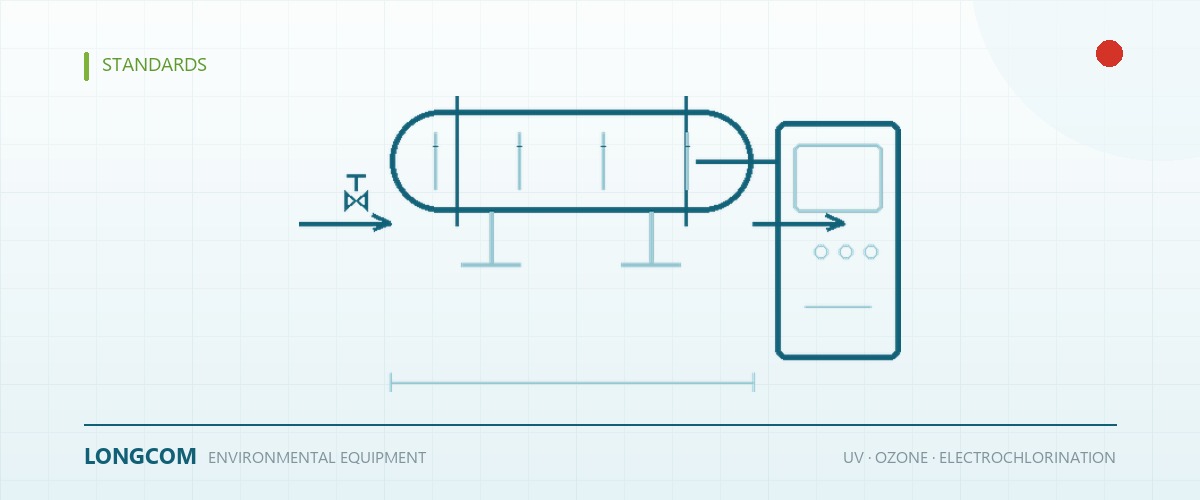
GB/T 19837-2005, UV Disinfection Equipment for Urban Water Supply and Drainage, is the national standard for UV sterilizers. It sets out the technical requirements, test methods and inspection rules for the equipment. Longkang UV sterilizers are manufactured in strict accordance with this standard. This article explains the main technical requirements of GB/T 19837.
1. Standard overview
GB/T 19837-2005, UV Disinfection Equipment for Urban Water Supply and Drainage, was issued by the Ministry of Construction and came into effect in 2006. It applies to the design, manufacture and inspection of UV disinfection equipment for urban drinking water, reclaimed water and wastewater treatment.
The standard covers the following content:
- Terms and definitions
- Classification and model designation
- Technical requirements
- Test methods
- Inspection rules
- Marking, packaging, transport and storage
2. Equipment classification
2.1 By application
- UV disinfection equipment for drinking water
- UV disinfection equipment for wastewater
- UV disinfection equipment for reclaimed water
2.2 By lamp type
- Low-pressure UV disinfection equipment
- Medium-pressure UV disinfection equipment
- Low-pressure high-intensity (amalgam) UV disinfection equipment
2.3 By installation method
- Pipeline (closed) type
- Open-channel (open) type
- Longkang mainly produces the pipeline type
3. UV dose requirements
3.1 Drinking water
- UV dose ≥40 mJ/cm²
- Corresponding germicidal rate ≥99.99 percent
- Applies to drinking water disinfection
3.2 Wastewater
- Grade 1A standard: ≥15 mJ/cm²
- Grade 2 standard: ≥10 mJ/cm²
- Applies to disinfection of wastewater treatment plant effluent
3.3 Reclaimed water
- Urban miscellaneous water: ≥20 mJ/cm²
- Landscape and environmental water: ≥15 mJ/cm²
- Industrial reuse: ≥30 mJ/cm²
4. Technical requirements
4.1 Chamber material
- Parts in contact with water should be made of corrosion-resistant materials
- Recommended: 304 or 316L stainless steel
- Internal walls should be smooth, with no dead zones
- Welds should be even and free of cracks
4.2 Quartz sleeve
- High-purity quartz glass should be used
- UV transmittance ≥80 percent (254 nm)
- Uniform wall thickness able to withstand water pressure
- Reliable sealing with no leakage
4.3 UV lamps
- Lamps should comply with the relevant standards
- Lamp life: low-pressure ≥8,000 h, medium-pressure ≥5,000 h
- Lamp power deviation ≤±10 percent
- Stable UV output
4.4 Ballast
- An electronic or inductive ballast should be used
- Power factor ≥0.9 (electronic ballast)
- Matched to the lamp for reliable starting
- Overcurrent and overvoltage protection
4.5 Sealing performance
- Hydrostatic test: 1.5 times rated pressure, held for 10 minutes
- No leakage and no deformation
- Sealing parts should resist ageing and corrosion
4.6 Electrical safety
- Insulation resistance ≥2 MΩ
- Dielectric strength: 1,500 V for 1 minute without breakdown
- Reliable grounding
- Waterproof rating: IP65 (outdoor type)
4.7 UV intensity monitoring
- A UV intensity monitor is recommended
- Real-time monitoring of UV output
- An alarm when intensity falls to 70 percent
- The monitor should be calibrated regularly
5. Performance requirements
5.1 Germicidal performance
- At the rated flow and dose
- A kill rate of ≥99.99 percent for indicator organisms (Escherichia coli or MS2 phage)
- Verified by third-party testing
5.2 Hydraulic performance
- Head loss: ≤0.05 MPa (at rated flow)
- Even flow with no short-circuiting
- No dead zones in the chamber
5.3 Noise
- Operating noise ≤60 dB(A)
- No abnormal vibration
5.4 Ozone concentration
- Ozone-free type: ambient ozone concentration ≤0.1 mg/m³
- Ozone type: the ozone generation rate should be stated
6. Test methods
6.1 Visual inspection
- Visually check the appearance, markings and welds
- Smooth surface with no obvious defects
6.2 Dimensional measurement
- Measure the overall dimensions and connection dimensions
- Conform to the design drawings
6.3 Hydrostatic test
- Fill with water and pressurize to 1.5 times rated pressure
- Hold the pressure for 10 minutes
- Check for any leakage
6.4 Electrical tests
- Insulation resistance test
- Dielectric strength test
- Ground resistance test
6.5 UV dose test
- Biological dosimetry: measure the kill rate with indicator organisms
- Or the mathematical model method: calculate the dose distribution
- Third-party testing
6.6 Lamp life test
- Run continuously to the end of life
- Record the decay of UV output
- Verify the lamp life specification
7. Inspection rules
7.1 Factory inspection
- Every product is inspected before leaving the factory
- Items: appearance, dimensions, hydrostatic, electrical and operation
- A certificate of conformity is issued after passing
7.2 Type inspection
- At least once a year
- Or when a new product is launched or materials and processes change
- Items: all technical requirements
- Carried out by a third-party testing body
7.3 Sampling
- Factory inspection: full inspection
- Type inspection: 1 to 2 units sampled
8. Marking, packaging, transport and storage
8.1 Marking
- Nameplate: model, flow, power, voltage, pressure, production date and manufacturer
- Warning labels: UV hazard and electrical hazard
- Inlet and outlet labels: direction of water flow
8.2 Packaging
- Wooden case or carton
- Shockproof and moisture-proof
- Enclosed documents: certificate, manual, warranty card and spare parts
8.3 Transport
- Handle with care and avoid impact
- Protect from rain and moisture
- Lamps packed separately
8.4 Storage
- Dry, ventilated and free of corrosive gases
- Temperature 5 to 40 °C
- Avoid direct sunlight
- Storage period not longer than 2 years
9. Longkang compliance
Longkang UV sterilizers are manufactured in strict accordance with GB/T 19837:
- 304 stainless steel chamber with a polished internal surface
- High-purity quartz sleeve with transmittance ≥90 percent
- Quality lamps with a life of ≥8,000 h
- Electronic ballast with a power factor ≥0.95
- Hydrostatic test on every unit (1.5 times rated pressure)
- Electrical safety testing
- Third-party germicidal test report
- Certificate of conformity and installation manual
Longkang’s technical team is familiar with GB/T 19837 and related standards, and can provide compliant products and technical support to help projects pass acceptance.
For selection support and compliance advice on UV disinfection equipment, contact Longkang.