

UV Sterilizer Terminology and Definitions
This article introduces the professional terms used for UV sterilizers and UV disinfection equipment, with their English names and definitions.
1. Ultraviolet (UV, 254 nm)
The wavelength best suited to disinfection is 254 nm. Among electromagnetic waves with wavelengths of 100–380 nm, the UV band with disinfecting capability is 200–280 nm, and within this band 254 nm is the wavelength most suitable for germicidal use.
2. Ultraviolet disinfection
Pathogenic microorganisms absorb UV energy in the 200–280 nm band, causing mutation of their genetic material (nucleic acid) so that the cells can no longer divide and reproduce. This achieves disinfection and sterilisation and is known as ultraviolet disinfection.
3. UV intensity
The UV energy received per unit area perpendicular to the direction of UV propagation per unit time. In this standard, UV intensity is used to describe the UV energy of UV disinfection equipment and is commonly expressed in mW/cm².
4. UV transmittance (UVT)
The ratio of UV that is not absorbed to the total output UV when ultraviolet light at 253.7 nm passes through a 1 cm cuvette containing a water sample.
5. Reactor effective dose (ED)
The UV dose for microorganism inactivation that UV disinfection equipment can achieve, also referred to as the bioassay dose of the equipment. Both terms are collectively called the reactor effective UV dose.
6. Low pressure high output lamp
A mercury vapour lamp operating at an internal pressure of 0.13 Pa to 1.33 Pa, with an electrical input of about 1.5 W per centimetre of arc length and a germicidal UV output of about 0.6 W per centimetre of arc length. Germicidal UV is emitted as a single spectrum at 253.7 nm.
7. Medium pressure lamp
A mercury vapour lamp operating at an internal pressure of 0.013 MPa to 1.330 MPa, with an electrical input of about 50 W to 150 W per centimetre of arc length and a germicidal UV output of about 7.5 W to 23 W per centimetre of arc length. Germicidal UV is emitted across the 200–280 nm band as multiple spectra.
8. Lamp aging factor (CLH)
The ratio of the UV output power of a lamp at the end of its operating life to the UV output power of a new lamp.
9. Lamp fouling factor (CJG)
The ratio of the UV transmittance of a lamp sleeve in service to the UV transmittance of a clean lamp sleeve.
10. Operation life of UV lamp
The continuous or cumulative operating time over which a UV lamp maintains effective UV output.
11. UV disinfector
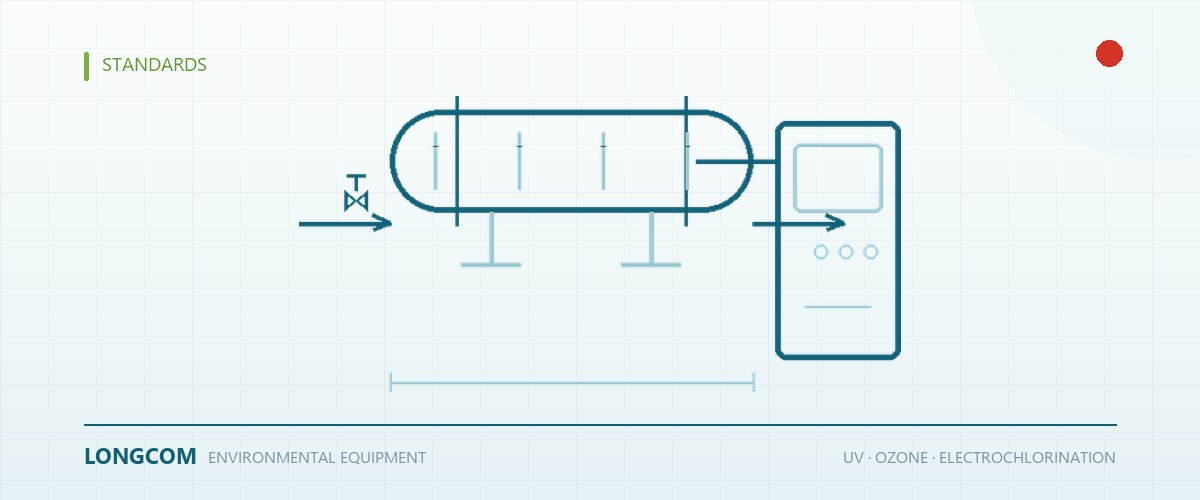
A chamber or vessel in which UV irradiation can be carried out. A UV disinfector consists of UV lamps, quartz sleeves, ballasts, UV intensity sensors, a cleaning system and other components enclosed within the vessel.
12. UV disinfection equipment validation
The actual disinfection performance of UV disinfection equipment should be verified by tests relating to the effective UV dose, the lamp aging factor and the lamp fouling factor.
13. Irradiation chamber (UV reaction chamber)
A reaction chamber made of 304, 316 or 316L stainless steel, selected according to requirements, containing UV germicidal lamps (UV lamps), quartz sleeves, UV sensors, automatic cleaning devices and other components.
14. Longkang terminology support
Longkang uses these terms in the specification and selection of UV disinfection equipment. Contact Longkang for selection support and clarification of UV dose, UVT and lamp life requirements for your application.